Professional solutions on concrete addtives, Concrete Foaming Agent, Superplasticizer, CLC Blocks Additives, and foaming machine

The Ultimate Guide to Selecting the Best Concrete Foaming Agent for Lightweight Blocks
The Core Challenge in Lightweight Concrete
Have you ever invested in a foaming agent, only to watch your fresh foam concrete slump and collapse? Or perhaps you’ve achieved the target density, but the final blocks lack the compressive strength your specifications demand. These aren’t minor setbacks. They represent costly production failures, wasted raw materials, and delayed projects. The root cause often lies not in the cement or the equipment, but in the unsuitability of the concrete foaming agent. Selecting the best concrete foaming agent for lightweight blocks is a technical decision with profound implications for structural integrity, thermal performance, and profitability. This guide, rooted in decades of field experience and industry data, will provide the objective analysis needed to make that choice with confidence.
Defining the Role: What a Foaming Agent Actually Does
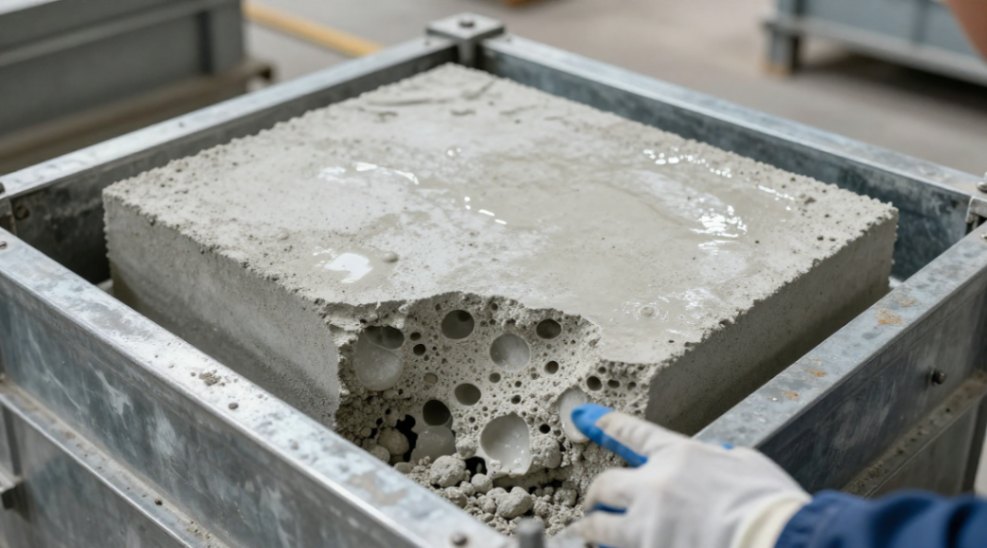
A concrete foaming agent is a specialized surfactant. Its purpose is to create a stable, microscopic air-void system within the cement paste. This is fundamentally different from air-entraining admixtures used in standard concrete. Foaming agents generate a pre-formed foam, which is then mechanically blended into the slurry. The result is Cellular Lightweight Concrete (CLC). This process dictates the block’s key properties: density, compressive strength, and thermal insulation. The quality of the foam directly determines the quality of the final product. Unstable foam leads to coalescing bubbles, resulting in an irregular, weak pore structure.
The Primary Decision: Synthetic vs. Protein-Based Foaming Agents
The industry divides foaming agents into two primary categories, each with distinct chemical foundations and performance profiles. The choice between them is the first and most critical step.
Performance and Application Comparison
| Parameter | Synthetic Foaming Agents | Protein-Based Foaming Agents |
|---|---|---|
| Base Material | Hydrolyzed proteins (animal/plant), saponins | Petrochemical-derived synthetic surfactants |
| Foam Stability | Excellent. Creates highly resilient, stiff foam with strong bubble walls. | Good for initial generation, but generally less stable over time. |
| Cell Structure | Closed, spherical, and uniform. Minimal interconnectivity. | More irregular, with a higher tendency for interconnected pores. |
| Impact on Strength | Superior. The closed-cell structure provides higher compressive strength at a given density. | Lower. Interconnected pores create stress concentration points. |
| Water Resistance | High. Hydrophobic protein films resist water absorption. | Moderate to Low. More hydrophilic, leading to higher absorption. |
| Cost Profile | Higher initial cost per liter. | Lower initial cost per liter. |
| Optimal Use Case | Structural-grade blocks, load-bearing panels, applications requiring low water absorption and high strength. | Non-load bearing infill blocks, insulation screeds, where ultimate strength is secondary to cost. |
As the table illustrates, the trade-off is clear. Protein-based agents offer superior performance but at a higher cost. Synthetic agents provide an economical entry point but often sacrifice long-term structural quality. Industry reports, such as those from the American Concrete Institute (ACI), consistently correlate closed-cell structures from protein foams with a 15-25% higher strength-to-density ratio compared to synthetic alternatives.
Critical Performance Criteria Beyond the Label
Choosing a category is just the start. Within each, you must evaluate agents against non-negotiable technical criteria.
- Foam Stability & Drainage Time: This is paramount. Stable foam must resist collapse and water drainage (bleeding) for at least the concrete’s initial setting period. Test this by generating foam and observing it in a measuring cylinder. High drainage within 30 minutes signals a poor agent.
- Cement Compatibility: Not all agents work optimally with all cement types, especially those with high C3A content or supplementary cementitious materials (SCMs) like fly ash. Compatibility affects foam stability and setting time.
- Dosage Consistency: The agent must produce consistent foam density (kg/m³) across multiple batches with minimal dosage variation. Inconsistent foam leads to inconsistent block weight and strength.
- Compatibility with Other Admixtures: Many mixes include superplasticizers or retarders. The foaming agent must not react adversely, causing foam collapse or excessive retardation.
The Ripple Effect: Impact on Final Block Properties
Your choice of foaming agent creates a domino effect. Consider these direct causal relationships.
Poor Stability → Irregular Pores → Lower Strength. Collapsing foam creates large, elongated voids. These act as failure initiation points under load.
Closed-Cell Structure → Low Water Absorption → High Frost Resistance. Protein-based foams create hydrophobic membranes around each bubble. This significantly improves durability in freeze-thaw cycles.
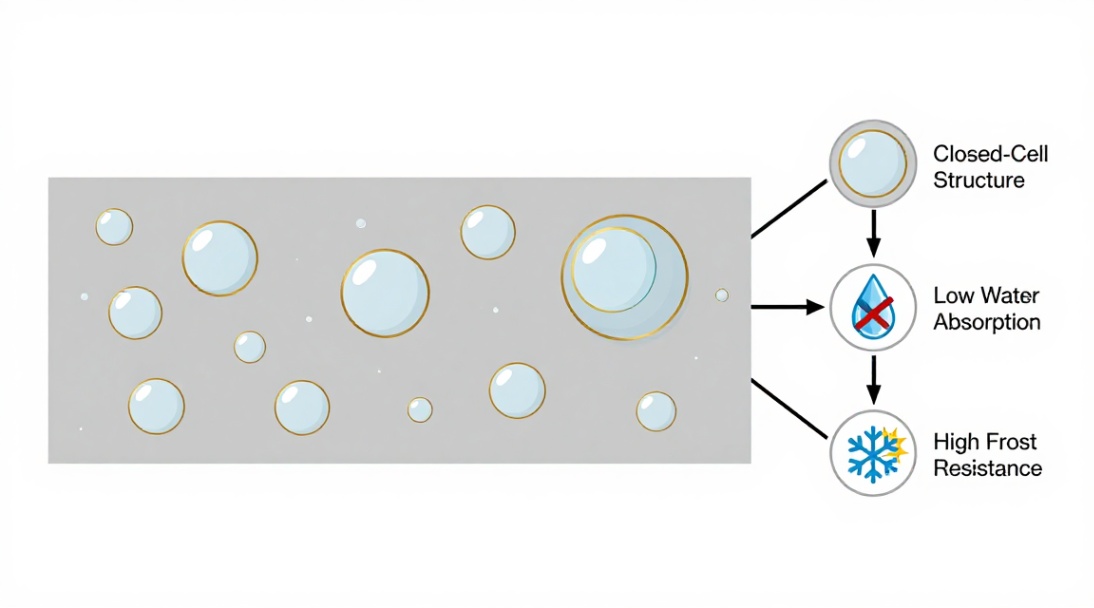
Uniform Cell Size → Predictable Density → Consistent Thermal Conductivity (k-value). A homogeneous void structure ensures even insulation properties across every block, a critical factor for energy code compliance.
Practical Application: Dosage, Mixing, and Troubleshooting
Correct application is as vital as the agent itself. Always follow the manufacturer’s prescribed dilution ratio with clean, cold water. Use a dedicated foam generator to produce dry, stiff foam. The foam should resemble shaving cream, not a bubbly liquid. Introduce the foam into the slurry mixer gradually for even distribution.
Solving Common Production Issues
- Foam Collapse During Mixing: Cheque water hardness. Excess calcium/magnesium ions can break down foam. Switch to potable water. Verify the agent is within its shelf life.
- Excessive Shrinkage or Cracking: This often indicates high water drainage from the foam, increasing the mix’s water-cement ratio. Use a more stable agent or reduce the mixing time after foam addition.
- Uneven Cell Structure: Causes include improper foam injection, over-mixing (which shears bubbles), or using a worn-out foam generator pump. Ensure mechanical processes are precise.
Data-Driven Recommendations for Specific Scenarios
Based on performance data and lifecycle cost analysis, here are objective recommendations.
- For High-Strength, Load-Bearing Blocks (Density: 1200-1600 kg/m³): Premium hydrolyzed protein-based agents are the only viable choice. Brands known for rigorous R&D, such as Laston or Kimix, consistently deliver the necessary closed-cell matrix. The higher initial cost is justified by superior mechanical properties and lower rejection rates.
- For Standard Non-Load Bearing Infill Blocks (Density: 600-1000 kg/m³): A mid-range synthetic or blended agent can be sufficient. Focus on suppliers who provide certified test data for stability and compatibility. Conduct thorough plant trials before full-scale adoption.
- For Projects Prioritizing Sustainability: Seek plant-based protein agents (e.g., derived from keratin or saponins). These combine strong performance with a reduced environmental footprint. Verify they meet the required performance standards despite their green label.
Never purchase based on price per litre alone. Calculate cost per cubic meter of finished foam concrete at your target density. A slightly more expensive agent with a lower dosage rate and higher yield often proves more economical.
The Final Analysis and Your Next Step
The search for the best concrete foaming agent for lightweight blocks ends with a technical audit, not a marketing brochure. You must prioritize foam stability and final cell structure above all. For projects where structural performance, durability, and insulation efficiency are non-negotiable, premium protein-based agents represent the definitive solution. The data is clear: they provide a return on investment through reduced waste, consistent quality, and superior block performance.
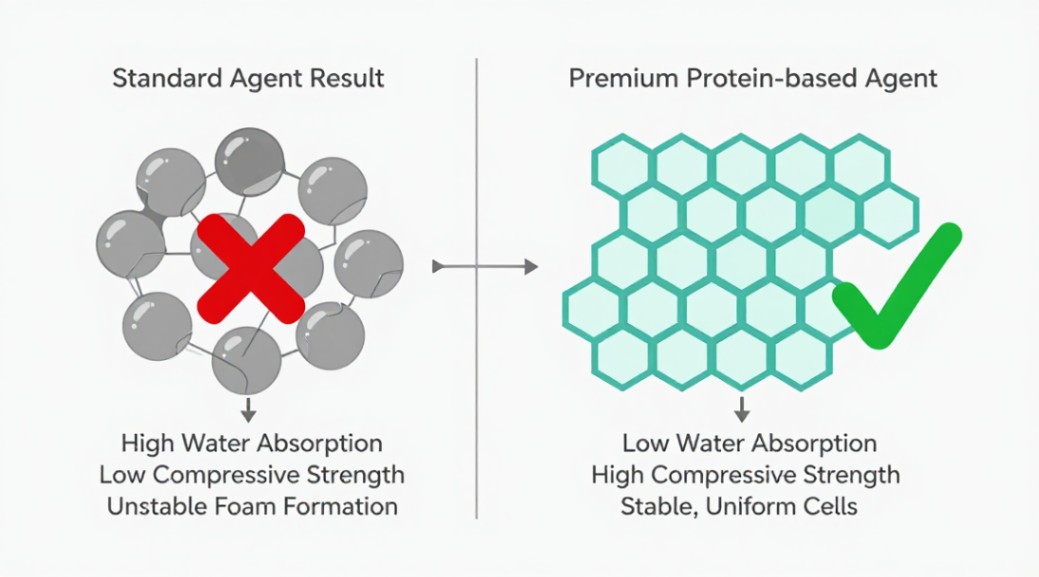
Theoretical knowledge must transition to practical validation. Your immediate action is to secure samples from the recommended protein-agent suppliers. Conduct side-by-side plant trials under your specific production conditions. Measure foam density stability, fresh concrete consistency, and, crucially, test the compressive strength and water absorption of the cured blocks. This empirical evidence will silence all doubt and optimize your production line for years to come. Contact a technical sales representative today to initiate this critical testing phase.
We are the global leader in lightweight concrete and advanced engineered foam solutions. Known globally for its commitment to research, innovation, and applied expertise, we have been providing engineered foam solutions since the early 2012’s.
We can supply high-quality concrete admixture and foam concrete related products all over the world.
The company has a professional technical department and quality supervision department, a well-equipped laboratory, and equipped with advanced testing equipment and after-sales customer service center.
If you are interested, please feel free and contact us.