Professional solutions on concrete addtives, Concrete Foaming Agent, Superplasticizer, CLC Blocks Additives, and foaming machine

Mastering the Superplasticizer Dosage for Flawless Self-Consolidating Concrete (SCC)
The Silent Struggle for Perfect Flow
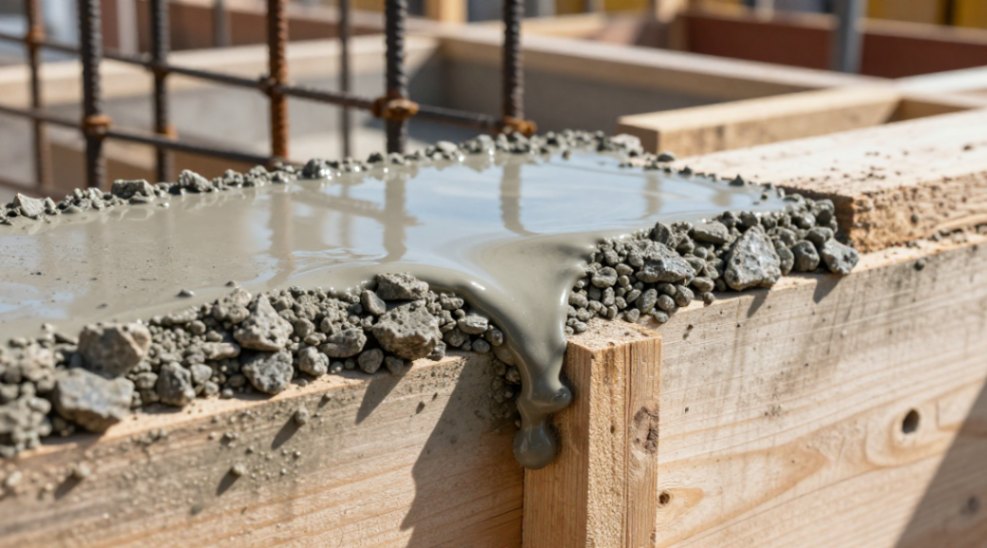
You stand at the edge of the formwork, watching as the concrete pour begins. The mix looks good in the drum, but as it flows, you see it. The first signs of segregation-a watery film at the edges, coarse aggregate beginning to settle. Or perhaps the opposite: the concrete stiffens prematurely, refusing to fill the intricate rebar cage completely, leaving you with honeycombs and surface defects. These are the moments that haunt producers and contractors of Self-Consolidating Concrete (SCC). The promise of effortless placement clashes with the reality of a delicate material balance. The root cause of both triumph and failure in SCC almost always traces back to one critical component: the superplasticizer. This is not just an admixture; it is the rheological command center of the mix. Mastering its use is not optional. It is the core competency for anyone serious about SCC.
The Molecular Command Centre: How Superplasticizers Govern SCC
Forget vague concepts of “making concrete flow.” A modern polycarboxylate ether (PCE) superplasticizer operates with precise molecular engineering. Upon mixing with water, its long polymer chains uncoil. Their backbone adsorbs onto cement particles, while the numerous side chains stretch out into the pore solution. This creates a powerful steric hindrance effect-a physical barrier that prevents cement grains from flocculating. The result is a dramatic dispersion of solids. This action liberates the water trapped within the flocculated structure, turning it into free water that lubricates the entire system. You achieve high fluidity without adding excess water, which preserves the essential paste viscosity needed to suspend aggregate and prevent segregation. The superplasticizer does not just reduce water demand; it re-engineers the internal architecture of the fresh concrete to be both fluid and cohesive.
The Practical Protocol: From Laboratory to Loader
Successful SCC production follows a disciplined sequence. Theoretical knowledge fails without strict procedural adherence.
Step 1: The Foundation – Establishing Baseline Proportions
Begin with a stable, well-graded aggregate skeleton and a cementitious materials content typically between 380 and 450 kg per cubic meter. Calculate your initial water content based on your target strength and durability requirements, but understand this is a starting point, not a final value. The superplasticizer will modify the effective water-to-cement ratio. At this stage, define your key performance indicators: target slump flow in millimeters (e.g., 650mm to 750mm), a visual stability index (VSI) of 0 or 1, and desired setting profile.
Step 2: The Critical Selection – PCE Type and Compatibility
Not all PCEs are equal. You face a choice primarily between ester-based and ether-based PCEs. Ether-based types generally offer stronger initial dispersion and higher water reduction. Ester-based types often provide better slump retention, which is crucial for long haul times or complex placements. There is no universal best. You must test for compatibility with your specific cement and supplementary materials like slag or fly ash. A simple mortar flow test can reveal severe incompatibility-signs include rapid loss of workability, excessive air entrainment, or viscous, sticky paste. This step prevents costly field failures.
Step 3: The Precision Adjustment – Dosage Determination
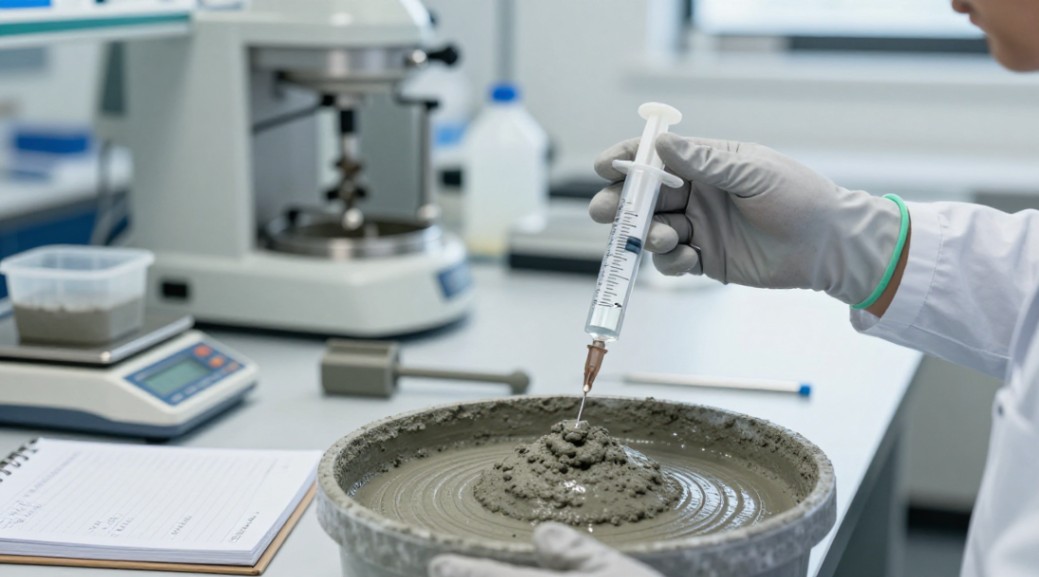
This is where art meets science. Start with a manufacturer’s recommended dosage, usually a percentage by weight of cementitious materials (e.g., 0.8% to 1.5%). Prepare trial batches of at least 50 liters. Introduce 75% of your estimated superplasticizer dose with the mixing water. Mix for the standard duration. Measure the slump flow. If the flow is insufficient, incrementally add additional superplasticizer in increments of 0.1% solids dosage. Record the exact dosage at which you achieve the target flow. This is your saturation point. Exceeding it wastes chemical and risks segregation or excessive retardation. Stop additions when the flow reaches specification or if the mix shows signs of bleeding.
| Observation | Likely Cause | Corrective Action |
|---|---|---|
| Slump flow too low, mix is stiff | Insufficient SP dosage; incompatible SP/cement; low paste volume | Increase SP dose by 0.1% increments; change SP type; increase powder content. |
| Segregation, aggregate settling | SP dosage too high; paste viscosity too low; excessive water | Reduce SP dose; increase fines content (e.g., fly ash, limestone powder); reduce water. |
| Rapid slump loss (within 15-30 mins) | High cement C3A content; hot weather; wrong SP type | Use an SP with better retention (ester-PCE); add a stabilizer; batch cooler materials. |
| Excessive air entrainment, foam | SP contains air-entraining agents; over-mixing | Switch to a low-foam SP; adjust mixing sequence and time. |
Step 4: The Controlled Introduction – Mixing Sequence
Sequence dictates performance. For central mix plants, the most reliable method is to add the majority of the superplasticizer with the initial batch water. This ensures uniform distribution from the start. For ready-mix trucks, a common practice is to hold back a portion (the “hold-back” dose) of the superplasticizer. Add this reserved portion at the site, just before placement, to restore any workability lost during transit. This practice, known as retempering, is acceptable with modern PCEs if done correctly and within limits specified by the mix designer. Never add undiluted superplasticizer directly to dry cement.
Step 5: The Final Verification – Quality Control Tests
Before release, you must verify more than just slump. The Slump Flow test measures spread diameter. The T-50 time (the time for the concrete to reach a 500mm diameter) indicates viscosity-a faster time suggests lower viscosity. The J-Ring test assesses passing ability through reinforcement. The V-Funnel test also measures viscosity. Perform these tests consistently. They are your early warning system. A change in T-50 time at a constant slump flow often signals a material change or compatibility issue before it becomes a placement crisis.
The Strategic Advantage: Beyond Placement
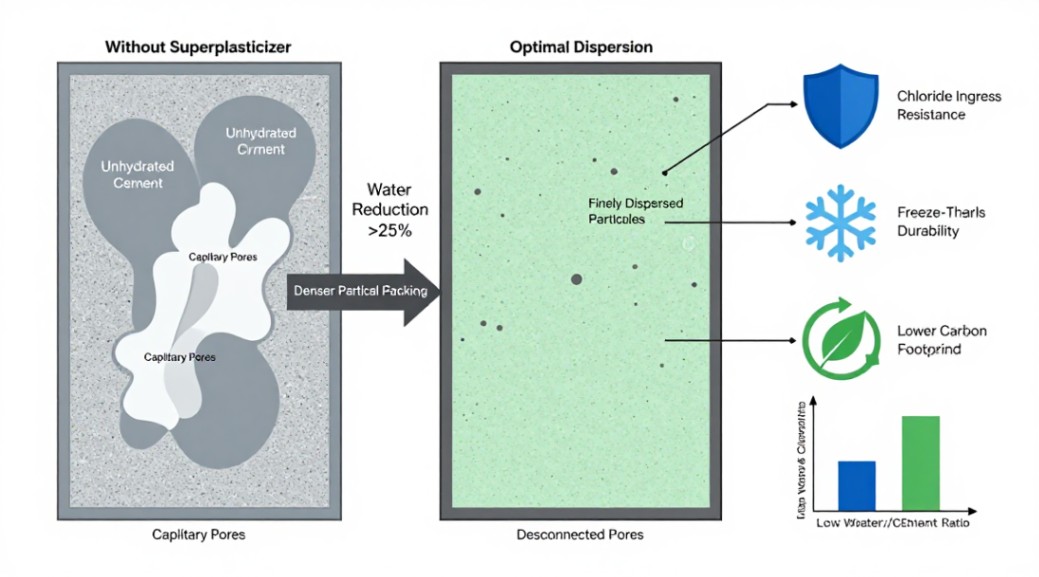
The benefits of a well-optimized superplasticizer system extend far beyond easy pouring. By enabling a reduction in water content by 25% or more, you directly increase compressive strength and durability. The dense, impermeable microstructure that results from optimal dispersion resists chloride ingress, sulfate attack, and freeze-thaw cycles. You can also incorporate higher volumes of industrial by-products like fly ash or slag, reducing the clinker factor and the carbon footprint of the concrete. This is not a trick. It is materials science applied with precision, yielding structures that last longer with less environmental impact.
The Path Forward
The journey to mastering SCC is a journey of controlled fluidity. It begins with understanding the superplasticizer as a system director, not just a flow agent. It proceeds through methodical selection, precise dosing, and rigid quality control. The next batch you produce should start with a review of your current superplasticizer dosage and compatibility data. If you lack this data, that is your first action. Run the compatibility tests. Record the saturation point dosage for your specific materials. Treat this number as a fundamental property of your mix, as critical as the cement content. This disciplined approach transforms SCC from a finicky specialty product into a reliable, high-performance standard.
We are the global leader in lightweight concrete and advanced engineered foam solutions. Known globally for its commitment to research, innovation, and applied expertise, we have been providing engineered foam solutions since the early 2012’s.
We can supply high-quality concrete admixture and foam concrete related products all over the world.
The company has a professional technical department and quality supervision department, a well-equipped laboratory, and equipped with advanced testing equipment and after-sales customer service center.
If you are interested, please feel free and contact us.