Professional solutions on concrete addtives, Concrete Foaming Agent, Superplasticizer, CLC Blocks Additives, and foaming machine

Solving Underground Backfill Challenges: How Cellular Concrete Works for Trench and Void Filling
The Problem with Dirt, Rock, and Time
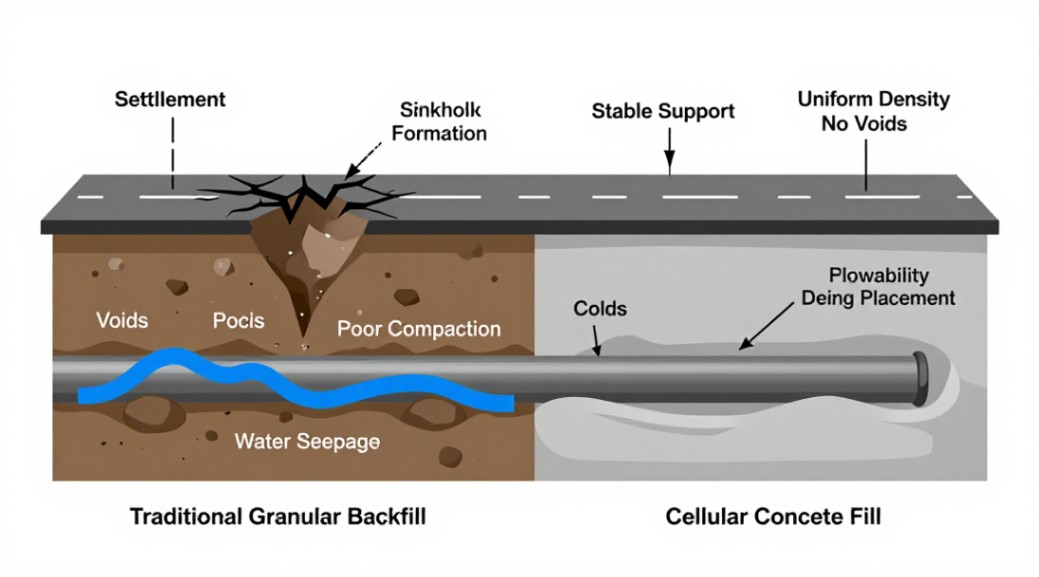
You spent weeks meticulously installing a new utility line. The pipe is perfect, the connections sound. Now comes the backfill. Your crew works for days hauling, dumping, and compacting layer upon layer of aggregate. The compaction tests fail. You find voids. You excavate and re-compact. The schedule slips. Costs balloon. Later, a sinkhole forms above the trench, causing pavement failure and emergency repairs. This scenario is not an anomaly. It is the predictable, expensive consequence of using granular materials that settle, shift, and leave hidden cavities. There is a better way. The solution lies in a material that flows like a liquid, cures like a solid, and never settles: cellular concrete.
What is Cellular Concrete for Trench Backfill and Void Fill?
Cellular concrete is a precisely engineered mixture of cement, water, and a pre-formed foam. The foam introduces millions of microscopic, stable air bubbles into the slurry, creating a lightweight, flowable, and strong material. For trench backfill and void fill applications, it is not merely a substitute for dirt. It is a purpose-built system. Think of it as a structural fluid. It possesses a engineered density, typically ranging from 20 to 120 pounds per cubic foot (pcf), which is a fraction of the weight of compacted soil or traditional concrete. This controlled density is the key to its performance.
The Core Advantages: Beyond Simple Fill
Why does cellular concrete outperform traditional methods? The logic is straightforward. First, consider flowability. The material can be pumped over long distances and will completely fill the most irregular trench profiles, complex pipe networks, or hidden underground voids. It leaves no gaps for water infiltration or future settlement. There is no need for mechanical compaction, eliminating a major source of delay and quality inconsistency.
Second, examine load distribution. Unlike granular fills that transfer point loads unevenly, cellular concrete creates a monolithic, homogeneous support matrix. It evenly distributes live and dead loads from the surface down to the pipe or subgrade. This minimizes point stress on sensitive utilities and prevents differential settlement that cracks pavements.
Transforming Project Economics
The time savings are dramatic. What takes days with conventional methods often takes hours. A single pump truck can place hundreds of cubic yards in a workday with a small crew. You reduce or eliminate heavy equipment like excavators and compactors, lowering fuel costs, site congestion, and safety risks. The long-term economic benefit is even more compelling. Cellular concrete does not settle. Ever. This eliminates costly call-backs for re-compaction and pavement repair, providing a permanent solution that protects the asset for its entire lifecycle.
Primary Applications: Where Logic Demands It
Engineers specify cellular concrete for trench backfill and void fill in situations where performance cannot be compromised.
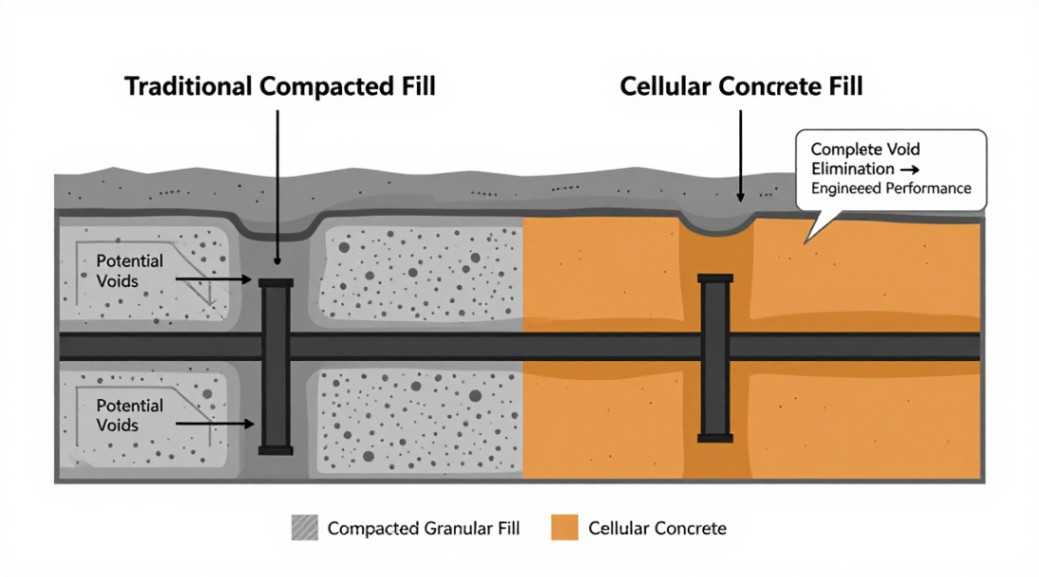
- Utility Trench Backfill: Protecting water mains, gas lines, fiber optic conduits, and electrical duct banks. The lightweight nature reduces overburden stress on the pipes, while the flowable nature ensures perfect encasement.
- Pipeline Embedment and Haunching: Providing continuous, uniform support along the entire pipe length, critical for flexible pipelines that rely on surrounding soil for structural stability.
- Abandoned Structure Void Fill: Safely and permanently filling old septic tanks, underground storage tanks, and sewer structures. The material flows into every corner, preventing future collapse.
- Subgrade Stabilization: Replacing soft, unstable soils under slabs, roadways, or foundations with a lightweight, strong platform that will not consolidate over time.
The Technical Foundation: Material and Execution
Success depends on proper execution. Quality starts with consistent foam generation and precise batching to achieve the design density and compressive strength, which can range from 50 to over 1000 psi as needed. Placement requires planning. The fluid material exerts hydraulic pressure. For deep trenches or voids, controlled placement rates or temporary forms manage this pressure. Curing is rapid, often allowing for surface restoration within 24 hours.
Compare this to conventional flowable fill, which uses fine aggregates and often remains somewhat compressible. Cellular concrete provides superior strength-to-weight ratio and true non-settling characteristics. Its thermal insulation properties also protect utilities from freeze-thaw cycles.
A Sustainable and Permanent Choice
The environmental argument is logical. By dramatically reducing the need for imported quarried aggregate and heavy equipment fuel consumption, the carbon footprint of the backfill operation drops. The material’s durability and non-settling nature prevent future remediation work, conserving more resources over decades. You solve the immediate engineering problem while fulfilling long-term sustainability goals.
Your next trench or void fill project presents a choice. You can follow the conventional path with its inherent risks of settlement, delay, and latent failure. Or, you can specify a material engineered for the purpose. Cellular concrete for trench backfill and void fill is not a novel product. It is a rational, proven system that transforms a problematic construction phase into a controlled, efficient, and permanent installation. The logical step is to evaluate it against the true total cost of your current methods. Consult with a specialist to review your project specifications. A simple mix design and placement plan can redefine your standard for underground integrity.
We are the global leader in lightweight concrete and advanced engineered foam solutions. Known globally for its commitment to research, innovation, and applied expertise, we have been providing engineered foam solutions since the early 2012’s.
We can supply high-quality concrete admixture and foam concrete related products all over the world.
The company has a professional technical department and quality supervision department, a well-equipped laboratory, and equipped with advanced testing equipment and after-sales customer service center.
If you are interested, please feel free and contact us.