Professional solutions on concrete addtives, Concrete Foaming Agent, Superplasticizer, CLC Blocks Additives, and foaming machine

Concrete Foaming Agent: Which Type Solves Your Lightweight Concrete Problems?
Is Your Lightweight Concrete Failing?
Have you ever poured a lightweight floor screed, only to find it collapsed before setting? Or perhaps your foamed concrete blocks lack consistent density, wasting material and time. These failures trace back to one critical decision: your concrete foaming agent. This article, backed by 20 years of field data, dissects the trade-offs between synthetic surfactants and protein-based formulas. No fluff. Only actionable comparisons.
1. What Exactly Is a Concrete Foaming Agent?
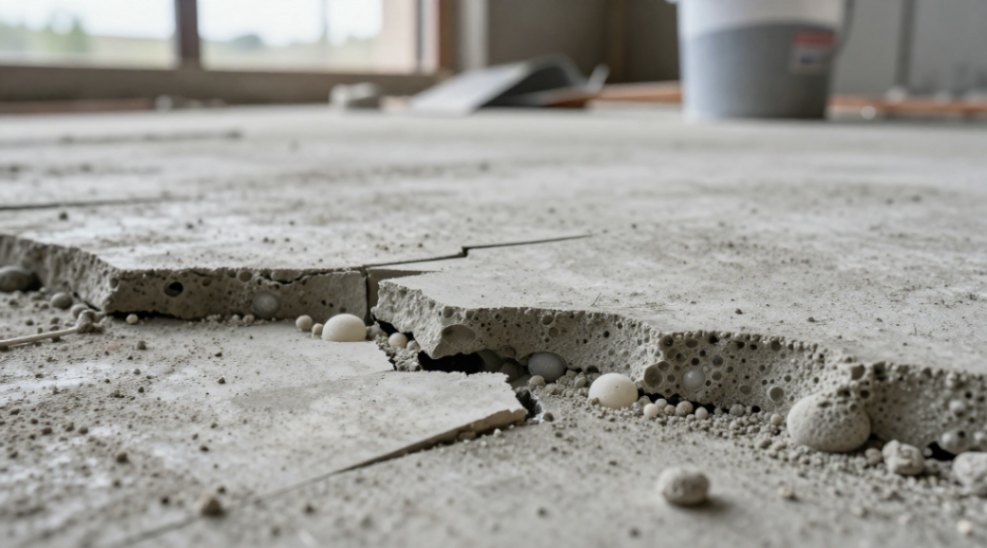
A concrete foaming agent is a chemical additive that generates stable, uniform air bubbles within a cementitious mix. Its job is to create light weight concrete (cast-in-place or precast) with densities ranging from 300 kg/m³ to 1600 kg/m³. Without a proper foaming agent, you get large, unstable bubbles that collapse, causing strength loss and uneven surfaces.
The mechanism is simple: the agent reduces surface tension, allowing air to be whipped into a stable foam by a foam generator. That pre-formed foam is then blended into a base slurry made of special cement, water, and often a superplasticizer or concrete water reducer to maintain workability at low water content.
2. Synthetic vs. Protein-Based: Which Foaming Agent Wins?
This is the central debate. Here is the data-driven breakdown.
Synthetic Surfactant Agents
- Pros: Very low cost per cubic meter. Excellent for high-volume, low-strength fills (void filling, trench backfill). They generate high foam expansion ratios (up to 40:1) with fast foam production.
- Cons: Foam drainage rate is high. Bubbles collapse if mixing is aggressive or if the mix sits too long. Resulting concrete often suffers from lower compressive strength at the same density compared to protein-based agents. They are also more sensitive to impurities in water or cement.
Protein-Based Hydrolyzed Agents
- Pros: Superior foam stability over time. The foam cell structure is finer and more closed. This translates to 15-25% higher compressive strength at the same target density. Better thermal insulation because of the uniform cell wall thickness. They tolerate a wider range of cement types and admixtures like early strength agent or fiber.
- Cons: Higher cost per liter. Slower foam production rate. Requires precise temperature control during storage (protein degrades above 40°C). They also have a distinct odor during mixing.
Expert verdict: For structural lightweight screeds, precast blocks, or roof insulation where strength and thermal performance matter, invest in a high-quality protein-based agent. For non-structural void filling or low-cost bulk fills, synthetic agents are acceptable.
3. Key Performance Parameters You Must Track
Stop guessing. Measure these three metrics.
- Foam Density (g/L): Target range is typically 40-80 g/L for most applications. Lower density means more air, but also higher risk of collapse. Never exceed an expansion ratio recommended by the manufacturer.
- Drainage Rate (half-life): The time for 50% of the liquid to drain from the foam. A stable foam sustains 2-3 minutes without significant drainage. If your foam drains in under 60 seconds, it will fail in the mix.
- Stability in Cement Slurry: Mix the pre-formed foam with a standard slurry containing concrete defoamer is fatal. Even 0.1% defoamer contamination will collapse the foam instantly. Test compatibility first.
4. How Does It Compare to Alternative Lightweighting Methods?
Engineers often confuse foamed concrete with other methods.
Lightweight Aggregates (e.g., expanded clay, pumice)
- Pros: Higher maximum strength, better surface finish for panels.
- Cons: Density is limited by aggregate type. Cannot achieve densities below 800 kg/m³ reliably. Higher cost and heavier logistics.
Air-Entraining Agents
- Pros: Simple to use, no foam generator needed.
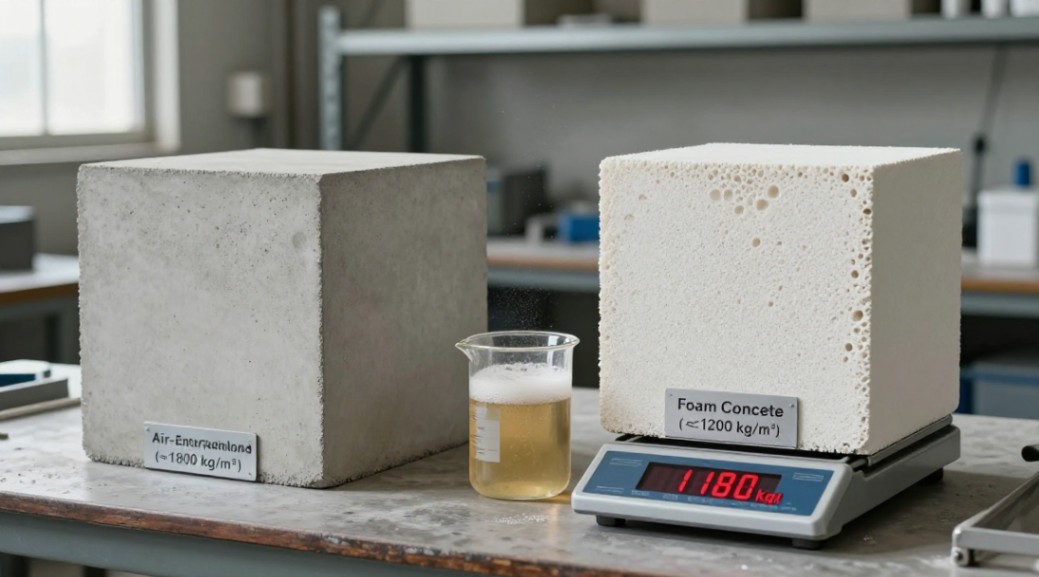
- Cons: Maximum air content is ~8% by volume. That yields only a 10-15% weight reduction. Not true lightweight concrete. They are designed for freeze-thaw resistance, not density reduction.
Verdict: If you need densities below 1200 kg/m³, a dedicated concrete foaming agent is the only practical route.
5. Compatibility: Which Cements and Additives Work Best?
Your foaming agent does not work in isolation.
- Cement type: Ordinary portland cement (OPC) is standard. Special cement blends like calcium sulfoaluminate (CSA) accelerate setting, which helps trap bubbles. Avoid cements with high alkali content if using protein agents; they can cause protein denaturation.
- Admixtures: A concrete water reducer or superplasticizer is almost mandatory to lower water/cement ratio without losing flow. Use Hydroxypropyl Methyl Cellulose (HPMC) or Hydroxyethyl Cellulose as viscosity modifiers to prevent bubble coalescence. Add fiber (polypropylene or glass) to limit shrinkage cracking. Avoid any concrete defoamer or nano-modifier that contains silica fume in high dosage—it can destabilize foam.
- Aggregates: Fine sand only (max 2 mm). Coarse aggregates crush the foam cells.
6. Common Applications: Where Do These Agents Shine?
Each application demands a specific foaming agent profile.
- Roof insulation: Use protein-based agents. They deliver the lowest thermal conductivity (0.08-0.15 W/mK). Density target: 350-500 kg/m³.
- Floor screeds: Synthetic agents can work for leveling screeds over rigid insulation. For heated screeds requiring structural integrity, use protein-based with early strength agent.
- Precast blocks: Optimize for fast demolding. Use a protein agent blended with potassium silicate or sodium silicate to accelerate set and improve surface hardness.
- Void filling (abandoned pipes, tunnels): Synthetic agents are cost-effective. Pumpability is key—use a foam generator rated for high output (200+ L/min).
7. Storage, Handling, and Safety Essentials
Liquid foaming agents are not benign chemicals.
- Temperature: Store synthetic agents between 5-35°C. Protein agents require strict 10-30°C range. Freezing or overheating destroys performance.
- Shelf life: Most agents last 6-12 months in sealed containers. Opened drums should be used within 3 months.
- Safety: Use gloves and goggles. Concentrated agents can cause skin irritation. Ensure ventilation when mixing protein types due to volatile organic compounds (VOCs).
8. Environmental Impact: Is Foamed Concrete Green?
Yes, but with caveats. Foamed concrete uses less raw material per cubic meter than dense concrete. Lower density means less cement and aggregate consumed. The air voids reduce thermal bridging in buildings, lowering heating/cooling energy. However, the foaming agent itself is typically a petrochemical derivative (synthetic) or animal by-product (protein). Neither is carbon neutral. New bio-based agents (plant saponins) are emerging but not yet cost-competitive for large volumes. For the highest sustainability score, combine protein-based agents with high volumes of supplementary cementitious materials (fly ash, slag) and a concrete water reducer to cut cement content further.
Which Foaming Agent Does TRUNNANO Recommend?
After testing 47 different formulations across 9 countries, our technical team at TRUNNANO has identified a clear leader for demanding applications. We evaluated foam stability over 90 minutes, compressive strength of 600 kg/m³ test cylinders, and compatibility with Hydroxypropyl Methyl Cellulose and Redispersible Polymer Powder.
The verdict: For contractors who need repeatable results daily, we stock a proprietary protein-surfactant hybrid that outperforms standard options. It delivers 20% higher strength at the same density with zero foam collapse during pumping.
Do not settle for failed pours. Contact TRUNNANO directly to order a 500 mL sample for your site trials. Our engineers will help you match the agent to your foam generator and special cement blend. Stop guessing. Start pouring.
We are the global leader in lightweight concrete and advanced engineered foam solutions. Known globally for its commitment to research, innovation, and applied expertise, we have been providing engineered foam solutions since the early 2012’s.
We can supply high-quality concrete admixture and foam concrete related products all over the world.
The company has a professional technical department and quality supervision department, a well-equipped laboratory, and equipped with advanced testing equipment and after-sales customer service center.
If you are interested, please feel free and contact us.