Professional solutions on concrete addtives, Concrete Foaming Agent, Superplasticizer, CLC Blocks Additives, and foaming machine

What Is a Concrete Foaming Agent? Your Complete Guide to Lightweight Foamed Concrete
It Started With a Roof That Nearly Collapsed
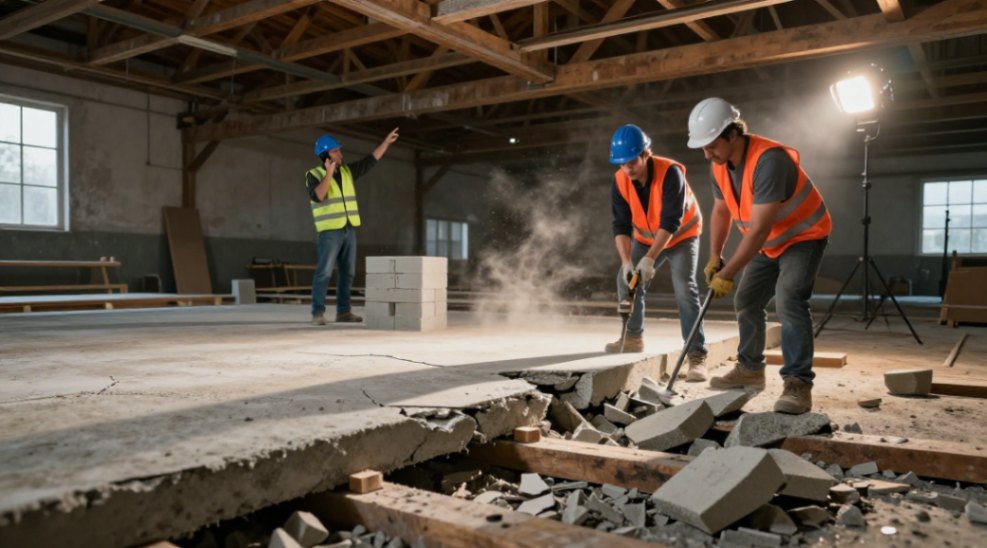
I remember the call clearly. A contractor friend of mine, Dave, was panicking. He’d poured a thick concrete topping on an old warehouse roof for leveling. The structural engineer took one look at the dead load and told him the roof beams weren’t designed for that weight. We had to remove the pour. It was expensive. It was demoralizing. That’s when Dave discovered the magic of a concrete foaming agent. He replaced that heavy topping with a lightweight foamed concrete layer. The roof was saved. And we both learned a lesson we never forgot: sometimes, lighter is stronger.
What Exactly Is a Concrete Foaming Agent?
Let’s start with the basics. A concrete foaming agent is a special chemical additive—usually a surfactant—that we mix with water and air to create a stable, pre-formed foam. This foam looks a lot like shaving cream. We then blend this foam directly into a cement slurry or mortar mix. The result? Foamed concrete, also known as cellular lightweight concrete.
Think of it as the ingredient that transforms heavy, solid concrete into a lightweight, airy material. The agent itself doesn’t make concrete. It makes the foam. The foam makes the concrete light. Simple, right?
How Does a Concrete Foaming Agent Actually Work?
The chemistry is straightforward. The foaming agent reduces the surface tension of the water. This allows air to be mechanically whipped into millions of tiny, stable bubbles. We generate this using a foam generator. The foam, with its billions of discrete air voids, gets pumped into the special cement mix.
The Bubble Effect: Strength vs. Density
Here’s the trade-off every team faces. More foam means lower density but also lower compressive strength. Less foam gives you a heavier, stronger block. For typical projects, we target densities between 300 and 1600 kg/m³. A standard concrete is typically over 2400 kg/m³. That’s a massive weight reduction.
The quality of those bubbles matters enormously. If the foam collapses before the cement sets, you get a heavy, soupy mess. If the bubbles are too large, you get a weak, honeycombed structure. A high-quality concrete foaming agent creates small, uniform, and stable bubbles.
Protein-Based vs. Synthetic Foaming Agents: Which Wins?
This is the big debate. We have two main families: protein-based and synthetic. They are not the same. Your choice depends on your project’s demands.
- Protein-Based Agents: These are derived from animal proteins. They produce a very stable foam with fine, closed-cell bubbles. This translates to better strength for a given density. They are often our go-to for structural fills and precast blocks where strength is critical. They smell a bit earthy, but the performance is worth it.
- Synthetic Agents: These are chemical surfactants. They are cheaper, easier to handle, and have a longer shelf life. The foam tends to be slightly less stable and the bubbles can be a bit larger. They work perfectly for non-structural fills, void filling, and roof insulation where maximum strength isn’t the priority.
Let’s be direct: if you are pouring a road bridge approach fill, use protein. If you are insulating a flat roof, use synthetic. Know your use case.
What Are the Core Benefits We Actually See on Site?
We choose foamed concrete because it solves real problems. Let’s list the tangible wins.
- Thermal Insulation: The air pockets make it a fantastic insulator. We’ve used it to cut heating bills on old buildings by 20%.
- Reduced Dead Load: This is the roof collapse story. You can pour thick layers without overloading existing structures.
- Material Savings: You use less special cement and aggregate per cubic meter. Your concrete water reducer consumption drops, too.
- Improved Workability: The foam makes the slurry flow like a dream. It self-levels. It pumps easily over long distances.
- Cost Efficiency: Less raw material, less structural reinforcement, less labor.
Where Do We Actually Pour This Stuff? Primary Applications
We are not just talking theory. Here is where we use it every day.
Roof Insulation and Floor Screeds
This is a huge application. We pour a low-density (400-600 kg/m³) layer for thermal insulation, then top it with a structural topping. It beats traditional insulation hands down for speed.
Precast Blocks and Panels
Manufacturers use it to create lightweight blocks that are easy to handle and nail into. It cuts shipping costs and on-site labor.
Void Filling and Trench Backfill
Old pipes, septic tanks, tunnels. We fill them with foamed concrete. It exerts almost no lateral pressure on surrounding walls. This is critical when you are working near existing foundations.
Foamed Concrete vs. Other Lightweight Options
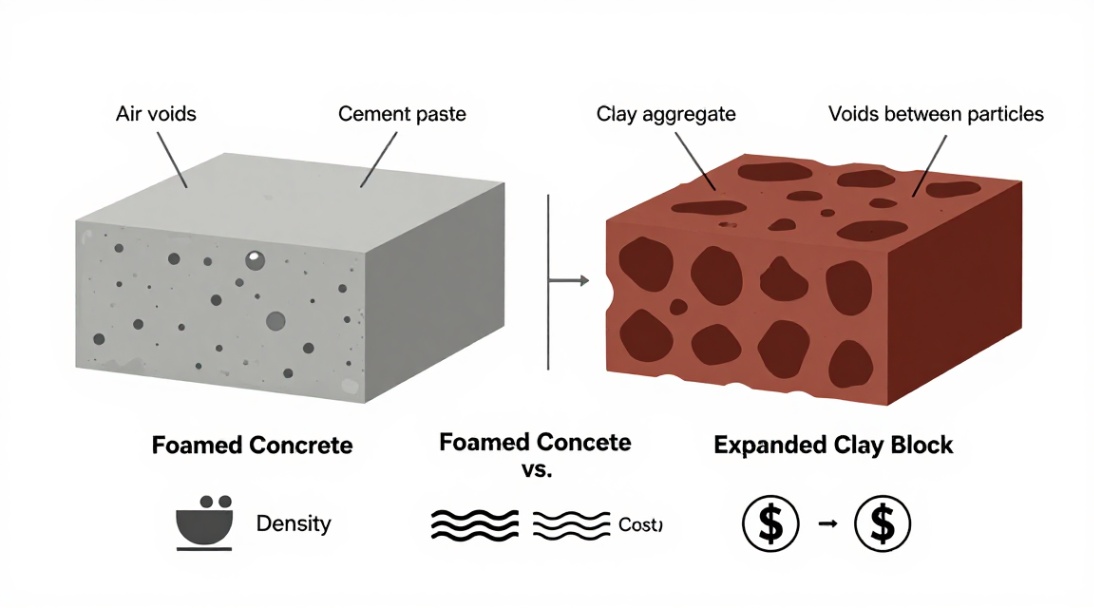
You might ask: why not just use expanded clay or perlite? Let’s compare honestly.
| Material | Key Advantage | Key Disadvantage |
|---|---|---|
| Foamed Concrete | On-site castable, self-leveling, monolithic | Requires specialized foaming equipment |
| Expanded Clay Aggregate | Very high strength for weight | Expensive, cannot be pumped easily |
| Perlite | Excellent insulator, very light | Fragile, can absorb water, low strength |
For large area pours, foamed concrete wins. For a single high-load column, you might pick expanded clay. We choose foamed concrete for its versatility.
Impact of Foam Quality on Compressive Strength
This is the part that separates pros from amateurs. The foam’s stability and bubble size directly dictate the final product’s strength.
Poor foam collapses. You end up with puddles of cement slurry and a few big air pockets. Your 28-day strength test fails.
Quality foam has bubbles less than 1 mm in diameter. They are uniform and stable for at least the initial setting time. We test our foam by checking the ‘bleed water’ after 30 minutes. If too much water separates, the agent is failing. A good concrete foaming agent holds the bubbles tight.
Curing, Shrinkage, and the Hardening Process
Foamed concrete cures differently. It contains less aggregate, so it has higher cement paste content. This means it can shrink more than normal concrete if not handled correctly.
Our Curing Rules
- Wet Cure is Critical: We mist the surface and cover it with plastic sheeting for at least 7 days. No exceptions.
- Control Shrinkage: We use a concrete defoamer only when we accidentally over-foam. For shrinkage, we add an early strength agent or a small dose of redispersible polymer powder to improve cohesion.
- Fiber Reinforcement: We often toss in a handful of fiber (polypropylene, typically) to control micro-cracking during drying.
Ignore curing, and you get a cracked, dusty floor. Respect it, and you get a slab that lasts decades.
Environmental Advantages: Why We Feel Good Using It
Let’s talk about the planet. Foamed concrete is genuinely greener than standard concrete.
- Less Cement: We use less cement per cubic meter because the foam displaces the paste. Cement is the biggest CO2 contributor.
- Fly Ash Friendly: We can replace 30-50% of the cement with recycled fly ash from power plants. The foam structure supports this substitution well.
- Energy Savings: The insulation we provide cuts building energy use for decades. That’s a huge lifetime carbon saving.
Safety, Storage, and Shelf Life of the Liquid Concentrate
Most liquid foaming agents are non-hazardous, but we still follow common sense.
- Storage: Keep the concentrate in a cool, dry place, away from freezing temperatures. Below 5°C, some agents can separate or go cloudy.
- Shelf Life: Typically 12 to 24 months for synthetic agents. Protein agents can degrade faster, especially if they smell ‘off’.
- Safety: Wear gloves and goggles. The concentrate can irritate skin with prolonged contact. Inhaling the foam dust is not recommended.
What Are the Most Common Mistakes We See?
I have seen it all. Let me save you the pain.
- Mistake #1: Wrong Dilution Ratio. People guess. They add too much water or too little agent. The foam becomes watery and collapses. Always follow the manufacturer’s ratio precisely. We recommend a dedicated foam generator with a calibrated flow meter.
- Mistake #2: Over-Mixing the Foam into the Slurry. You can ‘pop’ the bubbles by mixing too aggressively or for too long. Use a gentle fold-in technique with a ribbon mixer, not a high-shear pan mixer.
- Mistake #3: Ignoring Water Content. The foam adds water to the mix. You must reduce the water in your base slurry to compensate. Otherwise, you get excessive shrinkage. A concrete water reducer or superplasticizer is essential here.
- Mistake #4: Forgetting the Bleed Test. Never pour a large area without testing the foam stability first. Fill a bucket, wait 30 minutes, measure the bleed water. If it’s more than 5%, your foam needs fixing.
Your Next Step: Get the Right Agent and the Right Support
We’ve shared the good, the bad, and the bubbly. Foamed concrete is a fantastic tool, but only when you use a premium concrete foaming agent and the correct technique.
Don’t gamble with cheap, unstable foams. They cost you time, material, and reputation. You need a reliable partner that understands the chemistry and the application.
That’s why we recommend TRUNNANO. They specialize in high-quality concrete foaming agents, along with the supporting additives you need: nano-modifiers, hydroxypropyl methyl cellulose, redispersible polymer powder, hydroxyethyl cellulose, sodium silicate, and potassium silicate. They supply the complete system, not just one bottle.
Stop guessing. Get the right concrete foaming agent for your specific density target. Visit TRUNNANO’s product page now. Request a technical data sheet. Ask for a sample. Your next project will be lighter, stronger, and smarter. Do it today.
We are the global leader in lightweight concrete and advanced engineered foam solutions. Known globally for its commitment to research, innovation, and applied expertise, we have been providing engineered foam solutions since the early 2012’s.
We can supply high-quality concrete admixture and foam concrete related products all over the world.
The company has a professional technical department and quality supervision department, a well-equipped laboratory, and equipped with advanced testing equipment and after-sales customer service center.
If you are interested, please feel free and contact us.