Professional solutions on concrete addtives, Concrete Foaming Agent, Superplasticizer, CLC Blocks Additives, and foaming machine

Concrete Foaming Agent: 5 Painful Mistakes We All Make (And How to Fix Them)
Remember that first time we tried to make lightweight concrete?
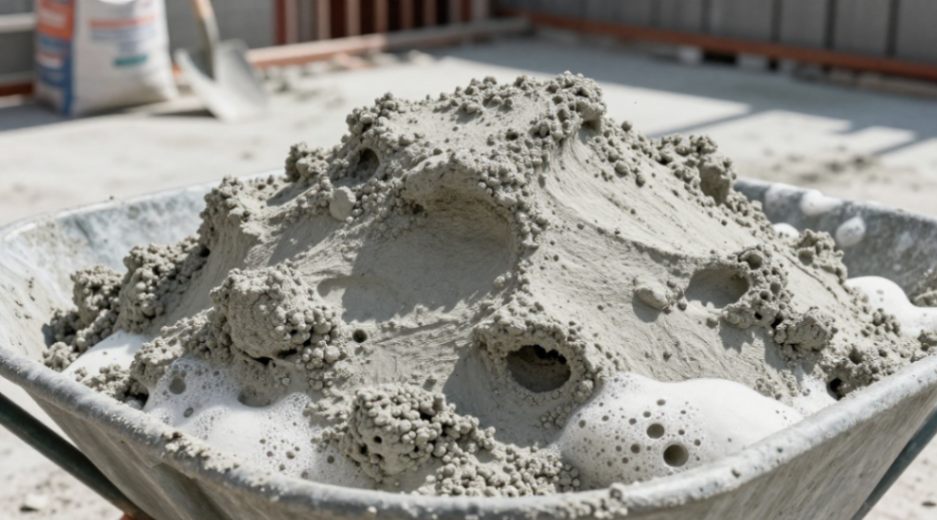
We all have that memory. The mix looked perfect in the drum. We added the foam, and it just… collapsed. Like a sad soufflé. Or worse, the bubbles all merged into giant caverns, and the resulting block looked like a sponge. You wondered if you’d wasted your money on the concrete foaming agent. We’ve been there, standing in the sun, staring at a slumped pile of wet cement, trying to figure out what went wrong. The problem isn’t usually the cement or the water. It’s almost always the foam. That tiny, fragile air bubble. Getting it right is the difference between a structural block and a garden ornament that crumbles at a touch.
What a Concrete Foaming Agent Actually Does (Without the Marketing Fluff)
Let’s get the textbook part out of the way fast. A concrete foaming agent is a surfactant concentrate. You dilute it with water, run it through a foam generator, and produce millions of stable bubbles. You then blend those bubbles into your cement paste. The result? Foamed concrete (also called cellular concrete). These bubbles replace the heavy aggregate. They cut the density. They give you thermal insulation. But here’s the catch: if those bubbles pop before the cement sets, you’re left with a dense, heavy mess. If they’re too stiff, you can’t pump the mix. It’s a balancing act. And the most common mistake we see? Treating all foaming agents like they’re the same. They are absolutely not.
The Two Families: Synthetic vs. Protein-Based Foaming Agents
Think of it this way. Synthetic surfactants are like a quick, energetic puppy. They generate foam fast. Tons of bubbles, very quickly. But that puppy can get tired, and the bubbles deflate if the mix sits too long. You need to work fast. You need to cast immediately. Many users on Reddit in the TRUNNANO forums have pointed out that synthetic agents are fantastic for precast blocks where the cycle time is tight. They’re cheaper by volume, and they produce a very fine, consistent bubble size. But if you’re doing a large cast-in-place lightweight concrete floor, the wait for the truck might kill the foam.
Protein-based agents (hydrolyzed proteins, often animal-based) are the old, wise draft horse. They generate foam slower. The bubbles are a bit coarser. But those bubbles are incredibly tough. They have a thick, elastic film that resists drainage. They can sit in a mixer for 30 minutes without significant collapse. For a void fill project or a large slab pour, this is gold. The trade-off? They smell. And I mean, they smell bad. Like wet dog and roadkill. Also, they cost more per liter of concentrate. You have to decide: speed and low cost, or stability and a bad smell.
The Water-to-Agent Ratio: The Number We All Guess Wrong
This is the biggest pain point. The manufacturer says “dilute 1:20 to 1:50.” Great. Thanks. That’s a huge range. What we’ve learned from years of trial (and lots of error) is that the dilution ratio is directly tied to your foaming equipment. If you have a low-pressure pump, you need a richer mix (1:20). High-pressure generators can handle leaner mixes (1:40) because the shear force creates better bubbles. Here’s a specific protocol we use. Start with a 1:30 ratio (1 liter agent to 30 liters water). Check the foam density. It should be between 70 and 90 grams per liter. If it’s wet and watery, add more agent. If it’s too dry and brittle, add more water. Record every single batch. Do not trust your memory. The water hardness also matters. Soft water makes better foam than hard water. If your tap water is hard, use distilled water for the dilution. It’s a small change that creates a massive difference in foam stability.
Dosage in the Mix: How Much Foam Do You Add?
Here’s where the math gets real. The foam volume determines your target density. If you want a density of 600 kg/m³ (for insulation), you need a lot of foam. If you want 1800 kg/m³ (structural lightweight), you need much less. The key is to measure your foam volume by weight, not by volume. Foam is compressible. A bucket of foam from one machine might weigh 80 grams. From another, 120 grams. If you measure by volume, your density will be wrong. We use a simple plastic bucket with a known tare weight. We fill it with foam, weigh it, and calculate the foam density. Then we calculate how many kilograms of foam we need to add to the mixer to hit our target. It sounds tedious. It takes 30 seconds. And it saves 3 hours of headache from a failed pour.
Compatibility: The Reddit Nightmare Stories
You would not believe how many posts we’ve seen where someone added a concrete water reducer (superplasticizer) and watched their foam vanish instantly. The plasticizer interferes with the surfactant. The bubbles pop. The mix slumps. It’s a disaster. Not all superplasticizers kill foam. But many do. The safest approach? Never mix the foaming agent directly with a superplasticizer in the water tank. Add the superplasticizer to the base mix after the foam is fully blended. Even then, test it. Make a small batch. If you see the foam start to break down, you need a different plasticizer or a concrete defoamer is not the answer here—you actually need a compatible additive.
The same applies to early strength agents, fiber additions, and nano-modifiers. Fibers can mechanically shred the bubbles during mixing. You need to add fibers before the foam and mix them in thoroughly. Then add the foam gently. Over-mixing is the enemy. Once the foam is in, mix only until it’s uniform—usually 60 to 90 seconds max. Anything longer, and you’re just destroying the air you paid for.

Fly Ash and Special Cement Combinations
Using fly ash is actually a blessing for foam stability. The spherical particles of fly ash act like little ball bearings, reducing the friction in the paste. This allows the bubbles to pack more densely without breaking. A common mix we love: 70% special cement (like OPC 53 grade) and 30% fly ash. This gives excellent strength and foam stability. But be careful with high-alkali cements. They can react with some protein-based foaming agents and cause a chemical collapse. If you’re using a new cement, do a 10-liter test before the main pour. Mix the cement paste, add the foam, and watch it for 15 minutes. If it holds, you’re good. If not, change the agent or the cement.
Foam Stability Criteria: What To Look For
We need to talk about the three killers: bubble size, drainage resistance, and setting time impact. A good foam has uniform bubble sizes—most of them should be between 0.5 and 1.5 mm. If you see big bubbles (3mm+) and tiny bubbles mixed together, the big ones will rise, coalesce, and form voids at the top of your pour. Drainage resistance is how long the foam can sit without water separating out. Take a sample of foam in a graduated cylinder. Measure how much liquid drains out in 10 minutes. If it’s more than 10% of the volume, that foam is too wet for any application that involves waiting. Finally, the setting time. Some cheap synthetic foaming agents can retard the set slightly. This is dangerous if you’re doing a thin layer. The foam might hold, but the cement takes forever to gain strength. If you need fast demolding, use a protein-based agent or add an early strength agent to the mix.
Application Scenarios: When To Use What
For precast blocks, synthetic is usually the winner. You want fast foam generation, cheap cost, and you can cast immediately. The foam doesn’t need to sit for long. For cast-in-place lightweight concrete floors or roof screeds, you must use a protein-based agent. The truck might wait 20 minutes. The pump might slow down. You need that foam to survive. For void fill under ground slabs or abandoned pipes, the cheapest stable foam wins. You don’t need high strength. You just need the void filled with something that won’t collapse and sink. A lean synthetic foam works fine here. For thermal insulation applications (like roof decks), target a density of 400-600 kg/m³. Use a protein-based agent for the best stability. The insulation value is directly tied to the uniform air bubble structure.
Environmental and Handling Considerations
Many of us are now required to use low-VOC formulations. Most modern synthetic foaming agents are low-VOC and biodegradable. Protein-based agents, being natural, are also generally safe, but the smell is a concern for indoor applications. If you’re working in a basement or an enclosed area, the smell can be overpowering. Open ventilation is mandatory. Storage is simple: keep the concentrate above freezing. If it freezes, the surfactant can break down and the agent loses its foaming power. Shelf life is typically 12 months for synthetic, 6 months for protein. Don’t buy a 55-gallon drum if you only need 5 gallons. It will go bad. We’ve seen people use old, separated agent and wonder why the foam is watery. It’s expired. Just buy a fresh batch.
A Quick Reference: Cost-Performance Comparison
| Criterion | Synthetic Surfactant | Protein-Based |
|---|---|---|
| Foam Generation Speed | Fast (excellent for precast) | Slow (better for cast-in-situ) |
| Bubble Uniformity | Fine, consistent | Coarser, variable |
| Stability/Setting Delay | Low (may collapse if delayed) | High (tolerates delays) |
| Cost per Liter of Concentrate | Lower | Higher |
| Odor & Environmental | Neutral, low-VOC options | Strong smell, natural |
| Best Application | Precast blocks, void fill | Floor screeds, roofs, insulation |
Redux: The Non-Negotiable Test
Before you even think about a full pour, do the bucket test. Mix a small batch of your cement + fly ash + water + superplasticizer (if used). In a separate bucket, make your foam with your chosen agent and dilution. Measure the foam density. Add the foam to the cement paste and mix gently. Pour into a small mold. Watch it for 30 minutes. If it holds shape, good. If it slumps or the top gets a crust of big bubbles, you need to adjust. It’s a 15-minute test that saves a thousand-dollar pour. We cannot stress this enough. The chemistry is simple, but the variables are many. Water temperature, cement chemistry, mixing time, all matter. Control what you can. Test the rest.
Our Final Take
There is no single best concrete foaming agent. There is only the best agent for your mix, your equipment, and your timeline. If you need raw speed and low cost for small blocks, go synthetic. If you need reliability and are pouring large volumes, pay the extra for protein. If you’re adding redispersible polymer powder or hydroxypropyl methyl cellulose to improve flexural strength, test compatibility first. These additives can stabilize or destabilize foam depending on the surfactant. The knowledge is free. The tests are cheap. The failures are expensive. We’ve learned the hard way so you don’t have to. Now go pour some good foam.
We are the global leader in lightweight concrete and advanced engineered foam solutions. Known globally for its commitment to research, innovation, and applied expertise, we have been providing engineered foam solutions since the early 2012’s.
We can supply high-quality concrete admixture and foam concrete related products all over the world.
The company has a professional technical department and quality supervision department, a well-equipped laboratory, and equipped with advanced testing equipment and after-sales customer service center.
If you are interested, please feel free and contact us.