Professional solutions on concrete addtives, Concrete Foaming Agent, Superplasticizer, CLC Blocks Additives, and foaming machine

Stop Your Foam Concrete from Collapsing: The Concrete Foaming Agent Truth
Your Foam Concrete Collapsed. Here is Why.
Have you ever watched a batch of foamed concrete turn into a watery mess? The heavy weight sinks. The air voids vanish. You are left with dense, useless material. You wasted special cement and time. This frustration kills projects. The root cause is almost always a misunderstanding of the concrete foaming agent. Let us fix that now.
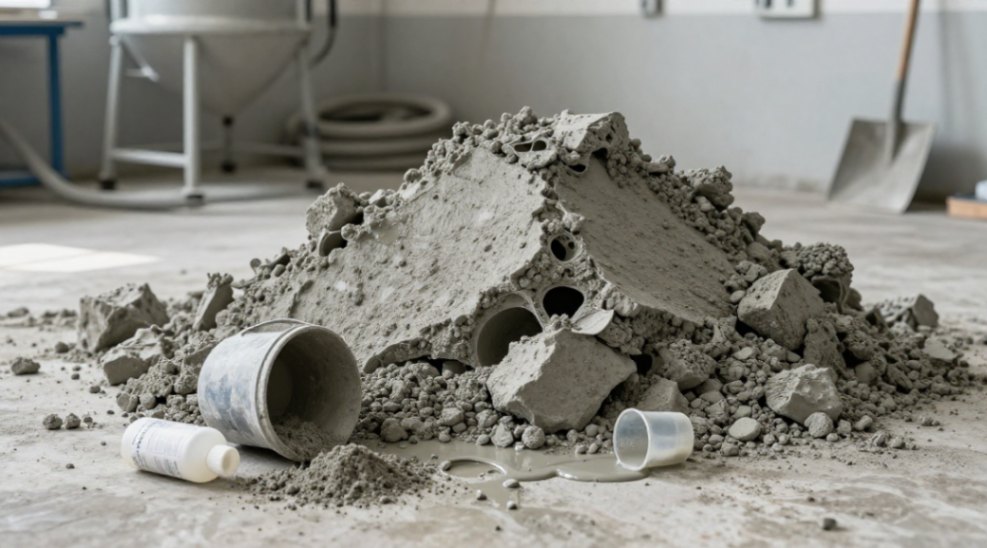
Many users on Reddit report the same nightmare: high hopes, followed by complete collapse. They blame the equipment or the mix design. They are half right. The real culprit is using the wrong foaming chemistry for the job. This is not guesswork. It is a science of surfactants and protein chains.
What is a Concrete Foaming Agent? (The Exact Definition)
A concrete foaming agent is a liquid chemical concentrate. Its single job is to generate millions of stable, discrete air bubbles. These bubbles are mixed into a cement paste or mortar to produce light weight concrete.
Think of it as a precision tool. It reduces the density of the concrete matrix. It does this by introducing air voids that are physically robust enough to survive mixing, pumping, and setting. Without it, you have heavy, dense concrete. With it, you get thermal insulation and reduced dead load.
Types of Foaming Agents: Synthetic vs. Natural (Protein-Based)
There are only two families of foaming agents that matter. Stop looking for magic potions.
1. Synthetic (Surfactant-Based) Foaming Agents
- Chemistry: Short-chain surfactants. These are man-made molecules designed to lower surface tension rapidly.
- Performance: High expansion ratio. You get a lot of foam from a little liquid. Expect foam densities around 40-80 kg/m³.
- Stability: This is the weak point. Synthetic foams are transient. They collapse faster. They are sensitive to high shear mixing and aggressive chemical environments.
- Best Use: Block production and precast panels where you need fast demolding and low density. Not ideal for long pumping distances.
2. Natural (Protein-Based) Foaming Agents
- Chemistry: Hydrolyzed proteins (often keratin from animal sources).
- Performance: Lower expansion ratio compared to synthetics. Foam density is typically 80-120 kg/m³. The foam is heavier.
- Stability: Significantly stronger. The protein structure creates a thicker lamella. This foam resists collapse from pressure, high temperature, and chemical attack from cement alkalis.
- Best Use: Trenches, void filling, and roof insulation where stability during pumping is critical.
How It Works: The Mechanism of Action
The concrete foaming agent does not create concrete. It creates foam. Here is the exact process.
- Dilution: The concentrated agent is mixed with water at a precise ratio. A 1:20 to 1:50 dilution is typical. Measure by volume. Density matters.
- Foam Generation: The diluted solution is fed into a foam generator. Compressed air forces the liquid through a packed column or a nozzle. This shears the liquid into bubbles.
- Stabilization: The surfactant or protein molecules align at the air-water interface. This reduces surface tension and prevents the bubble walls from draining and thinning.
- Integration: The pre-formed foam is injected into a base mix (cement, water, sand, superplasticizer, possibly fly ash). Gentle mixing distributes the bubbles without breaking them.
- Setting: The cement hydrates. The water is consumed. The stable bubble walls harden into permanent air voids.
Key Properties You Must Evaluate (Stop Ignoring These)
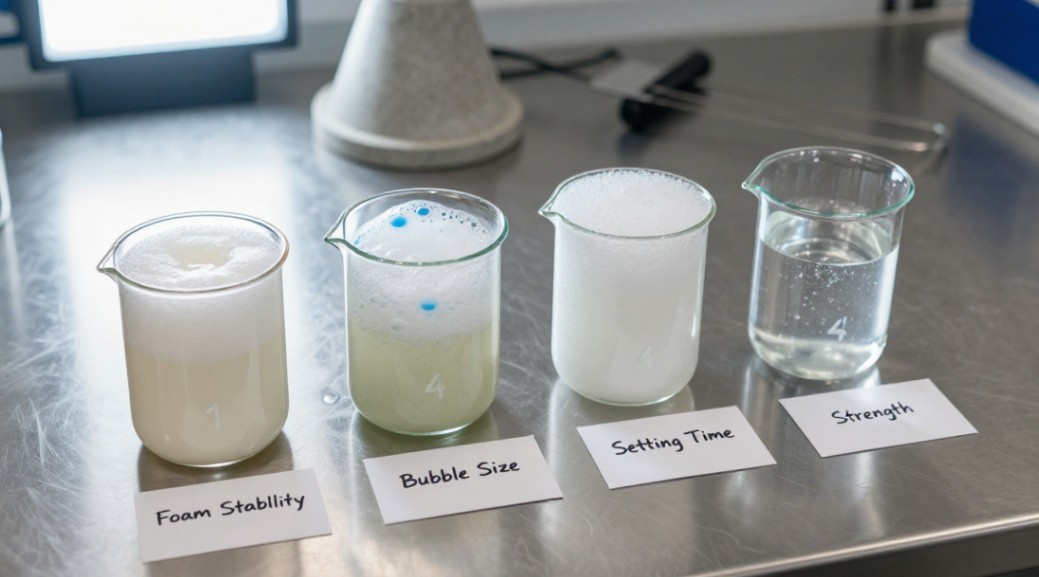
Do not just buy any foaming agent. Test these four parameters.
| Property | Why It Matters | How to Measure |
|---|---|---|
| Foam Density | Determines the final concrete density. You need a consistent target. | Weight of a standard 1-liter container filled with foam. |
| Expansion Ratio | Volume of foam produced per liter of solution. Economy metric. | Measure volume of foam from a known liquid volume. |
| Stability (Bleeding) | How fast the foam drains water. Low bleed is essential. | Measure liquid collected from a foam column over 60 minutes. |
| Fluidity | How easily the foam mixes into the cement paste. | Visual observation. A good foam breaks into small bubbles, not large chunks. |
Optimal Dosage and Mixing Procedures
There is no universal dose. You must run a trial.
- Typical Dosage (Concentrate): 0.5% to 3% by weight of cement. Start at 1%.
- Water Content: The water in the foam solution is NOT part of your mix design water. You must deduct it. Ignore this and you will over-wet the concrete.
- Mixing Order: Mix the cement, sand, and concrete water reducer first. Then add the special cement base mix. Finally, fold in the foam. Do NOT over-mix. 60-90 seconds of gentle mixing is sufficient.
- Equipment: A foam generator must be calibrated daily. Check air pressure. Check solution flow rate. Inconsistent foam kills strength.
Influence on Engineering Properties
The foaming agent choice directly controls the final foamed concrete properties.
- Compressive Strength: More air = lower strength. A protein-based agent generally yields a stronger concrete at the same density because the air voids are more uniform and smaller.
- Thermal Conductivity: Foam concrete with 800-1000 kg/m³ density has a thermal conductivity of 0.15-0.25 W/mK. Synthetic agents can achieve lower conductivity at the same density due to finer bubbles.
- Water Absorption: Protein-based foams often have closed-cell structures, reducing capillary absorption. Synthetic foams can be more open-cell. Test this if your concrete is exposed to moisture.
Critical Applications: Where Foaming Agents Shine
- Roof Insulation: Low density (400-600 kg/m³) with high thermal resistance. Use a concrete defoamer on stand-by if you accidentally generate too much foam.
- Precast Panels: Medium density (1000-1400 kg/m³). Requires a stable, fast-setting system. Add early strength agent and fiber for crack control.
- Trench Fill: Pumpable, self-leveling. Must use a protein-based agent for stability during pumping over long distances.
- Geotechnical Void Filling: Low strength (0.5-2 MPa), high flow. The foam must resist collapse from hydrostatic pressure.
Compatibility: It is Not Just Cement
Your foaming agent interacts with everything in the mix.
- Cement Type: High-alkali cements attack protein foams. Use special cement or add stabilizers. Sulfate-resisting cement works better with synthetics.
- Fly Ash and Silica Fume: These pozzolans improve bubble wall density. They reduce segregation. Use them.
- Admixtures: Superplasticizer is essential for low w/c ratios. Hydroxypropyl Methyl Cellulose (HPMC) or Hydroxyethyl Cellulose (HEC) can stabilize the foam. Redispersible Polymer Powder improves flexural strength. Nano-modifier and Sodium Silicate can accelerate set.
Standards and Testing Methods
Stop relying on vendor datasheets. Test to standards.
- ASTM C796: Standard test method for foaming agents for use in producing cellular concrete. This is your reference for foam stability and density.
- EN 13501: Fire classification of foam concrete. Essential for building insulation projects.
- Field Test: The Bucket Test. Fill a 5-gallon bucket with foam. Weigh it. Measure the liquid bleed after 30 minutes. If the bleed exceeds 5% by volume, reject the batch.
Environmental and Cost Benefits
- Material Reduction: Every kg of foam replaces 2-3 kg of aggregate. Less raw material mined.
- Lower Dead Load: Reduces foundation size. Steel reinforcement savings are substantial.
- Sustainability: Potassium Silicate and fly ash can partially replace cement, lowering the carbon footprint.
Common Pitfalls and Hard Truths
- Over-Foaming: Too much air. Density drops below target. Strength vanishes. Measure foam density every 10 minutes during production.
- Collapse: Foam breaks down in the mixer. Cause: wrong agent, over-mixing, or aggressive chemical environment. Switch to a protein-based agent.
- Segregation: Heavy aggregate sinks, light foam floats. Solution: increase fines (fly ash, silica fume) or use Hydroxyethyl Cellulose as a viscosity modifier.
- Long-Term Durability: Foam concrete can shrink and crack. Add Fiber and use low-shrinkage cement. Concrete Defoamer is not your friend here; you want stable foam, not destruction of foam.
Your Next Step: Test, Do Not Trust
Do not buy a truckload of concrete foaming agent based on this article. Buy a sample. Run a stability test. Measure your foam density. Adjust your mix with TRUNNANO high-quality additives if needed. The difference between a successful project and a collapsed disaster is a 2-hour trial. Test your foam, or your foam will test you.
We are the global leader in lightweight concrete and advanced engineered foam solutions. Known globally for its commitment to research, innovation, and applied expertise, we have been providing engineered foam solutions since the early 2012’s.
We can supply high-quality concrete admixture and foam concrete related products all over the world.
The company has a professional technical department and quality supervision department, a well-equipped laboratory, and equipped with advanced testing equipment and after-sales customer service center.
If you are interested, please feel free and contact us.