Professional solutions on concrete addtives, Concrete Foaming Agent, Superplasticizer, CLC Blocks Additives, and foaming machine

Foam Concrete Density for Walls: The Builder’s Guide to Choosing Right
Why Your Wall’s Weight Matters: A Story of Two Houses
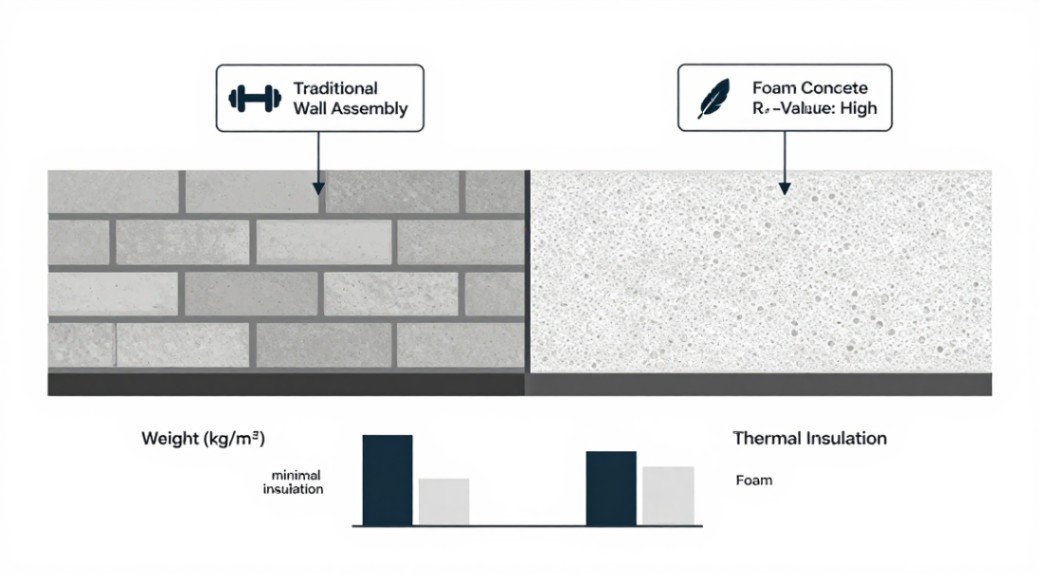
Years ago, we worked on two side-by-side projects. One used a standard, heavy insulation block. The other used a lightweight foam concrete. The crews on the second site moved faster, with less strain. But more importantly, that house now maintains a consistent, comfortable temperature with far less energy. The difference wasn’t just the material-it was the specific foam concrete density range for wall insulation they chose. That number, measured in kilograms per cubic meter (kg/m³), is the single most important specification you will make. It dictates everything: insulation value, strength, weight, and even how you install it. Let’s define it and get it right.
What is Foam Concrete Density?
Foam concrete density is simply its mass per unit volume. Think of it as how much air is trapped inside the hardened cement paste. We create this by mixing a cement slurry with a pre-formed foam. More foam means more air bubbles, resulting in a lighter, less dense material. For wall insulation applications, we typically work within a range of 300 kg/m³ to 1200 kg/m³. At the lower end, you get a product that’s almost sponge-like, with superb insulating properties but little strength. At the higher end, it behaves more like a lightweight concrete block, gaining structural capacity while sacrificing some thermal performance.
The Core Principle: Density vs. Thermal Performance
This is the non-negotiable trade-off. Air is an excellent insulator. The more air voids you have in the matrix, the better the material resists heat flow. A low-density mix, say 400 kg/m³, will have a thermal conductivity (k-value) around 0.10 W/mK. A higher density mix of 800 kg/m³ might have a k-value of 0.20 W/mK or more. For pure insulation, you go low. But walls have other jobs.
Choosing the Right Density Range for Your Wall
You don’t pick a single number. You choose a range based on the wall’s primary function. Here is how we break it down on every project.
For Load-Bearing Wall Insulation
These walls carry roof or floor loads. Density provides compressive strength. For this, you need a range of 800 kg/m³ to 1200 kg/m³. At 800 kg/m³, expect a compressive strength in the ballpark of 2-3 MPa (290-435 psi). At 1200 kg/m³, strengths can reach 7-10 MPa (1015-1450 psi). This density provides enough structural integrity for low-rise construction while still offering better insulation than traditional concrete. The mix design here uses less foam and often includes fine sand.
For Non-Load-Bearing Infill Wall Insulation
This is where foam concrete shines. The sole purpose here is thermal and acoustic insulation within a structural frame. Target a range of 300 kg/m³ to 600 kg/m³. A density of 400-500 kg/m³ is often the sweet spot, providing an optimal balance of very low thermal conductivity, manageable weight for easy handling, and enough cohesion to be pumped or placed without segregation. Compressive strength here is secondary, typically 0.5-1.5 MPa (72-217 psi).
Beyond Insulation: What Else Density Affects
Density is the master control. It doesn’t just change strength and insulation.
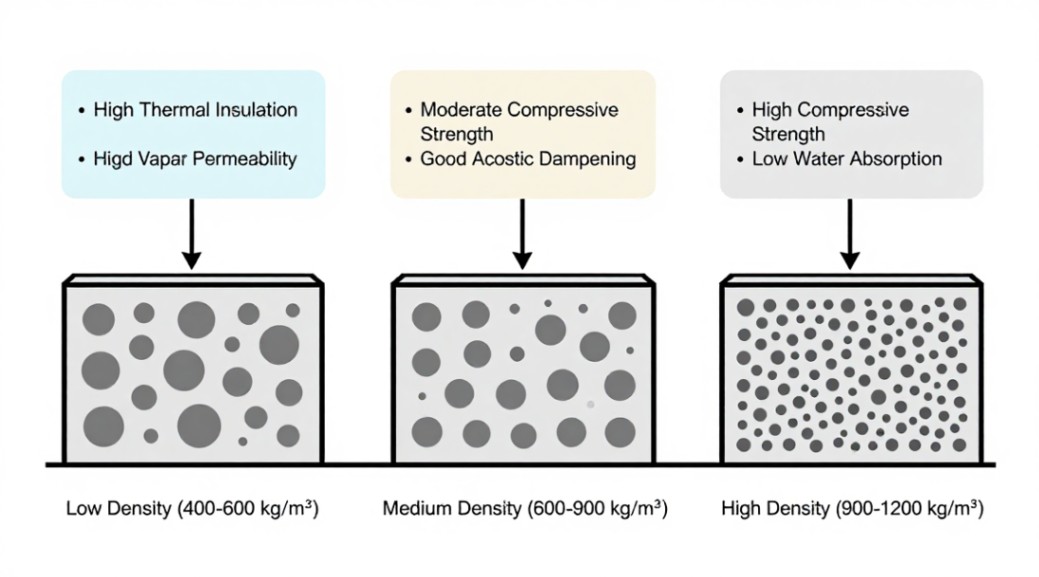
- Vapor Permeability: Lower density means more interconnected pores. This can be good for moisture diffusion in some climates but risks higher water absorption if not properly protected with a render or cladding.
- Fire Resistance: The cementitious matrix is inherently fire-resistant. However, higher density mixes perform better under prolonged fire exposure as they have less organic (air) content to contribute to spalling.
- Installation: Mixes below 500 kg/m³ are often pumpable and ideal for cavity infill. Mixes above 800 kg/m³ are better suited for pre-cast blocks or on-site casting into formwork.
Putting It Into Practice: From Mix Design to Code
Your chosen density dictates the mix. Key components are the cement-to-water ratio, the type of foaming agent, and the use of fillers like fly ash or fine sand. More cement and sand increase density. More foam decreases it. Simple in theory, precise in execution.
Always consult local building codes. They will specify minimum compressive strength values for wall elements, which directly translate to a minimum required density. A structural engineer must specify the exact density and strength for load-bearing applications. For infill, focus on the required R-value or U-value for your climate zone and select a density that achieves it.
The Final Decision: Clarity Over Compromise
Selecting the correct foam concrete density range for wall insulation is not a guessing game. Follow this logic: Is the wall structural? If yes, start at 800 kg/m³ and work with an engineer. If no, aim for 400-500 kg/m³ for maximum thermal efficiency. Never try to make one mix do both jobs perfectly. You will end up with a mediocre insulator that’s not quite strong enough.
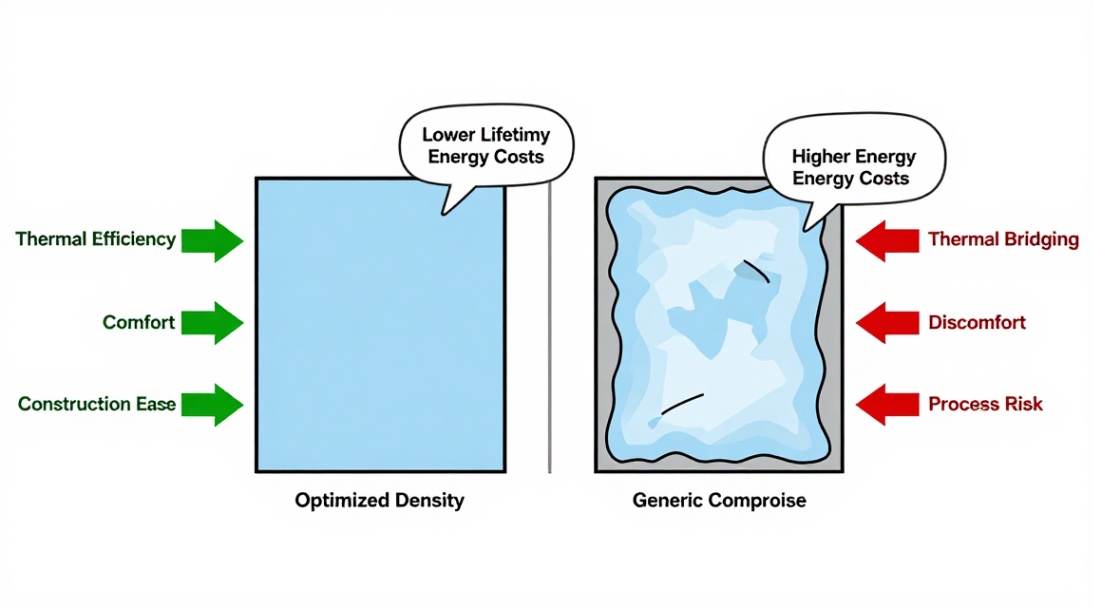
This knowledge separates a successful, energy-efficient build from a problematic one. The right density choice leads to lower lifetime energy costs, a more comfortable building, and a smoother construction process. Do not leave this critical specification to chance or a generic supplier recommendation. Your project deserves a precise, purpose-driven solution.
Ready to Specify with Confidence? Your next step is crucial. Download our free, detailed specification guide for foam concrete wall systems. It includes density-strength-thermal charts, mix design parameters, and a project checklist to ensure compliance and performance. Get the clarity you need-get the guide before your next project meeting.
We are the global leader in lightweight concrete and advanced engineered foam solutions. Known globally for its commitment to research, innovation, and applied expertise, we have been providing engineered foam solutions since the early 2012’s.
We can supply high-quality concrete admixture and foam concrete related products all over the world.
The company has a professional technical department and quality supervision department, a well-equipped laboratory, and equipped with advanced testing equipment and after-sales customer service center.
If you are interested, please feel free and contact us.