Professional solutions on concrete addtives, Concrete Foaming Agent, Superplasticizer, CLC Blocks Additives, and foaming machine

Mid-Range Water Reducers for Slabs: The Balanced Choice vs. Standard vs. High-Range
The Best Mid-Range Water Reducer for Concrete Slabs Is a Compromise of Strength, Workability, and Cost
For most conventional slab projects, a mid-range water reducer provides the optimal balance of properties that standard and high-range alternatives cannot match. This analysis breaks down the definitive choice based on project requirements, not marketing claims.
1. The Role of a Mid-Range Water Reducer in Slab Performance
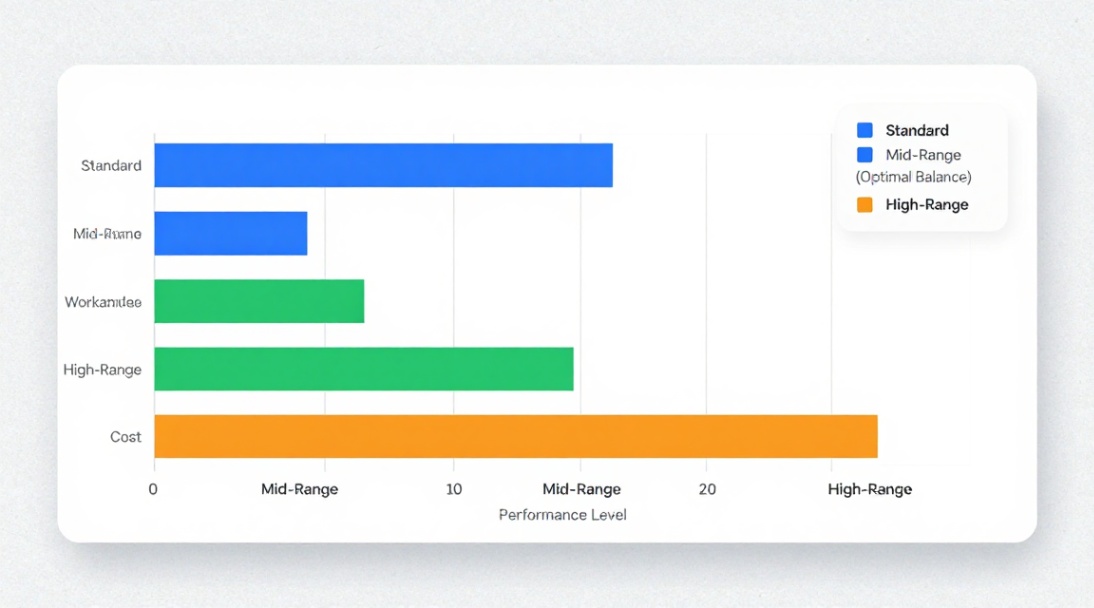
A mid-range water reducer is a chemical admixture that disperses cement particles. This action reduces the water demand for a given concrete mix by 8% to 15%, falling between standard water reducers (5-8%) and superplasticizers (15-30%). Its primary purpose in slab construction is not merely water reduction; it is a tool for achieving a specific, controlled rheology.
- Core Function: Disperses cement particles, freeing trapped water within the mix.
- Direct Effect: Lowers the water-cement (w/c) ratio for the same slump, or increases slump without adding water.
- Slab-Specific Goal: Enables a cohesive, placable mix that is neither too stiff for efficient finishing nor too wet for stability.
2. Mid-Range vs. Standard vs. High-Range: A Performance Comparison
2.1. Versus Standard Water Reducers
Standard water reducers (lignosulfonate-based) are cost-effective but limited.
Mid-Range Advantages:
- Higher Water Reduction: Enables a lower w/c ratio, directly boosting compressive and flexural strength.
- Improved Workability Retention: Slump loss is slower, crucial for transporting and placing large slab pours.
- Better Finishability: Produces a less sticky, more cohesive mix that bleeds less, leading to a superior surface finish.
Standard Reducer Limitations:
- Marginal water reduction offers limited strength gain.
- Often accelerates set time, which can stress finishing crews on slabs.
- May entrain excess air, compromising surface durability.
2.2. Versus High-Range Water Reducers (Superplasticizers)
Superplasticizers (polycarboxylate-based) offer dramatic water reduction but introduce complexity.
Mid-Range Advantages:
- Cost Efficiency: Significantly lower cost per cubic yard for moderate-performance needs.
- Predictable Slump Life: Offers a more gradual, controlled workability profile without the rapid ‘slump drop’ of some superplasticizers.
- Reduced Segregation Risk: The moderate water reduction maintains mix stability, whereas over-dosed superplasticizers can cause severe segregation in flatwork.
- Simpler Logistics: Less sensitive to batching sequence and mixing time variations common on smaller sites.
Superplasticizer Use Cases:
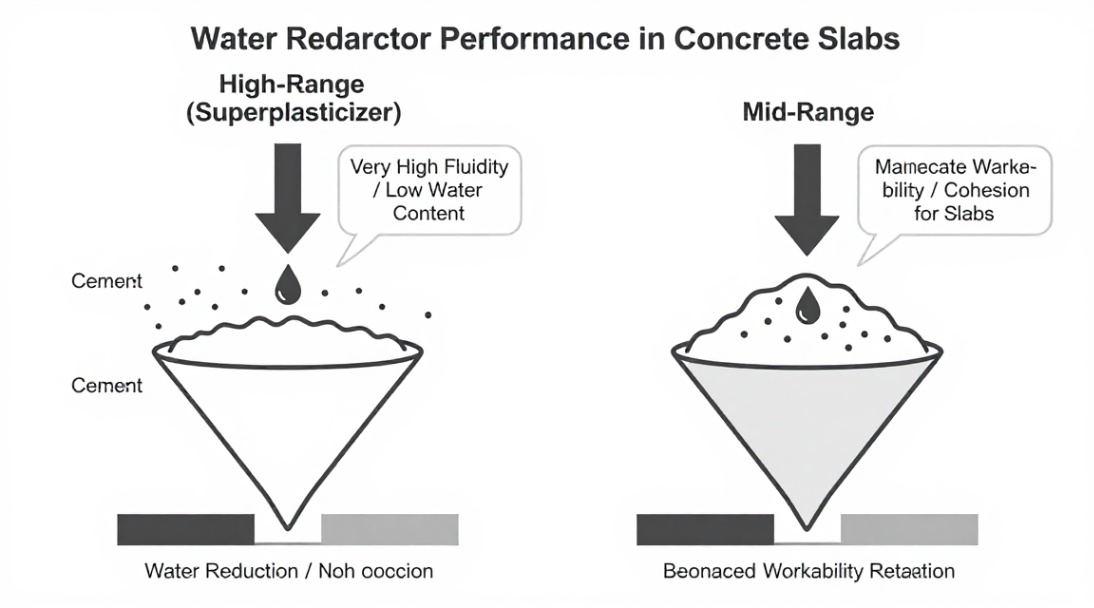
- Required for high-strength slabs with very low w/c ratios (<0.40).
- Necessary for self-consolidating concrete (SCC) applications.
- Ideal for slabs with extreme rebar congestion.
3. Critical Impacts on Concrete Slab Durability and Construction
3.1. Reducing Cracking and Improving Longevity
The primary durability benefit of a mid-range water reducer is its direct impact on the water-cement ratio. Every percentage point of water reduction lowers permeability and increases strength.
- Lower Permeability: A denser matrix resists chloride and sulfate ingress, critical for industrial or exterior slabs.
- Higher Early Strength: Faster strength gain allows earlier joint sawing, reducing the risk of random cracking.
- Reduced Plastic Shrinkage: Lower water content means less bleed water to evaporate, minimizing early-age surface cracking.
3.2. Key Application and Dosing Guidelines
Precise use dictates success. Dosage is always specified as fluid ounces per 100 pounds of cementitious material (fl oz/cwt).
| Step | Operation Method | Key Considerations |
|---|---|---|
| 1. Trial Batch | Conduct lab or field trials with the exact slab mix materials. | Test at 3, 5, and 7 fl oz/cwt to establish dose-response curve. |
| 2. Batching | Add with the mixing water or immediately after. Ensure a minimum of 5 minutes of mixing. | Uniform dispersion is critical. Never add undiluted to dry cement. |
| 3. Field Adjustment | Monitor initial slump. Adjust dose within ±1 fl oz/cwt based on aggregate moisture. | Do not add water to increase slump; adjust admixture dose instead. |
| 4. Compatibility Check | If using an air-entraining agent (AEA), combine in trial batches first. | Mid-range reducers can affect air-void system stability. Sequential addition often works best. |
4. Cost-Benefit Analysis and Ideal Project Types
The value proposition of a mid-range water reducer is clear for specific applications.
Cost-Benefit Breakdown:
- Material Cost: Higher than standard reducer, lower than superplasticizer.
- Performance Return: Achieves 90% of a superplasticizer’s strength benefit for 60% of the cost in moderate w/c ratio mixes (0.45-0.50).
- Labor Savings: Improved workability and finishability reduce crew effort and placement time.
Ideal Slab Project Types for Mid-Range Reducers:
- Commercial and industrial floor slabs (4,000+ psi typical)
- Parking garage decks and elevated slabs
- Exterior flatwork (sidewalks, aprons) requiring good finish and durability
- Residential basement slabs and garage floors where quality exceeds code minimum
- Slabs with moderate rebar mats where improved flow is needed without segregation
5. Best Practices for Mixing and Placing
Integrate these steps into your slab construction sequence.
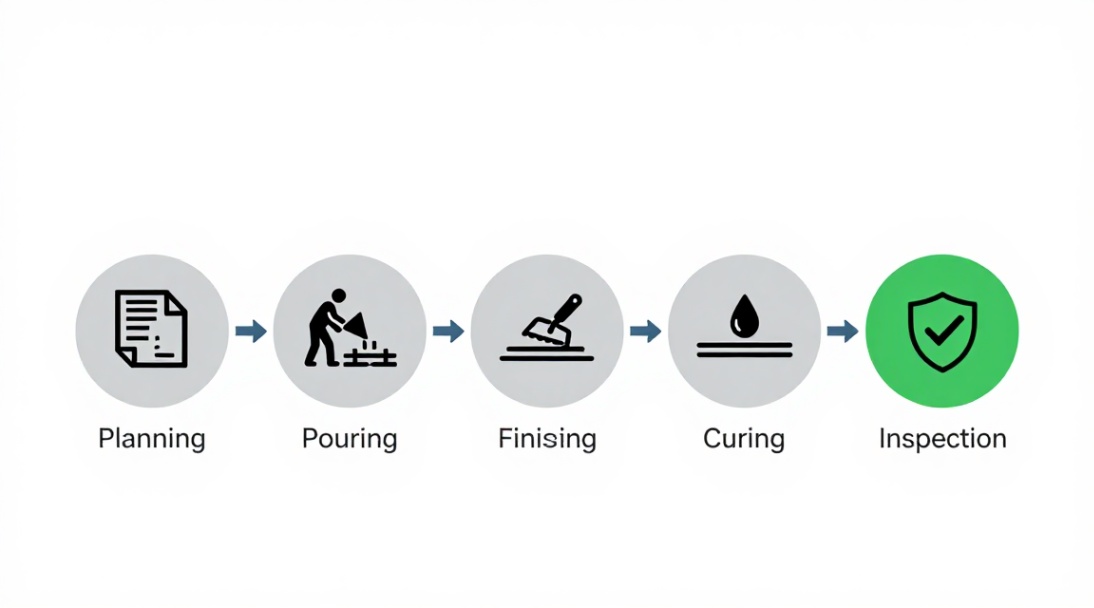
- Pre-Construction Meeting: Confirm dose rate, batching sequence, and slump target with the ready-mix producer.
- Temperature Awareness: In hot weather, mid-range reducers mitigate rapid slump loss. In cold weather, ensure they are not retarding set beyond specifications.
- Placement Technique: The improved cohesiveness allows for longer screed reaches but still requires proper vibration for consolidation.
- Finishing Window: Understand the admixture’s effect on set time. Most mid-range products offer minimal retardation, providing a predictable window for floating and troweling.
The choice for your next slab project is logical. For slabs requiring enhanced durability and finishability over a standard mix, but not the extreme performance of a superplasticizer, a mid-range water reducer is the technically sound and economically justified default. Specify it on your next commercial or high-end residential slab drawing set. Conduct a field trial with your ready-mix supplier to optimize the dosage for your local materials and achieve the precise balance your project demands.
We are the global leader in lightweight concrete and advanced engineered foam solutions. Known globally for its commitment to research, innovation, and applied expertise, we have been providing engineered foam solutions since the early 2012’s.
We can supply high-quality concrete admixture and foam concrete related products all over the world.
The company has a professional technical department and quality supervision department, a well-equipped laboratory, and equipped with advanced testing equipment and after-sales customer service center.
If you are interested, please feel free and contact us.