Professional solutions on concrete addtives, Concrete Foaming Agent, Superplasticizer, CLC Blocks Additives, and foaming machine

The Precise Role of High Range Water Reducers in Precast Concrete: A Guide to Workability, Strength, and Efficiency
The Power of High Range Water Reducers in Precast Concrete
Research from the National Precast Concrete Association indicates that up to 45% of mix design inconsistencies and early-age defects in precast elements directly relate to improper water control. High-range water reducers are the primary tool for mastering this variable. They are sophisticated chemical admixtures that radically improve the rheology of concrete with minimal water addition. Their role is not auxiliary; it is foundational to modern, high-performance precast production.
Frequently Asked Questions: High Range Water Reducers Explained
1. What exactly is a high range water reducer for precast concrete?
A high range water reducer (HRWR), often called a superplasticizer, is a chemical admixture added to concrete. Its core function is to disperse cement particles. This dispersion drastically reduces the water needed to achieve a fluid, workable mix. For precast concrete, this means you can design a stiff, low-water mix that pours like a high-slump mix. The result is a dense, strong, and durable product straight from the mold.
2. How does HRWR improve precast workability and flow?
It combats particle attraction. Cement grains naturally clump together, trapping water. HRWR molecules coat these grains, imparting a negative charge that causes them to repel each other. This repulsion frees the trapped water, allowing the entire mix to flow more freely at a given water content. You get exceptional flow for filling intricate molds and around dense reinforcement without adding excess water, which weakens the final product.
3. Why is high early strength so critical in precast, and how does HRWR help?
Precast economics depend on rapid production cycles. Faster demolding means faster reuse of expensive molds and factory space. A high-range water reducer enables a low water-cement ratio (w/cm) while maintaining workability. A lower w/cm is the single most significant factor for achieving high early strength. Concrete gains strength quicker, allowing for earlier stripping, handling, and curing. Cycles can be reduced by 25-40%.
4. Can HRWR enhance the durability of my precast elements?
Absolutely. Durability stems from low permeability. By enabling a denser, less porous concrete matrix through water reduction, HRWR directly reduces permeability. This means chloride ions, sulfates, and water itself struggle to penetrate. The result is enhanced resistance to freeze-thaw cycles, corrosion of embedded steel, and chemical attack. It extends the service life significantly.
5. What are the key surface and dimensional benefits for precast?
- Surface Finish: A fluid, cohesive mix with minimal bleed water produces a smooth, blemish-free surface right from the mold. This reduces post-cast finishing labor. Many users on industry forums note that switching to a modern polycarboxylate-based HRWR was the key to eliminating surface pinholes and achieving a ‘architectural-grade’ finish.
- Dimensional Accuracy: The mix flows uniformly into all mold details without segregation, ensuring precise replication of the mold’s shape and texture.
- Consistency: Batch-to-batch uniformity in workability translates to consistent setting times, strength gain, and final appearance.
6. What’s the difference between PCE and older HRWR types?
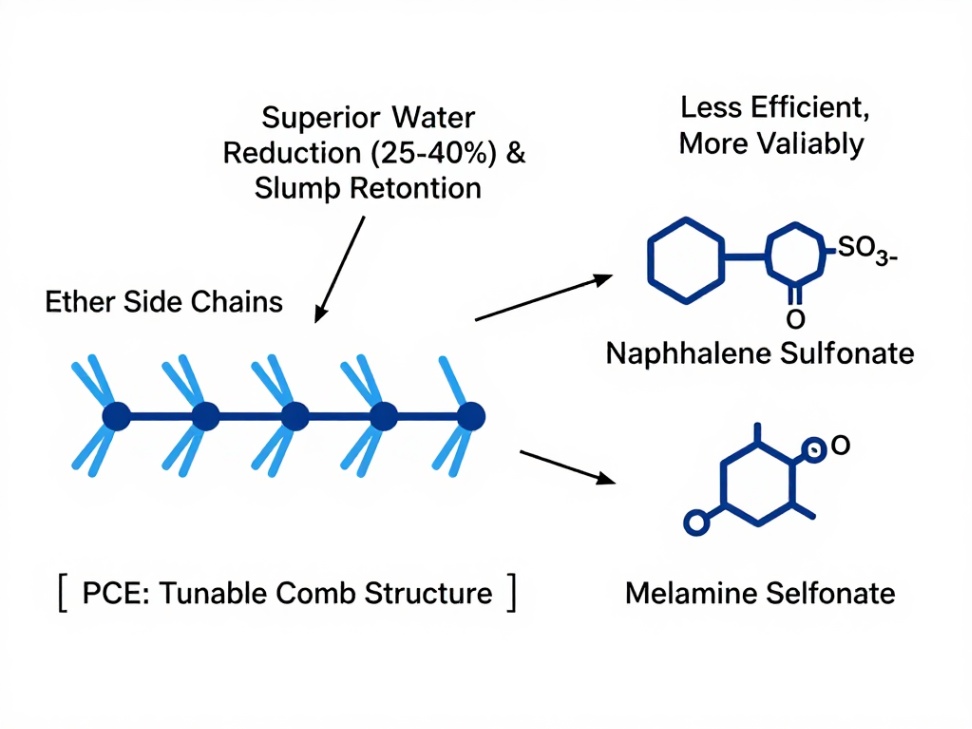
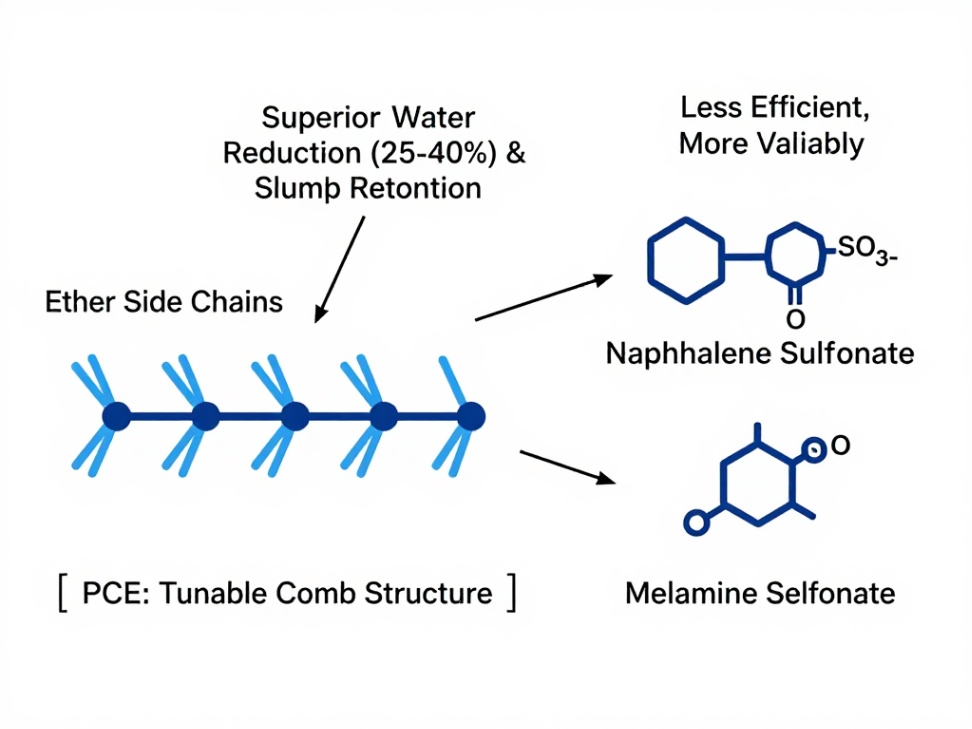
Polycarboxylate Ether (PCE) superplasticizers represent the current generation. They are more efficient, offer better slump retention, and are less sensitive to mix variations than older naphthalene or melamine-based products. PCEs provide superior water reduction-often 25-40%-and allow for greater flexibility in mix design. Their molecular structure can be ‘tuned’ for specific performance needs like rapid slump loss or extended workability.
7. How is dosage determined for precast mixes?
Dosage is never guesswork. It is determined through rigorous trial mixes targeting specific performance: a target slump flow, set time, and early strength. Dosage typically ranges from 0.5% to 2.0% by weight of cementitious materials. Precise batching is non-negotiable. A variance of just 0.1% can significantly alter rheology. Automated, calibrated admixture dispensers are standard in professional precast plants.
8. Is HRWR compatible with other admixtures like accelerators or fibers?
Compatibility must be verified through testing. Incompatibility can cause rapid slump loss, flash set, or reduced effectiveness. Generally, PCE-based HRWRs show good compatibility with many set accelerators and synthetic fibers. However, always conduct plant trials with the exact materials and sequence of addition you will use. Never assume compatibility.
9. How does HRWR enable sustainable mix design?
By providing high workability at very low water content, HRWR allows for two key optimizations: 1) Cement reduction for the same strength, lowering the carbon footprint, and 2) Increased use of supplementary cementitious materials (SCMs) like slag or fly ash. The enhanced particle dispersion ensures these SCMs react more efficiently. This leads to more sustainable, high-performance concrete.
10. What are the main application challenges in a precast plant?
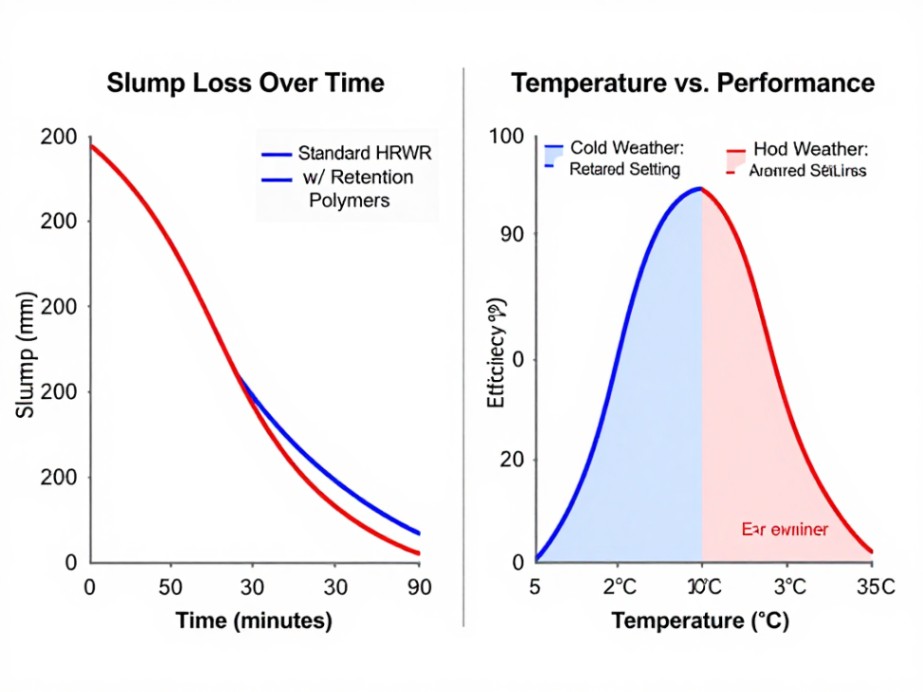
The two primary challenges are slump loss control and temperature sensitivity. Some HRWRs, especially older types, can suffer from rapid workability loss. Modern PCEs with ‘workability retention’ polymers address this. Temperature also affects performance; hot weather accelerates slump loss, while cold weather can retard setting. Mix designs and admixture selection must be adjusted seasonally.
11. What are the best practices for using HRWR in precast?
- Always add the HRWR to the mix water or with the initial mixing water, not onto dry materials.
- Ensure adequate mixing time for complete dispersion-usually 3-5 minutes at high speed.
- Monitor concrete temperature and adjust dosage or admixture type as needed.
- Keep detailed records of batch quantities, ambient conditions, and resulting concrete performance.
- Perform regular trial batches whenever a material source changes.
Moving Forward with HRWR in Precast
The effective use of a high range water reducer for precast concrete is a blend of material science and precise execution. It is not merely an additive but a central component of the mix design that dictates strength, appearance, and production speed. To implement it successfully, start with a clear performance specification. Then, partner with your admixture supplier to conduct full-scale plant trials. Measure everything: workability over time, set characteristics, and compressive strength at 12, 18, and 24 hours. Let that data, not assumptions, guide your formulation and process adjustments for a superior, more profitable precast product.
We are the global leader in lightweight concrete and advanced engineered foam solutions. Known globally for its commitment to research, innovation, and applied expertise, we have been providing engineered foam solutions since the early 2012’s.
We can supply high-quality concrete admixture and foam concrete related products all over the world.
The company has a professional technical department and quality supervision department, a well-equipped laboratory, and equipped with advanced testing equipment and after-sales customer service center.
If you are interested, please feel free and contact us.