Professional solutions on concrete addtives, Concrete Foaming Agent, Superplasticizer, CLC Blocks Additives, and foaming machine

Foamed Concrete Slump Test Pitfalls: Why Your Data is Lying to You
Your Slump Test is Failing You (And You Don’t Even Know It)
You carefully poured the foamed concrete sample into the cone. You tamped it, leveled it, and lifted the cone. The slump measured 150mm. You recorded the data, confident it matched the spec. Then, three days later, the on-site pour failed. The consistency was wrong. The foam collapsed. The density was off. Sound familiar? You’re not alone. Most technicians are using the standard slump test for foamed concrete incorrectly. This isn’t just a minor error; it’s a direct path to structural compromise, wasted material, and failed inspections. This guide exposes the critical mistakes and shows you how to get it right.
Foamed Concrete Consistency: The Unseen Battle
Consistency in foamed concrete isn’t just about flow. It’s the physical manifestation of a delicate balance between the paste and the air voids. Get it wrong, and the entire cellular structure collapses. The standard slump test, designed for dense, granular conventional concrete, is a blunt instrument for this precise task. It measures deformation under gravity, but foamed concrete’s behavior is dominated by foam stability and rheology, not just weight.
The Hard Truth About Foamed Concrete vs. Conventional Slump Tests
1. The Core Deception of the Standard Test
Never assume ASTM C143 or EN 12350-2 translates directly to foamed concrete. The traditional slump cone test measures the yield stress of a dense suspension. Foamed concrete is a lightweight, structured fluid. The foam bubbles introduce thixotropy and shear-thinning behavior that the standard procedure ignores. You’re measuring the wrong property.
2. The Major Adaptation You’re Probably Skipping
WARNING: Do NOT use the standard rodding/tamping procedure. Aggressive rodding destroys the foam’s bubble structure, giving you a false, denser reading. For foamed concrete with densities below 1600 kg/m³, use a gentle hand-scooping method to fill the cone. Avoid compaction. This single mistake invalidates more test results than any other.
3. The Instant Failure Signal Most People Miss
Observe the sample after the cone lifts. Does it hold its shape with a slight sheen, or does it visibly sag and bleed water? A quick, wet collapse indicates foam instability and severe segregation. The slump number is irrelevant at this point; the mix has already failed. Stop. Re-evaluate your foam agent and mixing sequence.
Beyond the Cone: When to Abandon Slump Entirely
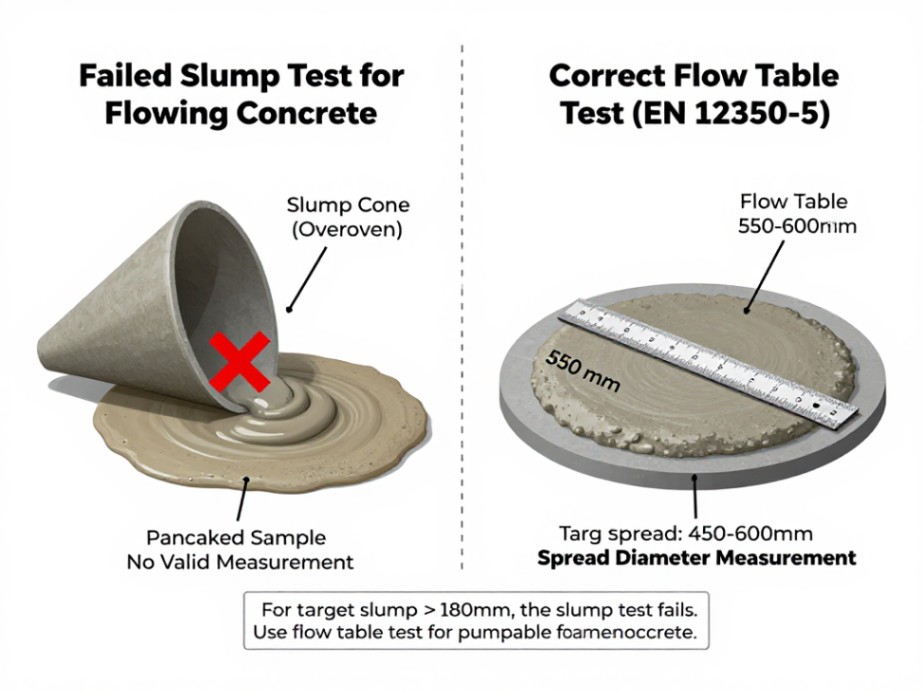
For flowing foamed concrete (target slump > 180mm), the slump test is useless. The sample will simply pancake. Here, you must switch to a flow table test (EN 12350-5) or measure the spread diameter. The target spread for pumpable foamed concrete is typically 450-600mm. Trying to use a slump cone here is professional negligence.
Target Consistency: The Numbers That Actually Matter
- Pre-cast Elements & Blocks: Aim for a stiff consistency. Target slump: 0-50mm (very low flow). This ensures minimal formwork pressure and precise dimensional stability.
- In-Situ Floor Screeds & Roof Insulation: Aim for a plastic consistency. Target slump: 100-150mm (or a spread of 300-400mm). This allows for easy placement and leveling without segregation.
- Pumped Applications & Cavity Fills: Aim for a flowing consistency. Target slump: >180mm (or a spread of 500-600mm). This is non-negotiable for pumpability.
The Real Levers of Control (Forget Just Adding Water)
Your first instinct when slump is low is to add water. This is a catastrophic error for foamed concrete. Adding water destroys foam stability, increases bleeding, and wrecks your strength-to-density ratio. Control consistency through these levers, in order:
- Adjust the Base Mortar Rheology: Fine-tune the superplasticizer dosage in your cement-sand-water slurry before introducing foam.
- Control Foam Volume & Stability: A more stable, drier foam produces a stiffer mix. A wetter, less stable foam increases flow but risks collapse.
- Modify the Mixing Regime: Mixing time and shear directly impact consistency. Overmixing after foam addition breaks bubbles.
On-Site QC: The 60-Second Reality Cheque
You don’t always have time for a full test. Do this instead: Take a trowel of fresh mix and turn it over. It should hold its shape on the trowel without slumping off immediately, but should also slide off cleanly with a gentle shake. If it sticks like paste, it’s too stiff. If it runs off like soup, the foam is failing. This simple cheque has saved more pours than any lab report.
The Final Verdict
The foamed concrete slump test is a useful tool, but only if you understand its severe limitations. Blindly following the conventional concrete standard is a recipe for failure. You must adapt the procedure, know when to use alternative methods, and interpret the results through the lens of foam stability. Consistency is the heartbeat of foamed concrete quality. Don’t measure it with a broken watch.
Stop Guessing. Start Measuring Correctly.
Your project’s integrity depends on accurate consistency control. If this guide revealed gaps in your process, you need a definitive solution. Our Foamed Concrete Consistency & Quality Control Kit includes the adapted slump cone protocol, flow table guide, and on-site troubleshooting checklist used by major producers. Don’t risk another failed pour or costly rejection. Download the definitive protocol now and execute with confidence.
We are the global leader in lightweight concrete and advanced engineered foam solutions. Known globally for its commitment to research, innovation, and applied expertise, we have been providing engineered foam solutions since the early 2012’s.
We can supply high-quality concrete admixture and foam concrete related products all over the world.
The company has a professional technical department and quality supervision department, a well-equipped laboratory, and equipped with advanced testing equipment and after-sales customer service center.
If you are interested, please feel free and contact us.