Professional solutions on concrete addtives, Concrete Foaming Agent, Superplasticizer, CLC Blocks Additives, and foaming machine

How to Select and Apply a Concrete Foaming Agent for Lightweight Concrete: A Step-by-Step Guide
Direct Answer: Choose a Synthetic Concrete Foaming Agent for High-Stability, Low-Density Foamed Concrete
For consistent, stable foam in structural lightweight concrete, select a synthetic-based concrete foaming agent with a dilution ratio of 1:40 to 1:60 and a dosage rate of 0.5% to 1.5% by weight of cement. This approach yields a wet density of 400–800 kg/m³ and a compressive strength of 1.5–6.0 MPa at 28 days. Protein-based agents suit specialized applications like fireproofing but require stricter pH control and are more prone to bacterial degradation. Follow the steps below to ensure production success.
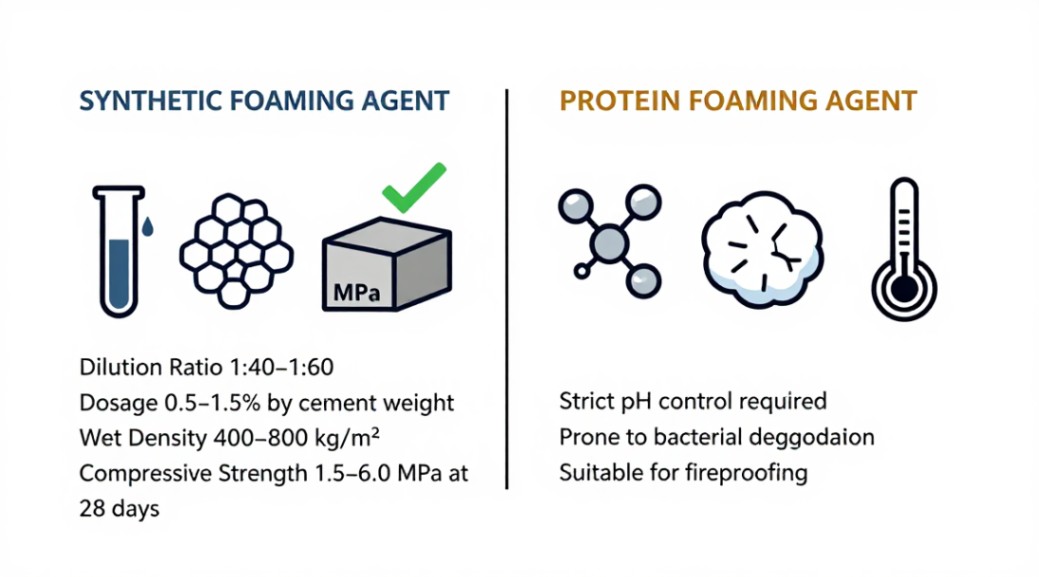
1. Understand the Role of a Concrete Foaming Agent
A concrete foaming agent is a surfactant that generates stable air bubbles when mixed with a foam generator. These bubbles displace coarse aggregates, creating a cellular structure. The result is foamed concrete with a density 40% to 80% lower than standard concrete. The agent directly controls bubble size distribution, foam stability, and final mechanical properties.
1.1 Foam Stability Mechanisms
Stability depends on the surfactant’s ability to lower surface tension and form a viscoelastic film around each bubble. Two main mechanisms maintain foam integrity:
- Marangoni effect: Surfactant molecules migrate to thinner film areas, repairing weak spots.
- Electrostatic repulsion: Charged surfactant heads repel adjacent bubble surfaces, preventing coalescence.
Failures occur when drainage (water loss from lamellae) or Ostwald ripening (gas diffusion between bubbles) accelerates. To avoid this, maintain a bubble size between 0.1 mm and 1.0 mm. A narrow distribution (< 0.3 mm spread) improves strength consistency.
2. Step-by-Step Selection and Application Process
Follow these five steps to integrate a concrete foaming agent into your mix design.
Step 1: Choose Between Synthetic and Protein-Based Agents
Your choice dictates foam stability, cost, and application scope. Use the table below to compare.
| Property | Synthetic (SLS/SLES-based) | Protein-based (Hydrolyzed keratin) |
|---|---|---|
| Foam density (fresh) | 30–100 g/L | 50–150 g/L |
| Bubble size range | 0.1–0.8 mm | 0.5–2.0 mm |
| Stability (time to 10% drainage) | > 60 minutes | 15–30 minutes |
| pH sensitivity | Resistant (pH 6–10) | Optimal pH 7–8.5 |
| Biodegradation risk | Low | High (requires biocide) |
| Cost per liter (concentrate) | US $2.5–5.0 | US $4.5–8.0 |
| Best application | Structural fill, blocks, floor screeds | Fire-proofing, rheology control |
Rule of thumb: Use synthetic for 80% of lightweight concrete jobs. Reserve protein-based for projects requiring enhanced fire resistance (e.g., tunnel linings) where sodium silicate is also added.
Step 2: Calculate Dilution and Dosage Rates
Use a three-step calculation sequence:
- Target density: Decide wet density (e.g., 600 kg/m³).
- Foam volume fraction: V_f = (1 – (target wet density / 2400)) × 100%. For 600 kg/m³, V_f = 75%.
- Dosage: Multiply V_f by the agent’s concentration factor. Typical synthetic agents require 0.5–1.5 kg per m³ of concrete.
Dilute the concentrate with water in the foam generator tank at a ratio between 1:40 and 1:60. Higher dilution (1:60) yields lighter foam but reduces stability below 0.4% solid content. Test each batch with a density cup (ASTM C796).
Step 3: Verify Compatibility with Cement and Additives
Not every binder works with every foaming agent. Synthetic agents generally match special cement types like calcium sulfoaluminate or sulfate-resistant Portland. Protein-based agents fail with high-alkali cements (alkali content > 0.8%) because the protein hydrolyzes.
Include performance data from industry trials:
| Cement type | Synthetic agent compatibility | Protein agent compatibility |
|---|---|---|
| Ordinary Portland (OPC CEM I 42.5) | Excellent | Good (buffered pH) |
| Sulfate-resistant (SRPC) | Excellent | Moderate |
| Calcium sulfoaluminate (CSA) | Excellent | Poor (high pH) |
| Blended (fly ash 30% replacement) | Excellent | Moderate (set delay) |
If you use a superplasticizer or concrete water reducer, add it after foam generation. Polycarboxylate-based reducers (1.0–1.5% by cement weight) improve workability without collapsing foam. Avoid naphthalene-based; they increase foam drainage.
Step 4: Control the Mixing Sequence and Equipment
This is where most field failures occur. Mix the base mortar first, then integrate foam.
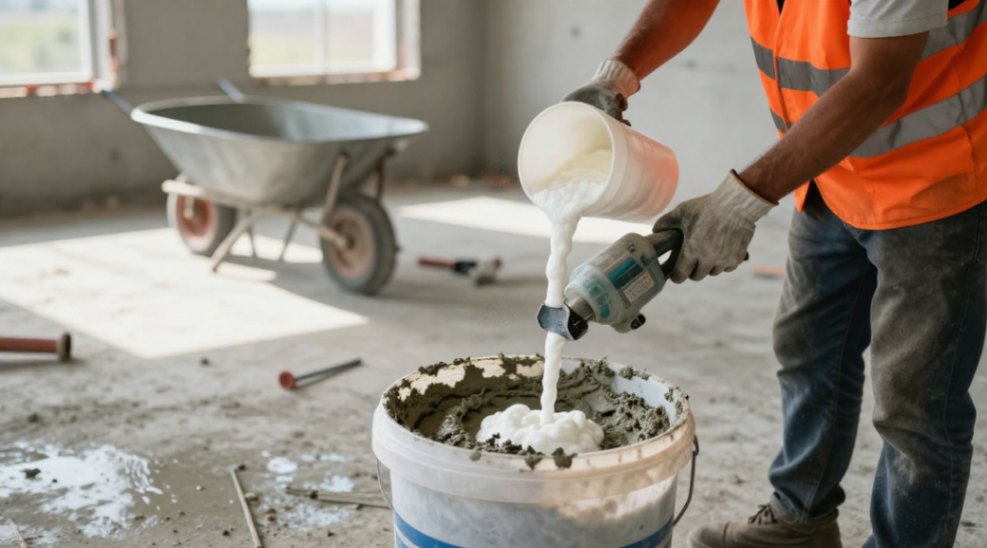
- Base mortar: Combine cement, sand (if used), water, and 50% of the foaming agent concentrate in a forced-action mixer. Mix 90 seconds.
- Foam injection: Generate foam using a foam generator set to 5–8 bar pressure. Inject directly into the mixer while running at low speed (30–40 rpm).
- Final blend: Mix an additional 60 seconds. Total mixing time under 3 minutes. Overmixing collapses bubbles.
Equip your foam generator with a manometer and a flow meter. The air-to-liquid ratio should be 12:1 to 18:1 for synthetic agents. If foam appears wet (watery), increase air pressure by 0.5 bar. If dry and brittle, reduce pressure.
Step 5: Test Fresh and Hardened Properties
Before casting, measure wet density (ASTM C796) and foam drainage cup test. Acceptable drainage after 30 minutes: < 5 mL from a 250 mL sample. Below is a typical performance range for a well-designed mix using a synthetic concrete foaming agent.
| Property | Value (target density 600 kg/m³) | Test standard |
|---|---|---|
| Fresh wet density | 600 ± 30 kg/m³ | ASTM C796 |
| Flow table spread | 160–180 mm | ASTM C1437 |
| Compressive strength (28 d) | 3.0–4.5 MPa | ASTM C495 |
| Thermal conductivity | 0.15–0.25 W/(m·K) | ASTM C518 |
| Drying shrinkage (28 d) | < 0.15% | ASTM C596 |
If compressive strength is below 2.0 MPa, reduce the foam volume by 5% and re-test. If thermal conductivity exceeds 0.3 W/(m·K), increase the agent dosage by 10% or switch to a finer bubble distribution.
3. Common Failure Modes and How to Fix Them
Three issues dominate field reports.
- Foam collapse during mixing: Check that your foam generator air pressure is within 5–8 bar and that the dilution ratio is not below 1:40. Also, verify the special cement does not have an alkali content above 0.8%. A 0.2% addition of hydroxypropyl methyl cellulose (HPMC) can stabilize the foam.
- Segregation (aggregate settling): Increase the concrete water reducer dosage by 0.2% or add 0.1% by weight of redispersible polymer powder. This improves cohesion without altering foam stability.
- Over-bleeding: Mix a concrete defoamer at 0.05% by weight of cement only if bleeding exceeds 5% of water content. Otherwise, reduce water-to-cement ratio from 0.50 to 0.45.
4. Environmental Benefits and Cost Comparison
Foamed concrete reduces aggregate usage by up to 75% per cubic meter. That cuts transportation emissions and quarry impacts. On average, replacing 1 m³ of normal-weight concrete with lightweight foamed concrete (density 600 kg/m³) reduces CO₂ emissions by 60–65% according to 2023 life-cycle data from the International Concrete Sustainability Council.
From a cost perspective, using a concrete foaming agent is competitive versus lightweight aggregates.
| Material | Cost per m³ (US $, 2024 estimates) | Density (kg/m³) |
|---|---|---|
| Foamed concrete (synthetic agent) | $85–115 | 600 |
| Foamed concrete (protein agent) | $120–160 | 600 |
| Lightweight aggregate concrete (LECA) | $140–190 | 1000–1400 |
| Normal-weight concrete | $90–120 | 2400 |
Foamed concrete with a synthetic agent is often the cheapest lightweight solution, especially if logistics are local. For projects requiring fire resistance or rapid strength, a protein-based agent with sodium silicate and potassium silicate additives adds $5–8 per m³.
5. Storage, Handling, and Shelf-Life
Store concrete foaming agent concentrates between 5°C and 35°C. Freezing degrades surfactant performance. Protein-based agents require biocides; even then, shelf life is 6–9 months. Synthetic agents last 12–18 months if sealed. Do not store in direct sunlight; UV breaks down the surfactant molecules.
Before use, shake or gently stir the container to re-disperse any settled solids. If the concentrate smells rotten (protein-based) or has a milky precipitate (synthetic), discard. Never mix old and new batches in the same foam generator without full cleaning.
6. Final Expert Recommendation
For maximum operational success, select a synthetic concrete foaming agent from a verified manufacturer like TRUNNANO, known for consistent mill equivalent of 40–50 g/L foam density. Combine it with a calibrated foam generator and a forced-action mixer. Ensure your special cement and superplasticizer are tested together first. To further enhance early strength in cold weather, add a early strength agent at 1.5% by weight of cement. For crack control in thin sections, incorporate fiber at 0.3% by volume. For nanoscale improvement in thermal performance, a nano-modifier (e.g., nano-silica at 1% replacement) can boost strength 15–20% without density increase. Do not attempt all modifications in one mix. Start with the base recipe, validate, then add one variable at a time.
Ready to produce consistent, high-performance foamed concrete? Begin by sourcing a laboratory-tested synthetic concrete foaming agent and a reliable foam generator. Then run a 1 m³ trial. Measure density, strength, and thermal conductivity. Adjust as directed. If you need technical datasheets or samples, contact TRUNNANO for precise product specifications and performance curves. Your next project deserves foam that stays stable and performs.
We are the global leader in lightweight concrete and advanced engineered foam solutions. Known globally for its commitment to research, innovation, and applied expertise, we have been providing engineered foam solutions since the early 2012’s.
We can supply high-quality concrete admixture and foam concrete related products all over the world.
The company has a professional technical department and quality supervision department, a well-equipped laboratory, and equipped with advanced testing equipment and after-sales customer service center.
If you are interested, please feel free and contact us.