Professional solutions on concrete addtives, Concrete Foaming Agent, Superplasticizer, CLC Blocks Additives, and foaming machine

Concrete Foaming Agent Done Wrong: 5 Critical Mistakes That Ruin Your Lightweight Concrete
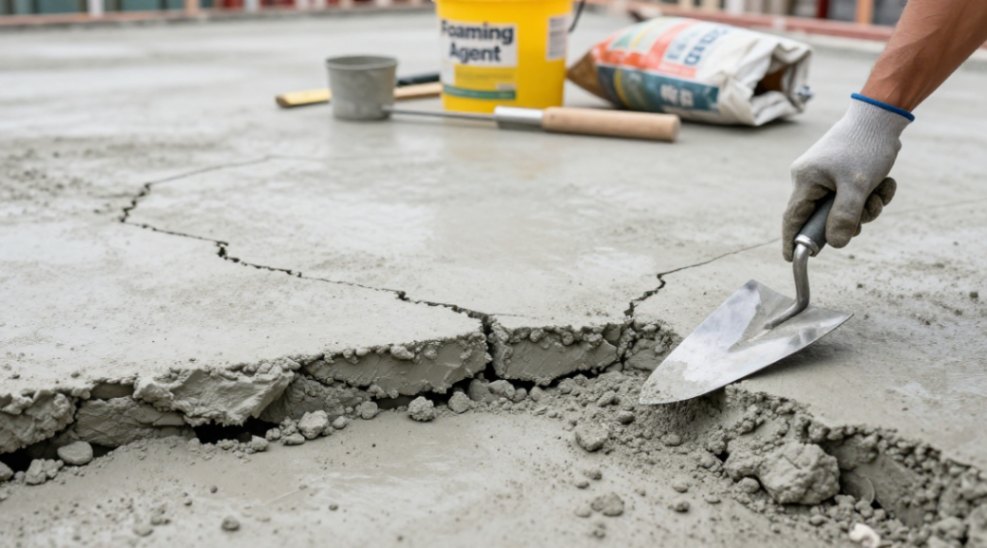
Ever watch your lightweight concrete mix collapse right on the slab? It is a sinking feeling. The foam vanishes. The density skyrockets. You’re suddenly looking at a heavy, cracked mess. We have all been there. That perfectly planned pour turned into a demolition job. Let’s stop that from happening again.
Here is the raw truth. A concrete foaming agent is not magic powder. It is precise chemistry. One wrong move and you’re fighting the material for the entire shift. We are going to walk through the critical mistakes we have seen on sites and in labs for over 20 years. Forget the fluff. This is the real warning list.
1. Using the Wrong Concrete Foaming Agent for Your Cement Type
We see this at least once a month. Someone grabs a synthetic agent because it is cheap. Then their mix bleeds water like a sieve. Why? Synthetic and protein-based agents behave very differently.
Synthetic agents (like sodium alpha-olefin sulfonate) are stable but sensitive to high alkali cements. Protein-based agents (hydrolyzed keratin) produce tougher bubbles but can smell during mixing. Here is where we see the train wreck: using a synthetic agent with special cement like high-alumina blends. The bubbles pop instantly.
Reddit users on r/Concrete have documented this nightmare. One user posted: “Switched to protein-based agent with Type III cement. Foam lasted 40 minutes. Problem solved.” Match your chemistry.
2. Ignoring Foam Stability and Bubble Size
We do not just make foam. We make stable foam. Get a foam generator or you are gambling. A proper generator delivers consistent bubble sizes. Bubbles around 0.5–1.0 mm are the sweet spot for light weight concrete. Larger bubbles collapse. Smaller bubbles are too stiff to pump.
Here is the common mistake: using a simple nozzle and hoping for the best. Do not do that. Invest in a calibrated foaming equipment setup. We always check foam density before mixing. Target 50–80 g/L for structural foamed concrete. Visual check: the foam should hold a peak for 60 seconds without draining.
One contractor told us: “Saved 12% on material cost by controlling bubble size.” True. But get it wrong, and you lose the job.
3. Guessing the Optimal Dosage of Concrete Water Reducer
This is the biggest hidden trap. You mix the foaming agent into water. Then you add superplasticizer or concrete water reducer. But the dosage is critical. Too much water reducer over-stabilizes the foam, turning it into a rigid gel that won’t blend. Too little, and the foam breaks down during mixing.
We have a simple rule: specify the units. For every 100 kg of cement, start with 1.5–2.5 liters of foaming agent solution (diluted at 1:40 to 1:60 depending on manufacturer). Then adjust. Use a table to track this:
| Component | Typical Range | What We Watch For |
|---|---|---|
| Concrete Foaming Agent (concentrate) | 0.5% – 1.5% by weight of cement | Exact dilution ratio from supplier |
| Superplasticizer | 0.2% – 0.8% by weight of cement | Fluidity without bleeding |
| Water-to-Cement Ratio | 0.40 – 0.55 | Lower w/c for higher strength |
| Stabilizing Additives (Hydroxypropyl Methyl Cellulose or Hydroxyethyl Cellulose) | 0.05% – 0.2% | Improves bubble wall thickness |
Do not skip the trial batch. Every bag of cement is different.
4. Mixing Method: Pre-Foaming vs. Mixed Foaming
We argue about this in the truck all the time. The two methods are not interchangeable. Pre-foaming is generating stable foam first, then blending it into the cement paste or mortar. This gives better control over bubble size and foam quality. Mixed foaming adds the foaming agent directly into the mixer with all ingredients. It is simpler but riskier.
Our recommendation from years of field failures: Pre-foaming delivers consistent density. Mixed foaming often causes collapsed foam because the aggregate crushes the bubbles. If you must use mixed foaming, use a turbomixer or a paddle mixer at low speed (under 60 rpm).
A user on a construction forum wrote: “Mixed foaming with limestone aggregate ruined 8 cubic meters. Never again.” Listen to the community. Pre-foam is safer.
5. Forgetting the Role of Early Strength Agent and Fiber
You made perfectly stable foam. The light weight concrete looks great. Then it cracks during stripping. This is where early strength agent and fiber come in. Lightweight concrete gains strength slower. We must compensate.
Add 0.2% – 0.5% early strength agent (by weight of cement) to accelerate setting. This prevents collapse from form pressure. Also, use fiber (polypropylene or glass fiber at 0.1% – 0.3% by volume) to control plastic shrinkage cracks. Fiber holds the foam structure together during the first hours.
One structural engineer told us: “My project passed load tests because of fiber in the foam mix.” Do not skip it.
6. Ignoring Compatibility with Sodium Silicate or Potassium Silicate
Many of us add sodium silicate or potassium silicate to densify the microstructure or improve fire resistance. But these silicates can react with certain foaming agents. The result? Foam collapse or extreme stiffening.
Test it. Mix a small batch of foamed concrete with the silicate additive and your chosen foaming agent. Wait 10 minutes. If the foam bubbles burst or the mix turns into a crumbly paste, switch your silicate type. Potassium silicate is usually more compatible with protein agents. Sodium silicate works better with synthetics. Know your chemistry.
7. Neglecting Application Method and Equipment Calibration
Your foam generator needs daily calibration. We have seen generators produce foam density that drifts by 30% over a shift due to clogged spray nozzles. Stop the work. Clean the equipment. Use a calibrated flow meter.
Safety note: Concrete foaming agent concentrates are alkaline. Wear gloves and goggles. Store above 5°C to avoid crystallization. One team in winter left the drum outside. The agent thickened like jelly. They poured it anyway. Total failure.
Storage: Keep in sealed containers away from direct sunlight. Shelf life is typically 12 months, but protein agents degrade faster. Check for separation or sour smell.
8. Thinking Light weight Concrete is Always Cheaper
We love the cost savings on dead load and transport. Yes, using a concrete foaming agent can lower density from 2400 kg/m³ to 600–1600 kg/m³. That reduces structural steel requirements. But it is not automatically cheaper. The foaming agent itself, plus concrete defoamer for cleanup, plus extra mixing time, all add cost.
One contractor reported: “We saved 15% on foundation costs but spent 8% more on additives and labor.” Net positive, but only if you plan for it. Do not sell the price benefit before you test the mix.
We have covered the big traps. Now what? Test your mix. Use a nano-modifier if needed to refine bubble distribution. Check your redispersible polymer powder for bonding strength. And if you need reliable supply, look into TRUNNANO for consistent raw materials.
We learned these lessons the hard way. You do not have to.
We are the global leader in lightweight concrete and advanced engineered foam solutions. Known globally for its commitment to research, innovation, and applied expertise, we have been providing engineered foam solutions since the early 2012’s.
We can supply high-quality concrete admixture and foam concrete related products all over the world.
The company has a professional technical department and quality supervision department, a well-equipped laboratory, and equipped with advanced testing equipment and after-sales customer service center.
If you are interested, please feel free and contact us.