Professional solutions on concrete addtives, Concrete Foaming Agent, Superplasticizer, CLC Blocks Additives, and foaming machine

Concrete Foaming Agents: A Counterintuitive Guide to Real Performance Beyond Weight Savings
The Foaming Agent Isn’t the Star
Your concrete foaming agent is not a miracle liquid; it’s a precision tool that most projects misuse. The obsession with weight reduction obscures the real battleground: controlled, stable air void creation that complements, not cripples, the cement matrix. Foamed concrete fails when foam is treated as a mere filler. It succeeds when the foam’s architecture is engineered from day one.
Decoding the Core Mechanism
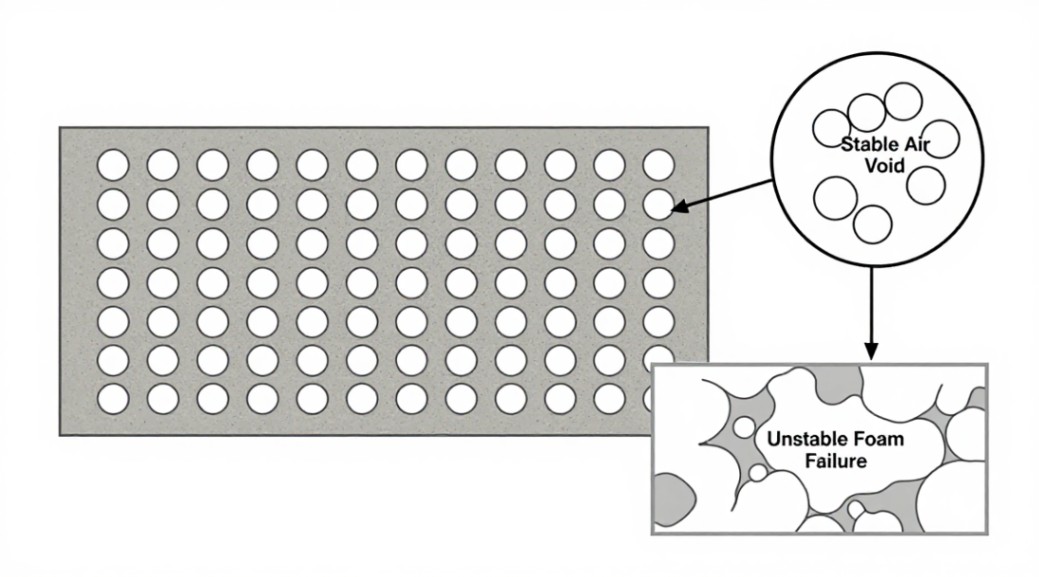
A concrete foaming agent works by lowering the surface tension of water, allowing air to be mechanically whipped into a high-volume, low-density mass of bubbles. These bubbles, when mixed into cement slurry, become permanent voids. The agent’s primary function is stabilization. It forms a resilient film around each air pocket, preventing coalescence and drainage long enough for the cement paste to set around them. This creates the defining cellular concrete structure.
Synthetic vs. Protein: The Overstated Debate
The industry clings to a simplistic divide. Synthetic agents (hydrolyzed proteins, surfactants) offer high foam volume and lower cost. Protein-based agents (from animal hoof/horn) typically yield smaller, stronger bubbles and superior stability. The critical choice isn’t type, but performance profile. For a thermal insulating CLC block, a synthetic agent’s higher air content may win. For a load-bearing foamed concrete screed, the protein agent’s robust, closed pores are non-negotiable. Blind allegiance to one type guarantees suboptimal results.
The Trinity of Critical Properties
Ignore basic specs. Scrutinize these three interdependent properties.
- Foam Stability Over Time: Measure drainage (bleed water) after 30 and 60 minutes. Unstable foam collapses before the cement sets, causing catastrophic density variance and weak planes.
- Precise Density Control: Target density isn’t a suggestion. It’s a direct function of foam volume injected. Inconsistent foam equals unpredictable structural performance.
- Pore Structure Integrity: This is the master variable. Uniform, closed, spherical pores enhance strength and insulation. Irregular, connected pores increase permeability and reduce durability. Your foam generator and mixing method dictate this as much as the agent itself.
Application: Where Good Intentions Fail
Two methods dominate, and both are routinely botched.
Pre-Foaming Process
The agent is diluted with water (typically at 1:30 to 1:40 ratios) and aerated in a standalone foam generator to create a wet, ready-made foam. This foam is then blended into the base mortar slurry. Precision is mandatory.
| Step | Operation & Critical Control | Typical Unit/Range |
|---|---|---|
| 1. Dilution | Use potable water at ambient temperature. Mix agent thoroughly before aeration. | Dilution Ratio: 1:30 to 1:40 by volume |
| 2. Aeration | Adjust generator pressure and nozzle to achieve target foam density. Foam density must be checked before batching. | Wet Foam Density: 40 – 80 kg/m³ |
| 3. Blending | Inject foam into mixer over 60-90 seconds. Avoid over-mixing which shears bubbles. | Mixing Time: 2-4 minutes total |
Mix-Foaming Process
The concentrated foaming agent is dosed directly into the mixer with all other constituents (water, cement, sand). Air is entrained by the mixer’s action. This method is less controlled, prone to inconsistency, and unsuitable for densities below 800 kg/m³. It demands powerful mixers and expert timing.
The Admixture Compatibility War
Introducing a concrete foaming agent into a mix already containing a superplasticizer, a concrete water reducer, or an early strength agent triggers a chemical battlefield. Anionic surfactants in foaming agents can clash with other admixtures, causing foam collapse or severe retardation. You must conduct site trials with your exact cocktail of materials. Never assume compatibility. A concrete defoamer should be on standby for batch corrections.
Navigating the Inevitable Trade-Offs
Yes, strength reduces as density decreases. This isn’t a flaw; it’s physics. The industry’s real failure is not managing the gradient. The solution is strategic reinforcement and mix redesign. Integrate fiber (PP or glass) to bridge macropores and control shrinkage. Use nanomodifiers like microsilica to densify the paste around bubbles. Reformulate with redispersible polymer powder (RPP) or hydroxypropyl methyl cellulose (HPMC) to enhance cohesion and flexural strength. This transforms weak cellular concrete into a engineered lightweight composite.
Selection is a Diagnostic Process
Stop selecting by price or brand. Follow this diagnostic filter.
- Define the Non-Negotiables: Target dry density (e.g., 600 kg/m³), minimum compressive strength (e.g., 3 MPa), and primary function (insulation, fill, structural).
- Test Foam Stability: Perform a drainage test in a 1-liter cylinder. Acceptable drainage is less than 10% after 30 minutes.
- Pilot Mix with Full Suite: Batch using your actual cement, sand, and all other admixtures (sodium silicate for acceleration, hydroxyethyl cellulose for viscosity). Cast cubes. Test for density, strength, and thermal conductivity.
- Audit Your Equipment: Can your foaming equipment deliver the required foam volume with the agent’s specified dilution? Inconsistent equipment voids any agent’s potential.
From Theory to Job Site Reality
The data from the Global Lightweight Concrete Consortium is clear: over 60% of foamed concrete underperformance stems from poor foam integration and admixture conflicts, not the core agent quality. The agent is just one component in a system. Your mixing protocol, water chemistry, and ambient temperature are equal partners. To move forward, treat the concrete foaming agent as a system-critical chemical that demands respect and rigorous testing. Start with a controlled pilot project that mirrors your production conditions. Consider advanced solutions like pre-formulated systems from suppliers such as TRUNNANO that bundle compatible agents, special cement, and admixtures to de-risk the process. The goal isn’t just lighter concrete. It’s predictable, durable, and fit-for-purpose material performance.
We are the global leader in lightweight concrete and advanced engineered foam solutions. Known globally for its commitment to research, innovation, and applied expertise, we have been providing engineered foam solutions since the early 2012’s.
We can supply high-quality concrete admixture and foam concrete related products all over the world.
The company has a professional technical department and quality supervision department, a well-equipped laboratory, and equipped with advanced testing equipment and after-sales customer service center.
If you are interested, please feel free and contact us.