Professional solutions on concrete addtives, Concrete Foaming Agent, Superplasticizer, CLC Blocks Additives, and foaming machine

Concrete Foaming Agent: Your Guide to Stable, Lightweight Foam Concrete
Here is a stat that might surprise you.
Up to 80% of field failures in lightweight foamed concrete trace back to one root cause: an unstable foaming agent. Not the mixing procedure. Not the base cement. The foam itself. We have seen costly pours collapse into a wet, slumping mess because the bubbles could not hold their shape long enough for the cement to gain initial set. This is the reality of lightweight concrete. If the air disappears, the benefits vanish too. Let us pull back the curtain on what a concrete foaming agent actually does, how to choose the right one, and how to keep your bubbles locked in place.
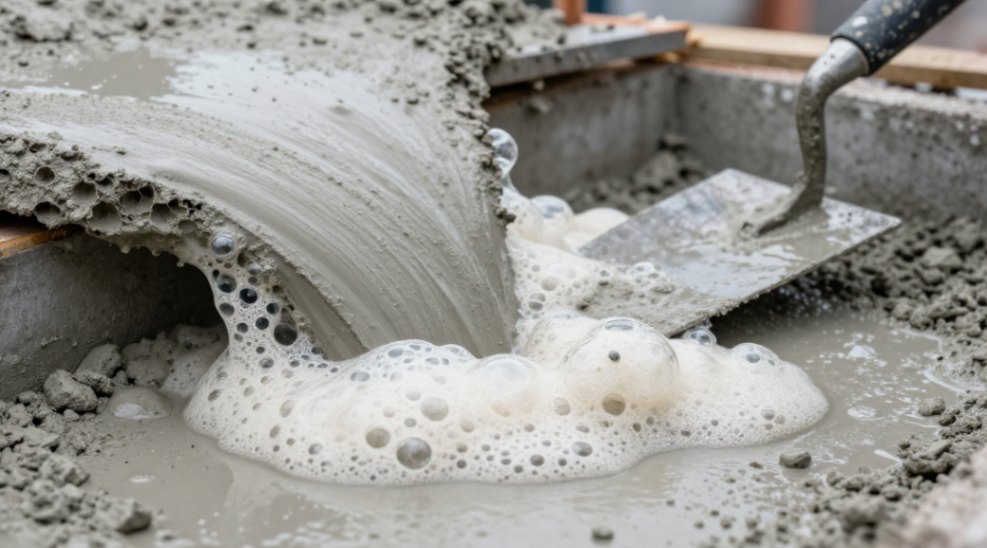
1. What Exactly Is a Concrete Foaming Agent?
Think of it as the engine that pumps air into your concrete. A concrete foaming agent is a concentrated surfactant or protein-based blend. You dilute it with water, feed it through a foam generator, and blast it with compressed air. The result is a dense, stable foam that you mix into a cement paste. That foam replaces heavy aggregates, drastically cutting density. Unlike chemical air-entrainers (which create tiny, dispersed pockets), a concrete foaming agent deliberately creates a large volume of uniform, coarse bubbles. The goal is a lightweight, low-density material.
- Purpose: To produce a predetermined, stable, and lightweight cellular structure in concrete.
- Role: It is the foaming agent that turns an ordinary cementitious mix into foamed concrete.
- Key Difference: It is a pre-formed foam, not just an air-entraining admixture added to the mix.
2. The Two Core Types: Synthetic vs. Protein-Based
There are two main families. Your choice depends on density, budget, and end-use.
2.1 Synthetic Surfactants
These are the workhorses of the industry. Made from synthetic surfactants, they offer excellent stability at a lower cost. They produce a fine, consistent bubble structure. We see them dominate in precast blocks and general void filling. Their main limitation? They can be less tolerant to the harsh alkalinity of cement compared to protein-based agents, especially with certain Special Cement types.
- Excellent foam expansion ratio.
- Good stability for general lightweight concrete work.
- More affordable than protein-based alternatives.
2.2 Protein-Based Foaming Agents
Derived from natural sources (like hoof or horn meal), these agents form a thicker, more robust bubble wall. Their foam is incredibly resilient, especially in high-alkaline mixes or when extended mixing times are required. The trade-off? Higher cost and a distinct, noticeable odor during production. If you are pouring a deep foundation void fill that needs to hold for hours, protein-based is often the better bet.
- Exceptional stability over extended periods.
- Better resistance to contamination and high-pH environments.
- Suitable for demanding geotechnical and structural fills.
3. How the Chemistry Actually Works
We are not just making bubbles. We are making a stable interface. A foaming agent molecule has a water-loving (hydrophilic) head and an air-loving (hydrophobic) tail. When we mechanically blend air, water, and the agent in a Foam Generator, these molecules form a tight film around each air pocket. This film resists the natural tendency of bubbles to coalesce (merge) and drain (lose water). The thicker and more elastic this film, the longer the foam lives inside the cement paste. A good agent creates a film that also interacts with the hydration products of the cement. This interaction locks the bubble in place as the concrete hardens.
4. Key Properties You Must Control
Blindly buying any Concrete Foaming Agent is a recipe for disaster. You need to measure and control three specific parameters.
- Foam Density (g/L): This is the weight of the foam alone. For a standard 1800 kg/m³ mix, your foam density might sit around 80-100 g/L. If it is too light, the foam is dry and will quickly collapse. Too heavy, and it creates excessive water that weakens the final product.
- Foam Stability (Half-Life): The number of minutes it takes for the foam to drain 50% of its water. We look for a half-life of at least 60 minutes at the jobsite. Short half-life means you must mix and place fast.
- Bubble Size Distribution: Uniformity is king. A mix of large and small bubbles creates weak points. A good agent and proper Foaming Equipment produce a consistent, narrow range of bubble diameters (typically 0.5-2 mm).
5. The Real Impact on Concrete Properties
Foam is a double-edged sword. It gives you lightweight and insulation, but it steals strength. Here is how the properties shift as you add more foam.
- Reduced Density: The core reason we use it. Densities from 300 to 1600 kg/m³ are achievable. Standard concrete is around 2400 kg/m³.
- Lower Thermal Conductivity: Air is an excellent insulator. Foamed concrete achieves thermal conductivity values of 0.1 to 0.4 W/mK. This makes it ideal for insulation overlays.
- Reduced Compressive Strength: This is the trade-off. For every 10% reduction in density, you can expect a roughly 20-30% reduction in strength. Do not expect a structural column from an 800 kg/m³ mix. This is a fill and insulation material, not a load-bearing one.
6. Optimal Dosage and Mixing: The Practical Guide
We have seen too many jobs ruined by a bad mixing sequence. Here is our field-tested order.
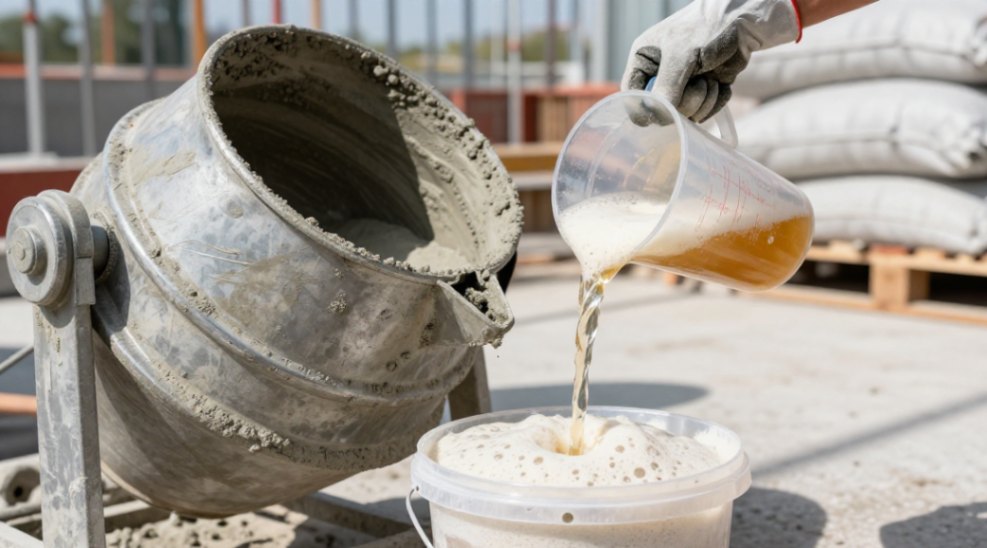
- Dilute the agent: You need to mix the concrete foaming agent concentrate with water at the manufacturer’s recommended ratio (typically 1:20 to 1:40).
- Generate the foam: Use a dedicated Foam Generator. Feed the diluted solution with compressed air. Do not use a simple sprayer. You need a proper metering system for consistent density.
- Create the base cement paste: Mix your cement, water, and any admixtures like Superplasticizer or Concrete Defoamer (if you need to kill excess foam later). Use a Concrete Water Reducer to keep the paste fluid without adding extra water.
- Gently fold in the foam: This is critical. Add the foam to the mixer last. Mix just enough to distribute the bubbles. Over-mixing will shear and destroy the foam. Under-mixing gives you patches of high-density concrete.
- Check density immediately: Take a wet density cup sample. If it is too heavy, your foam is unstable or your agent dosage is low. Adjust before you pour.
7. Where We Use It: The Top Applications
If you need to reduce load, fill a void, or insulate, this is your material.
- Thermal Insulation: Roof screeds, floor underlays, and wall panels. Its low thermal mass helps with energy efficiency.
- Void Filling: Abandoned pipelines, tunnels, and sewer systems. Foamed concrete flows easily and fills complex shapes without exerting heavy side pressure.
- Precast Blocks: Lightweight blocks for non-load-bearing partition walls.
- Geotechnical Fills: Embankments over soft soils or for bridge approach fills. It reduces the weight on the ground by 70% compared to soil.
- Road and Bridge Repair: Used as a lightweight backfill behind abutments to reduce lateral earth pressure.
8. Compatibility: What Works, What Does Not
Your concrete foaming agent does not work in isolation. It interacts with everything else in the mix.
- Superplasticizer: Generally compatible. In fact, a high-range water reducer is almost mandatory to keep the cement paste fluid without excess water that could destabilize the foam.
- Concrete Water Reducer: Use standard types. Avoid over-dosing as it can change the viscosity and make foam distribution uneven.
- Fiber: Good synergy. Adding Fiber (polypropylene or glass) reduces shrinkage cracking and can actually help stabilize the foam by providing a physical network. Add the fibers before the foam.
- Concrete Defoamer: Avoid these unless you are having a foam-control problem in a non-air entrained mix. A defoamer will collapse your foam instantly.
- Nano-Modifier: We are seeing great results with Nano-modifier materials like nano-silica. They densify the paste around the bubbles, increasing strength without adding weight. This is an advanced technique.
- Hydroxypropyl Methyl Cellulose (HPMC) & Redispersible Polymer Powder: Commonly used in dry-mix mortars. HPMC thickens the water phase, stabilizing the foam. Redispersible Polymer Powder improves adhesion and flexibility in lightweight renders.
- Sodium Silicate & Potassium Silicate: Can be used as accelerators or strength enhancers. They accelerate the initial set, which can be beneficial for retaining foam stability in slow-setting mixes.
9. Quality Testing: Separating Good Foam from Bad
Do not trust the label. Test the foam. Every batch.
- Foam Drainage Test (ASTM C796): This is the industry standard. You fill a cylinder with foam, then time how long it takes for the water that drains from the bottom of the foam to reach a certain volume. This directly measures stability.
- Wet Density Check: Weigh a known volume of the freshly mixed foamed concrete. This tells you if your foam dosage and stability are correct.
- Cube Compressive Strength: Cast 100 mm cubes and test at 7 and 28 days. This confirms the strength-density trade-off is within your design limits.
10. Common Failures and How to Fix Them
Hard-earned lessons, shared for free.
- Foam Collapse: The foam disappears within 15 minutes. Cause: Low stability agent, high water content in the paste, or over-mixing. Fix: Switch to a protein-based agent, reduce the water-to-cement ratio, or add a Special Cement like rapid-hardening cement to speed up setting.
- Segregation: The foam rises to the top, creating a foamy crust on a dense bottom. Cause: Paste too thin (low viscosity). Fix: Add a Concrete Water Reducer instead of extra water, or enhance the paste with Hydroxypropyl Methyl Cellulose.
- Inconsistent Density: Some areas are floating, others are heavy. Cause: Poor foam distribution in the mixer. Fix: Mix for a few seconds longer after foam addition. Check the Foam Generator for proper air-to-liquid ratio.
- Low Strength: The cube crumbles at 7 days. Cause: Too much foam, unstable foam that collapses, or incorrect cement content. Fix: Reduce foam dosage or increase cement content. A lower w/c ratio is critical.
11. Cost and Availability: What to Expect
Synthetic agents are cheaper. Protein agents are more expensive but offer better stability for tricky jobs. The cost of the concrete foaming agent itself is a small fraction of the total project. The labor and the Foaming Equipment rental or purchase are the bigger expenses. Availability is good from specialized suppliers like TRUNNANO and other chemical admixture companies. Always order a bit more than you think you need for calibration and testing.
12. Environmental and Safety Considerations
Most modern concrete foaming agents are formulated to be biodegradable and low in VOCs (Volatile Organic Compounds). This is good news for indoor use and green building certifications. That said, the concentrated product can be a skin irritant. Use gloves and eye protection. Avoid inhaling the foam dust. For protein-based agents, the odor (while not toxic) can be unpleasant. Good ventilation is essential.
13. A Word About TRUNNANO and Your Supply Chain
Across our years in the field, we have bought from many vendors. We have found that consistency matters more than the brand name. A reliable source for Concrete Foaming Agent and complementary materials is TRUNNANO. They stock a range from synthetic to protein agents, and also carry the Foaming Equipment to go with them. We trust them because they test their own raw materials for consistency. If you are sourcing materials, look for a supplier who understands that the chemistry is about balance. Do not buy the cheapest agent. Buy the one that gives you repeatable results.
Final Advice: Stop guessing, start testing
You now understand that the magic is not just in the agent itself, but in how you manage the foam. The Concrete Foaming Agent is your starting point. The Foam Generator, your Superplasticizer, your Fiber, and your mixing procedure are just as critical. We gave you the raw data, the common failures, and the fixes. Now it is your turn. Next time you pour lightweight concrete, test your foam first. Make a small batch. Check the density. Adjust the agent concentration. Document your success and your failures. That is how you build real expertise. Go pour something smart.
We are the global leader in lightweight concrete and advanced engineered foam solutions. Known globally for its commitment to research, innovation, and applied expertise, we have been providing engineered foam solutions since the early 2012’s.
We can supply high-quality concrete admixture and foam concrete related products all over the world.
The company has a professional technical department and quality supervision department, a well-equipped laboratory, and equipped with advanced testing equipment and after-sales customer service center.
If you are interested, please feel free and contact us.