Professional solutions on concrete addtives, Concrete Foaming Agent, Superplasticizer, CLC Blocks Additives, and foaming machine

How to Use HPMC in Cement Render: The Expert’s Guide to Water Retention and Workability
A Lesson in Control
Twenty years ago, I watched a crew lose an entire day’s work. They applied a beautiful, smooth cement render to a sun-blasted wall. Within an hour, the surface crazed with hairline cracks. The material had set before it could hydrate properly. We tore it off. The foreman blamed the sand. The apprentice blamed the water. The real culprit was a lack of control. Today, that control has a name: Hydroxypropyl Methylcellulose. Using HPMC in cement render isn’t just adding a powder; it’s engineering the behavior of the material from mix to cure.
HPMC in Render: Core Functions and Decision Points
HPMC is a cellulose ether. In cement render, it performs two non-negotiable functions. First, it provides exceptional water retention. This allows cement particles full hydration time, developing ultimate strength and minimizing plastic shrinkage cracks. Second, it acts as a lubricant and thickener, dramatically improving workability, sag resistance, and adhesion to the substrate. You trade a minor cost increase for major gains in consistency and finished quality.
The HPMC Advantage vs. Traditional Methods
Understanding why you would use HPMC requires a direct comparison. Traditional renders rely on perfect weather and perfect timing. HPMC renders are engineered for consistency.
- Water Retention: Plain cement render loses water fast to suction or evaporation. HPMC forms a colloidal network, locking water in place. This is its primary job.
- Workability: Lime is sometimes used for workability but weakens the mix. HPMC improves cohesion and “butteriness” without compromising the cement’s structural strength.
- Open Time: Standard mixes give you minutes. An HPMC-modified mix can remain workable and trowelable for over an hour, forgiving application delays.
- Adhesion: HPMC’s sticky consistency promotes mechanical keying and reduces the risk of delamination, especially on smoother substrates.
Implementation: A Precise Protocol
Success with HPMC depends on method. Haphazard addition leads to lumps and ineffective performance.
Dosage and Selection
The typical dosage range for HPMC in cement render is 0.1% to 0.5% by weight of cement. For a standard render mix (1:4 cement:sand), this often translates to 0.3 to 1.5 grams per kilogram of total dry mix. Start at 0.2% (approx. 0.8g/kg) for hand application. Increase to 0.3-0.4% for machine application or highly absorbent substrates. Viscosity grades matter. For render, a medium viscosity (around 40,000 to 60,000 mPa.s) offers the best balance of water retention and workability without over-thickening.
The Critical Mixing Procedure
- Pre-dispersion is Mandatory. Never add HPMC powder directly to the mixing water. It will clump into gelatinous lumps that never fully disperse.
- Dry Blend First. Add the measured HPMC powder to your other dry materials-cement, sand, any filler. Mix for at least two minutes until the powder is uniformly distributed. This is the most important step.
- Add Water, Mix Thoroughly. Introduce the mixing water. The HPMC will hydrate gradually throughout the mix. Continue mixing for 3-5 minutes until a smooth, cohesive mortar forms.
- Slake and Re-mix. Let the mixed render stand for 5-10 minutes. This allows the HPMC to fully develop viscosity and water retention. Give it a brief final mix before application. You will notice a significant increase in consistency.
Advanced Application and Compatibility
HPMC does not work in isolation. You must consider its interaction with the entire system.
Adjusting for Conditions and Method
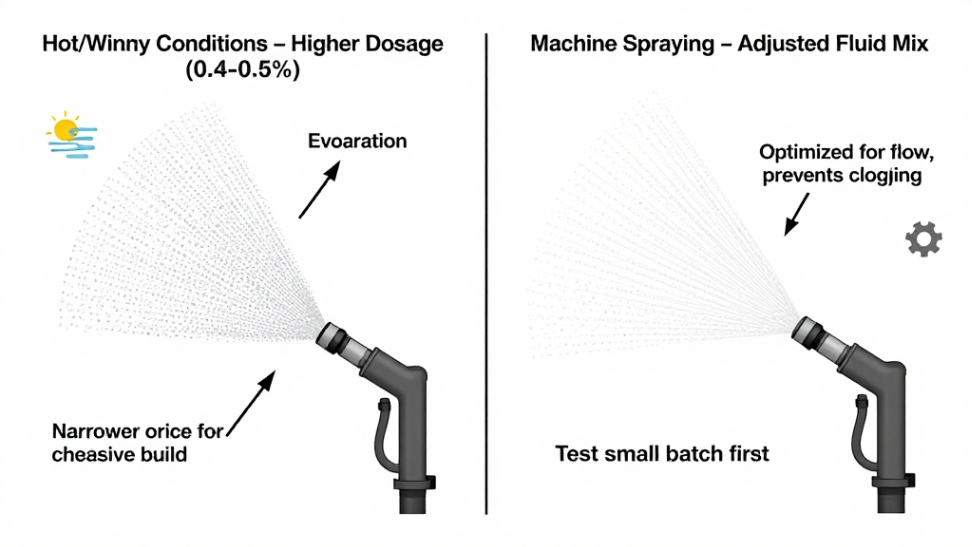
For hot, windy weather, use the higher end of the dosage range. This compensates for rapid evaporation. For machine spraying, you need a more fluid but cohesive mix. A slightly higher dosage (e.g., 0.4%) with a possible adjustment in water content prevents nozzle clogging and ensures good build thickness. Test a small batch first.
Synergy with Other Additives
HPMC is fully compatible with most common render additives. It works synergistically with:
- Redispersible Polymer Powder (RDP): HPMC provides water retention and workability; RDP enhances flexibility, adhesion, and abrasion resistance. They are a powerful duo for premium renders.
- Air-Entraining Agents: HPMC can slightly entrain air, but for dedicated freeze-thaw resistance, specific AEA’s are used alongside it. Monitor density.
- Retarders: HPMC already extends open time. If further retardation is needed, use a dedicated set retarder at a reduced dosage to avoid over-retardation.
Avoiding the Pitfalls
Failure modes are predictable and preventable.
Gel Lumps: Caused by incorrect addition. Always dry blend. Over-retardation & Weakness: Caused by excessive HPMC dosage. Stick to the 0.5% ceiling. Poor Workability: Often due to using a viscosity grade too high for the application. For render, avoid very high viscosity grades (>100,000). Dusting: If the surface dusts after curing, the HPMC dosage may be too low, allowing insufficient cement hydration at the surface.
Curing and Finishing
While HPMC retains internal water, the surface can still dry. After the initial set, maintain a moist cure for 24-48 hours, especially in adverse conditions. This practice, combined with HPMC’s internal water reserve, guarantees maximum strength development. Finishing techniques remain the same, but you will have a longer window for tooling and a more cohesive, less sticky feel under the trowel.
The Final Trowel
Using HPMC in cement render transforms it from a reactive material into a managed one. You control the water, the time, and the adhesion. The process is simple: select the correct grade, measure precisely, dry blend thoroughly, and allow proper slaking. The result is not just a render that avoids catastrophic failure. It is a consistent, crack-resistant, high-performance finish that applies predictably, cures correctly, and lasts. Your next step is to source a medium-viscosity HPMC from a reputable supplier, mix a 5kg test batch using the dry-blend method, and feel the difference in your hawk. The data will be in the trowel.
We are the global leader in lightweight concrete and advanced engineered foam solutions. Known globally for its commitment to research, innovation, and applied expertise, we have been providing engineered foam solutions since the early 2012’s.
We can supply high-quality concrete admixture and foam concrete related products all over the world.
The company has a professional technical department and quality supervision department, a well-equipped laboratory, and equipped with advanced testing equipment and after-sales customer service center.
If you are interested, please feel free and contact us.