Professional solutions on concrete addtives, Concrete Foaming Agent, Superplasticizer, CLC Blocks Additives, and foaming machine

What is Sulfate Resistant Cement? Defining the Key to Durability in Marine Construction
A Prematurely Failing Structure
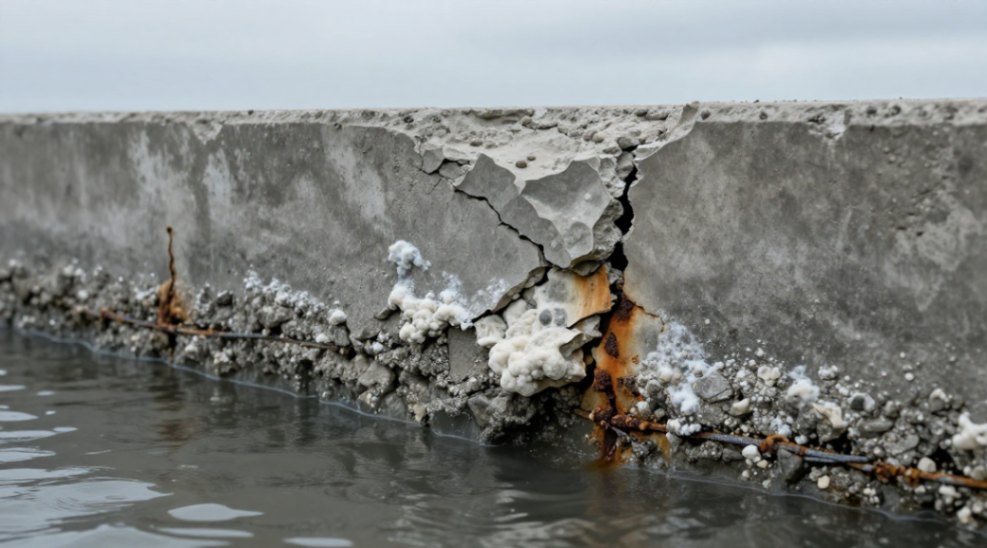
Have you witnessed cracks, spalling, and a soft, crumbling paste on a concrete sea wall or pier, seemingly long before its expected service life? The culprit is rarely the initial design load. More often, it is a silent, chemical war waged by the marine environment itself. Sulfate attack systematically degrades ordinary concrete from within. Understanding the specific defense engineered into sulfate resistant cement is fundamental to stopping this decay.
The Definition and Core Principle of Sulfate Resistant Cement
Sulfate Resistant Cement (SRC) is a specialized hydraulic cement engineered to resist chemical degradation caused by sulfate ions, primarily those abundant in seawater, brackish groundwater, and certain soils. Its resistance is not achieved through magical additives but through precise chemical composition control. The cornerstone of its design is a deliberate restriction of tricalcium aluminate (C3A), a key compound in Portland cement clinker.
The Attack Mechanism and the Defense
Seawater contains high concentrations of sulfate ions (SO₄²⁻). In ordinary cement, these ions react with hydrated C3A and calcium hydroxide in the presence of moisture to form a crystalline compound called ettringite. Ettringite formation creates significant internal expansive pressure. This pressure cracks the concrete, increasing permeability and accelerating the cycle of decay. SRC directly addresses this by minimizing the C3A available for the reaction, fundamentally slowing or preventing the destructive expansion.
The primary specification for SRC is Type V cement per ASTM C150 (or its international equivalents like Type SR in EN 197). A secondary, moderate-sulfate-resistant option is Type II, which has a higher permitted C3A content than Type V.
Comparative Analysis: SRC vs. Ordinary Portland Cement & Other Marine Protection Strategies
Choosing the right material strategy requires a clear comparison. While sulfate resistant cement for marine environments is often the foundation, it is not always a standalone solution.
| Strategy / Material | Primary Function | Key Mechanism | Typical Use Case in Marine | Critical Consideration |
|---|---|---|---|---|
| Sulfate Resistant Cement (Type V) | Resist internal chemical expansion | Low C3A content prevents ettringite formation | Mass concrete below splash zone, foundations, piles in sulfate-rich soils/water | Does not protect against chloride-induced steel corrosion. Requires low water-cement ratio. |
| Ordinary Portland Cement (Type I) | General purpose binding | Standard C3A content for early strength | Not recommended for permanent immersion in seawater | Highly vulnerable to sulfate attack in marine conditions. |
| Protective Coatings / Membranes | Create a physical barrier | Blocks ingress of chloride and sulfate ions | Splash zone, tidal zone, above-water superstructures | Requires maintenance and re-application. A breach compromises the entire system. |
| Supplementary Cementitious Materials (SCMs) like Slag or Fly Ash | Enhance durability & reduce permeability | Pozzolanic reaction consumes calcium hydroxide, refines pore structure | Used in conjunction with SRC in mix design for ultra-low permeability | Not a direct substitute for low-C3A cement. Performance depends on replacement level and exposure. |
| Corrosion-Resistant Reinforcement (e.g., Epoxy-Coated, Stainless Steel) | Prevent steel corrosion | Barrier or electrochemically inert material | Critical elements in splash zone where chloride penetration is highest | Addresses a different failure mode (steel corrosion) than SRC (paste disintegration). |
Specification, Design, and Best Practices for SRC
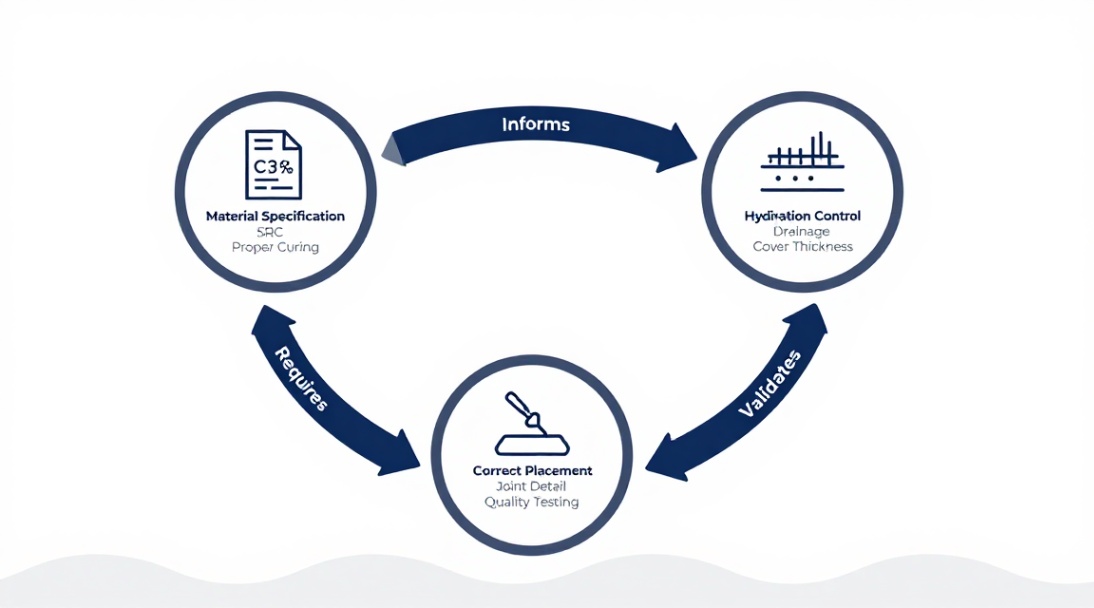
Specifying sulfate resistant cement is only the first step. Its performance is fully realized only through disciplined design and construction practices.
Exposure Classifications and Mix Design
Standards like ASTM C150 and ACI 318 define sulfate exposure classes (e.g., Moderate, Severe, Very Severe) based on water-soluble sulfate concentrations. Seawater typically qualifies as Severe or Very Severe exposure, mandating Type V cement or equivalent. The cement type alone is insufficient. The mix design must achieve low permeability through a low water-cement ratio (typically 0.40 or lower) and often incorporates SCMs. Properly designed, the concrete becomes a dense, impermeable barrier, physically limiting ion ingress to complement the cement’s chemical resistance.
Construction Imperatives and Quality Control
Curing is non-negotiable. SRC concrete, especially with SCMs, requires extended moist curing to develop its protective microstructure. Inadequate curing creates a permeable, vulnerable surface that nullifies the cement’s benefits. Quality control must verify both the cement composition (C3A content) and the hardened concrete’s permeability, often through tests like the rapid chloride permeability test (ASTM C1202).
Clarifying Limitations and the Lifecycle Perspective
A common misconception is that SRC is “waterproof” or fully corrosion-proof. It is not. Its singular purpose is to resist sulfate attack on the cement paste. It does not significantly enhance resistance to chloride penetration, which is the main driver of steel reinforcement corrosion. For comprehensive marine durability, SRC serves as the foundational matrix within a system that may include low permeability, adequate cover, and corrosion-resistant steel.
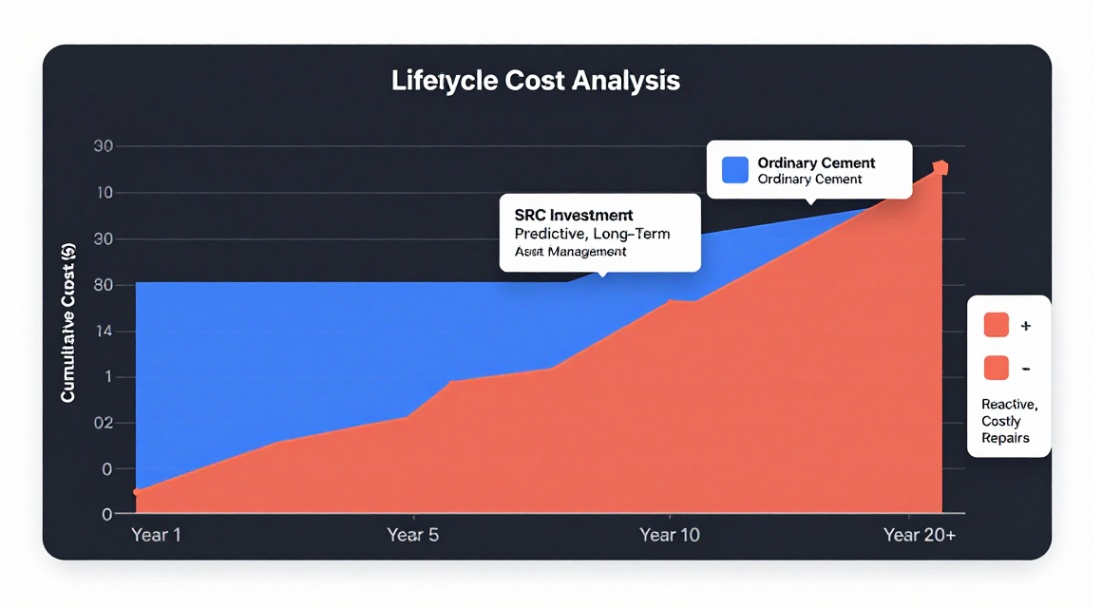
The initial cost of SRC is higher than ordinary cement. This analysis is shortsighted. The lifecycle cost benefit is profound. Preventing premature repair or catastrophic failure of a marine jetty, offshore platform, or sewage outfall represents an overwhelming economic advantage. The investment shifts from reactive, costly repairs to predictive, long-term asset management.
The Professional’s Path Forward
Specifying sulfate resistant cement for marine environments is a decision based on fundamental chemistry and proven material science. Start by rigorously classifying the project’s sulfate exposure per relevant standards. Base your specification on ASTM C150 Type V or its performance-equivalent mix designs. Integrate SRC with a low water-cement ratio, appropriate SCMs, and meticulous curing protocols. Finally, design the entire structural system-considering reinforcement protection and concrete cover-to address all simultaneous threats of the marine environment: sulfate attack, chloride ingress, abrasion, and freeze-thaw cycles. This holistic, material-informed approach is the hallmark of durable marine concrete construction.
We are the global leader in lightweight concrete and advanced engineered foam solutions. Known globally for its commitment to research, innovation, and applied expertise, we have been providing engineered foam solutions since the early 2012’s.
We can supply high-quality concrete admixture and foam concrete related products all over the world.
The company has a professional technical department and quality supervision department, a well-equipped laboratory, and equipped with advanced testing equipment and after-sales customer service center.
If you are interested, please feel free and contact us.