Professional solutions on concrete addtives, Concrete Foaming Agent, Superplasticizer, CLC Blocks Additives, and foaming machine

Superplasticizer for Self-Consolidating Concrete SCC: The Data-Driven Guide to Mix Design & Performance
The Silent Hero in Modern Concrete Construction
I recall a project nearly 20 years ago, a complex architectural element with dense rebar. The team spent hours laboriously vibrating concrete, fighting honeycombs and surface defects. Today, that same element would be poured in minutes with self-consolidating concrete (SCC). The difference isn’t magic. It’s chemistry. More precisely, it’s the strategic use of a superplasticizer for self-consolidating concrete SCC. This single admixture transformed concrete from a stubborn, heavy paste into a fluid, self-leveling material. But its role is often misunderstood. The true story is one of precise rheological engineering.
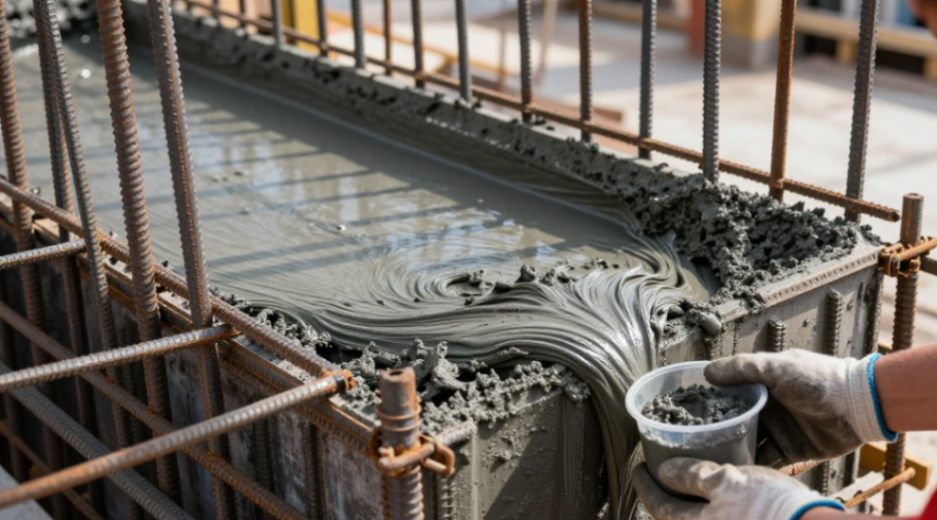
1. Defining the Core Mechanism: Water Reduction and Flow
A superplasticizer for self-consolidating concrete SCC is a high-range water reducer (HRWR). Its primary function is to disperse cement particles. Imagine breaking apart a cluster of magnets. The admixture’s molecules adsorb onto cement grains, creating negative charges that cause mutual repulsion. This frees the water trapped within the flocculated structure.
The benefit is twofold. First, it allows for a dramatic reduction in mixing water-often 25-40%-while maintaining fluidity. This directly increases the paste’s density and strength potential. Second, it provides the extreme workability and flow required for SCC to fill forms without mechanical consolidation. The goal is not just to make it wetter; it’s to make it smarter.
The Rheology Triad: Flow, Stability, and Passing Ability
SCC must satisfy three key rheological properties: filling ability (slump flow), passing ability (to navigate reinforcement), and resistance to segregation. A basic superplasticizer provides flow. A well-designed superplasticizer for self-consolidating concrete SCC manages all three. It achieves this through a sophisticated balance of dispersancy and, often, complementary viscosity-modifying agents (VMAs). The admixture must maintain a cohesive, viscous paste that carries aggregate uniformly without separation of water (bleeding) or materials (segregation).
2. The Evolution and Dominance of PCE Technology
Early SCC mixtures often relied on naphthalene or melamine sulfonate-based superplasticizers. They worked, but with limitations: high dosage sensitivity, rapid slump loss, and challenging compatibility. The industry shift to polycarboxylate ether (PCE)-based superplasticizers was fundamental.
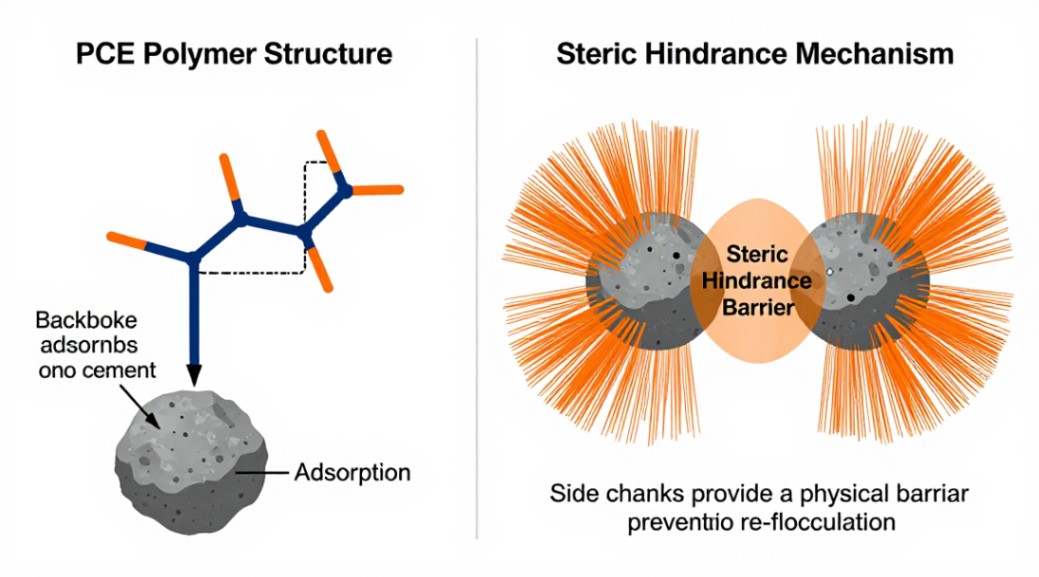
PCEs offer a “comb-like” polymer structure. The backbone adsorbs onto cement. The side chains provide steric hindrance-a physical barrier preventing particles from re-flocculating. This mechanism is more robust and tunable than the electrostatic repulsion of older technologies. Manufacturers can engineer the polymer’s structure for specific performance: extended slump life, faster or slower setting, reduced viscosity. As Dr. Alan Roberts, a leading concrete materials scientist, noted in a 2022 industry review: “The advent of PCE technology didn’t just improve SCC; it made modern, reliable, high-performance SCC commercially viable. It moved us from art to applied science.”
3. A Data-Driven Comparison: Key Superplasticizer Considerations
Selecting the right admixture is a balancing act. The following table consolidates critical performance factors based on typical industry data and mix design reports.
| Performance Parameter | PCE-Based Superplasticizer | Traditional Sulfonate-Based | Key Implication for SCC |
|---|---|---|---|
| Water Reduction Potential | Very High (30-40%) | High (20-25%) | Higher paste quality, increased strength, reduced permeability. |
| Slump Flow Control | Excellent, highly tunable | Good, but less precise | Predictable flow, easier to achieve target spread (e.g., 650-750mm). |
| Slump Life / Retention | Superior, can be engineered for hours | Limited, often rapid loss | Critical for long haul times or large placements without re-dosing. |
| Compatibility with Cements/SCMs | Generally high, but requires testing | Often problematic, especially with SCMs | Reduces risk of flash set, erratic rheology, or rapid slump loss. |
| Impact on Setting Time | Can be tailored (retarding or neutral) | Often has a retarding effect | Allows for scheduling control in hot or cold weather. |
| Viscosity Modification | Often combined or co-formulated with VMAs | Usually requires separate VMA | Simplifies mix design, improves stability against segregation. |
| Dosage Sensitivity | Moderate to High | Very High | Requires careful batching but offers finer performance adjustment. |
4. From Plastic to Hardened State: The Durability Dividend
The influence of a well-dosed superplasticizer for self-consolidating concrete SCC extends far beyond placement. The high water reduction creates a denser cement matrix with fewer capillary pores. This directly translates to enhanced long-term durability. Permeability to chloride ions drops significantly, improving corrosion protection for reinforcement. Resistance to freeze-thaw cycles increases due to a refined pore structure. Sulfate attack is mitigated by the reduced permeability. The admixture, therefore, is not merely a workability agent; it is a cornerstone of durable concrete design.
5. Best Practices: Integration, Not Just Addition
Mistakes happen at the plant, not just in the lab. Success with SCC requires disciplined procedures.

- Batching Sequence: Add the superplasticizer with the mixing water or after a brief initial mixing of solids. This ensures uniform dispersion.
- Mixing Energy & Time: Ensure adequate mixing time to fully develop fluidity. Undermixing leads to false, low slump flow readings.
- Temperature Awareness: Hot weather accelerates reactions and slump loss. You may need a retarding-type PCE. Cold weather can excessively delay set.
- The Golden Rule: Test with Full Materials. Cement source, supplementary cementitious materials (SCMs like fly ash or slag), and even aggregates can affect admixture performance. A trial batch with your project’s materials is non-negotiable.
Conclusion: A Tool for Engineering Certainty
The superplasticizer for self-consolidating concrete SCC is the enabling technology. It turns a theoretical mix design into a predictable, reliable fluid system. The trend is clear: towards more sophisticated, application-specific PCE polymers that offer greater control over rheology and durability. The next step is yours. Move beyond generic specification. Engage with admixture technical teams. Conduct rigorous trial mixes. Use the data from those tests-slump flow, T50 time, J-Ring, visual stability index-to refine your approach. Treat the superplasticizer not as a simple liquid additive, but as the primary rheological modifier it is. Your reward is concrete that performs precisely as engineered, from placement through decades of service.
We are the global leader in lightweight concrete and advanced engineered foam solutions. Known globally for its commitment to research, innovation, and applied expertise, we have been providing engineered foam solutions since the early 2012’s.
We can supply high-quality concrete admixture and foam concrete related products all over the world.
The company has a professional technical department and quality supervision department, a well-equipped laboratory, and equipped with advanced testing equipment and after-sales customer service center.
If you are interested, please feel free and contact us.