Professional solutions on concrete addtives, Concrete Foaming Agent, Superplasticizer, CLC Blocks Additives, and foaming machine

A Practical Guide to Using Sulfate Resistant Cement for Marine Environments
Introduction: The Saltwater Menace
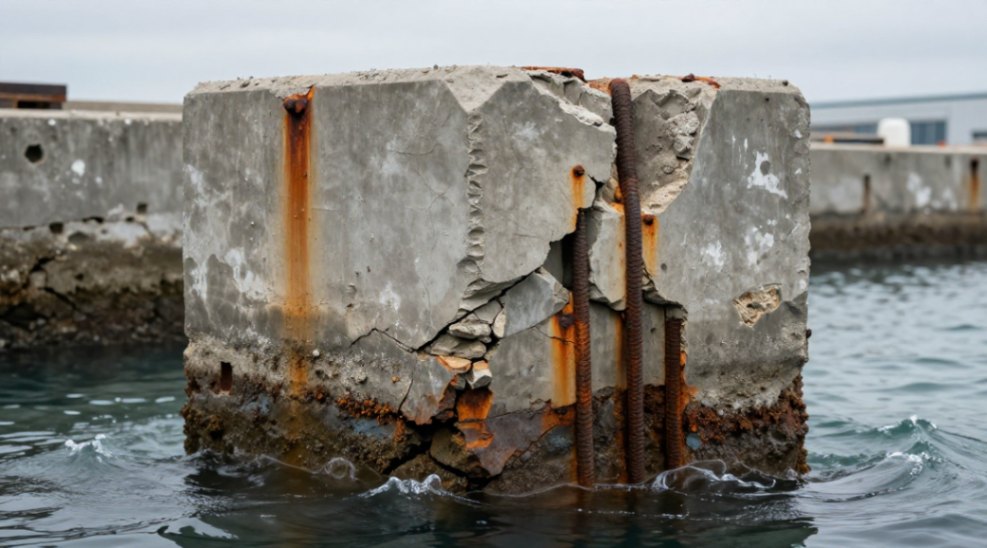
Have you watched concrete pilings crumble after just a decade in seawater? Have you seen maintenance budgets evaporate on endless repair cycles for a harbor wall or seawall? The culprit is often sulfate attack, a chemical degradation process accelerated by marine environments. Many engineers on platforms like Reddit and professional forums report the same frustrating pattern: standard concrete fails prematurely in these aggressive conditions, leading to costly interventions and safety concerns. This guide provides a direct, technical approach to selecting and using the right material for the job: sulfate resistant cement for marine environments.
What is Sulfate-Resistant Cement and Why is it Needed?
Sulfate-resistant cement (SRC) is a specialized hydraulic cement formulated to withstand chemical attack from sulfate ions, prevalent in seawater, brackish water, and some coastal soils. Its primary purpose is to ensure the long-term durability and integrity of concrete structures exposed to these aggressive conditions, from offshore platforms to tidal pools.
The Chemistry of Destruction
Sulfate attack is a two-stage process. First, sulfate ions penetrate the concrete. They then react with hydrated compounds, primarily tricalcium aluminate (C3A) and calcium hydroxide, to form expansive products like ettringite and gypsum. This internal expansion generates tensile stresses that crack the concrete from within, increasing permeability and accelerating a cycle of deterioration.
Core Principle: The Role of Low C3A Content
The defining characteristic of sulfate resistant cement is a strictly limited tricalcium aluminate (C3A) content. While ordinary Portland cement (OPC) may contain 8-12% C3A, SRC like ASTM C150 Type V restricts this to 5% or less. This chemical composition difference is non-negotiable. By minimizing the reactive “fuel” for sulfate reactions, the cement inherently resists the formation of destructive expansive compounds. This is a fundamental, material-level defense.
Identifying Marine Environments That Demand SRC
Not every coastal project requires sulfate resistant cement. You must assess the exposure severity. Use the following criteria:
- Tidal and Splash Zones: The most severe. Cyclical wetting and drying concentrate salts. Piers, seawalls, and bridge abutments here are prime candidates.
- Permanently Submerged Zones: Less severe than tidal zones but still exposed. Foundations, piles, and submarine pipelines benefit from SRC.
- Coastal Soil and Groundwater: Soils with high sulfate content or brackish groundwater can attack buried foundations and basements.
Sulfate Resistant Cement vs. Protective Coatings
A common question is whether a protective coating or waterproofing membrane can substitute for SRC. The answer is clear: they serve complementary but distinct roles. Coatings are a physical barrier subject to abrasion, UV degradation, and installation flaws. Sulfate resistant cement is a bulk material property. Best practice uses SRC as the primary, inherent defense, with high-quality coatings as a secondary protective layer for critical structures. Relying solely on a coating is a high-risk strategy.
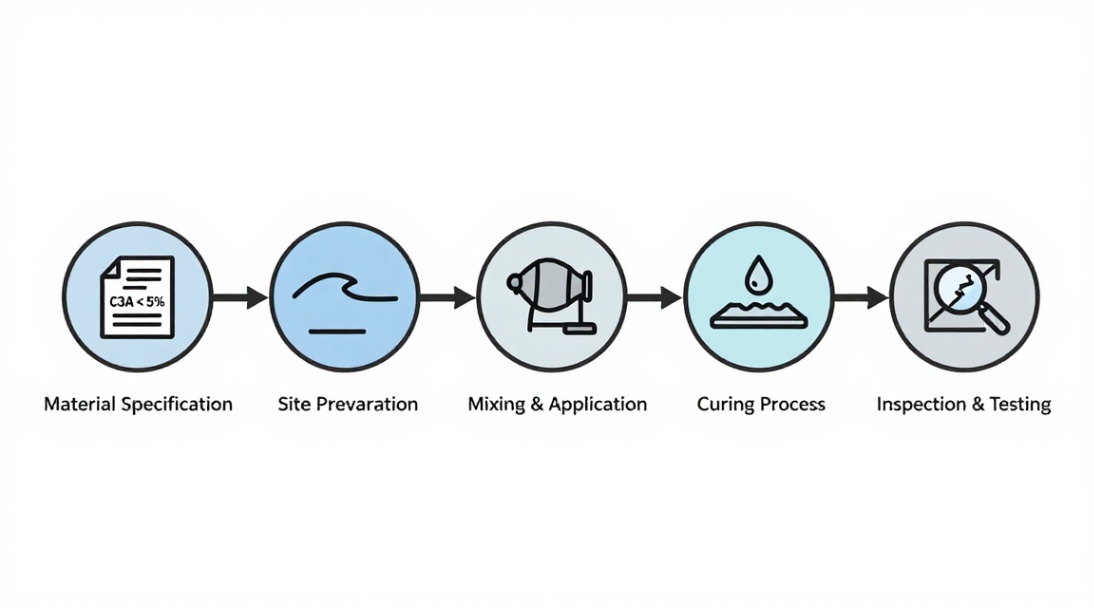
Step-by-Step: Specifying and Using Sulfate Resistant Cement
Material selection is only the first step. Proper implementation is critical for performance.
1. Mix Design and Water-Cement Ratio
The single most important factor you control on-site, besides the cement type, is the water-cement (w/c) ratio. Aim for a low w/c ratio, typically 0.40 or lower. This directly reduces concrete permeability, the main conduit for sulfate ingress. Use water-reducing admixtures to maintain workability without adding water. A dense, impermeable concrete matrix is your secondary defense line.
2. Construction and Curing Best Practices
Poor construction voids the benefits of any special cement. Follow these steps:
- Placement: Ensure proper consolidation to eliminate honeycombing and voids that create permeability shortcuts.
- Curing: Implement immediate and prolonged moist curing (minimum 7 days). This is non-negotiable. Proper curing allows the cement to hydrate fully, developing a dense microstructure and sealing capillary pores.
- Finishing: Avoid premature finishing or adding water to the surface, which creates a weak, permeable layer.
Long-Term Performance and Cost Analysis
SRC typically carries a 10-20% cost premium over standard Type I cement. The cost-benefit analysis, however, must consider the entire lifecycle. The reduced risk of catastrophic failure, extended service life before major repairs, and lower maintenance costs almost always justify the initial investment for true marine exposure. A harbor quay wall built with SRC may have a 50+ year service life with minimal intervention, while one with OPC could require major rehabilitation in 15-20 years.
Standards and Specifications
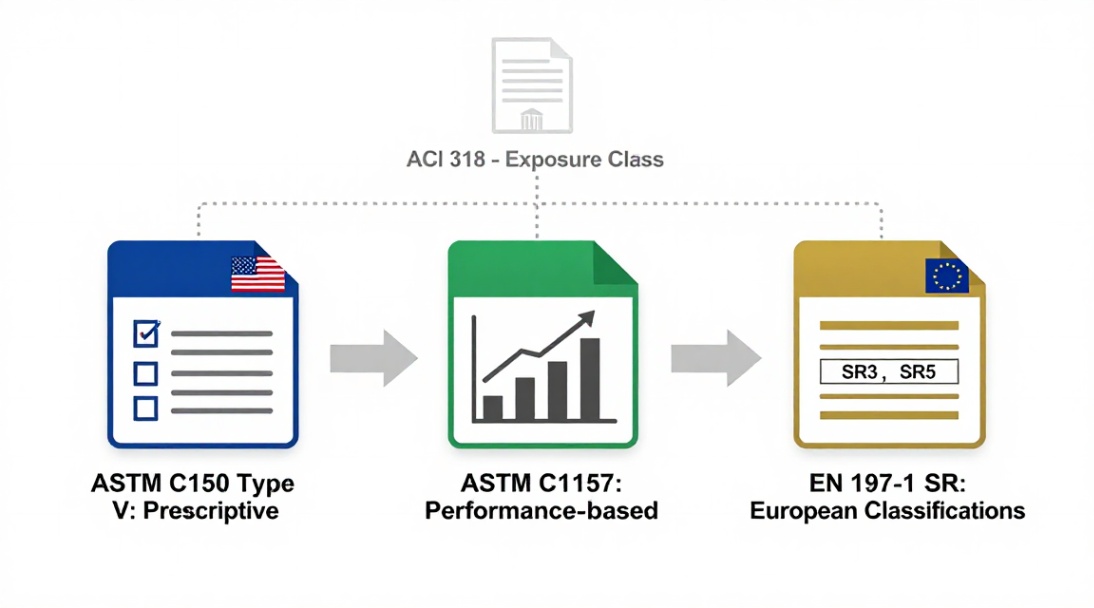
Always specify by standard. ASTM C150 Type V is the most common specification for sulfate resistant cement in North America. Other relevant standards include ASTM C1157 (Performance-based) and EN 197-1 SR classifications in Europe. Your project specifications must explicitly call for the correct type based on the exposure class defined in codes like ACI 318.
Implement Proven Marine Durability
Theoretical knowledge is useless without application. To stop guessing and start building durable marine structures, you need the right material and the right knowledge. For your next marine or coastal project, demand ASTM C150 Type V sulfate resistant cement from your ready-mix supplier. Do not accept vague promises of “marine-grade” mixes without the mill certificate to prove the low C3A content. Then, enforce strict control over the w/c ratio and curing regime on site. Consult with a materials engineer specializing in durability to review your mix designs and construction sequences. The cost of prevention is always lower than the cost of repair. Specify sulfate resistant cement for marine environments correctly, and build to last.
We are the global leader in lightweight concrete and advanced engineered foam solutions. Known globally for its commitment to research, innovation, and applied expertise, we have been providing engineered foam solutions since the early 2012’s.
We can supply high-quality concrete admixture and foam concrete related products all over the world.
The company has a professional technical department and quality supervision department, a well-equipped laboratory, and equipped with advanced testing equipment and after-sales customer service center.
If you are interested, please feel free and contact us.