Professional solutions on concrete addtives, Concrete Foaming Agent, Superplasticizer, CLC Blocks Additives, and foaming machine

Lightweight Concrete for Bridge Decks: The Engineer’s Guide to Weighing the Options
The Bridge Engineer’s Dilemma: A Weighty Decision
I once consulted on a 40-year-old bridge crossing a major river. Corrosion had compromised its deck. The original design couldn’t support the dead load of a conventional concrete overlay for rehabilitation. Adding more steel was cost-prohibitive. We faced a critical choice: a complete, disruptive deck replacement or find a smarter overlay solution. The answer was lightweight concrete for bridge deck overlays. This decision extended the structure’s life by 50 years without requiring massive substructure modifications. It taught me that in bridge rehabilitation, reducing weight isn’t a luxury; it’s often a structural necessity.
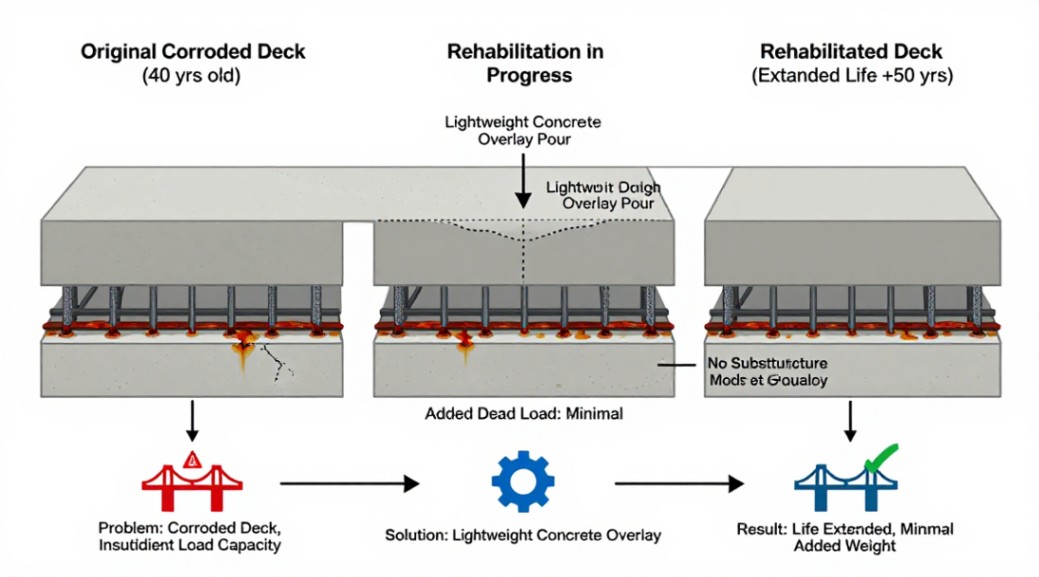
Lightweight Concrete for Bridge Decks: The Core Questions
What is lightweight concrete for a bridge deck overlay? It’s a specialized concrete where traditional stone aggregates (like gravel) are replaced with lightweight aggregates. These aggregates, often expanded shale, clay, or slate, have a porous structure. This yields a concrete with a density typically 25% to 35% lower than conventional concrete, while still achieving the required compressive strength for structural overlays.
What is the primary advantage of using it? The singular most impactful benefit is dead load reduction. Every cubic yard of conventional concrete adds about 4,000 lbs. Lightweight concrete can cut that by 1,000 lbs or more per cubic yard. This directly translates to increased live-load capacity for existing bridges and allows for potential widening without reinforcing the substructure.
Key Properties: Density, Strength, and Durability
Engineers must verify three critical properties. First, density. A typical target is 110 to 120 pounds per cubic foot (pcf) in the fresh state, compared to 145 pcf for conventional concrete. Second, compressive strength. Mix designs must reliably meet or exceed the project specification, often 4,000 to 5,000 psi at 28 days. Third, durability. The concrete must resist chloride ingress, freeze-thaw cycles, and scaling. Proper air entrainment and a low water-cementitious materials ratio are non-negotiable.
The Ultimate Comparison: Lightweight vs. Conventional vs. Latex-Modified
Choosing an overlay system is a trade-off. Here’s an objective breakdown.
Lightweight Concrete Overlay: Pros and Cons
Advantages:
- Major Dead Load Reduction: The core benefit. Enables rehabilitation of load-restricted bridges.
- Enhanced Thermal Insulation: The porous aggregate provides better thermal resistance, reducing thermal stress and potential for de-icing salt use.
- Improved Fire Resistance: Lower thermal conductivity slows heat transfer to the underlying deck and reinforcing steel.
- Full-Depth Structural Section: It replaces the entire wearing surface, addressing both corrosion protection and profile correction.
Disadvantages:
- Higher Initial Material Cost: Lightweight aggregate is more expensive than conventional stone.
- Demanding Placement & Finishing: The mix is stickier and less workable. Crews require specific training to properly place, consolidate, and finish it without segregating the aggregate.
- Stringent Curing Requirements: It loses moisture faster. Immediate, thorough, and prolonged curing is critical to prevent plastic shrinkage cracking.
- Specialized Mix Design: Requires more precise batching and quality control.
Conventional Concrete Overlay
Advantages: Lower material cost, familiar placement procedures for crews, wide availability of materials, proven long-term track record.
Disadvantages: Adds maximum dead load, offers no inherent thermal benefits, higher thermal stress potential, not suitable for load-restricted structures.
Latex-Modified Concrete (LMC) Overlay
Advantages: Excellent bond strength, very low permeability, can be placed in thinner sections (1.5-3 inches), rapid strength gain.
Disadvantages: Very high material cost, complex placement requiring specialized equipment, sensitive to weather during placement, still adds significant dead load compared to lightweight options.
Application and Performance: Getting It Right
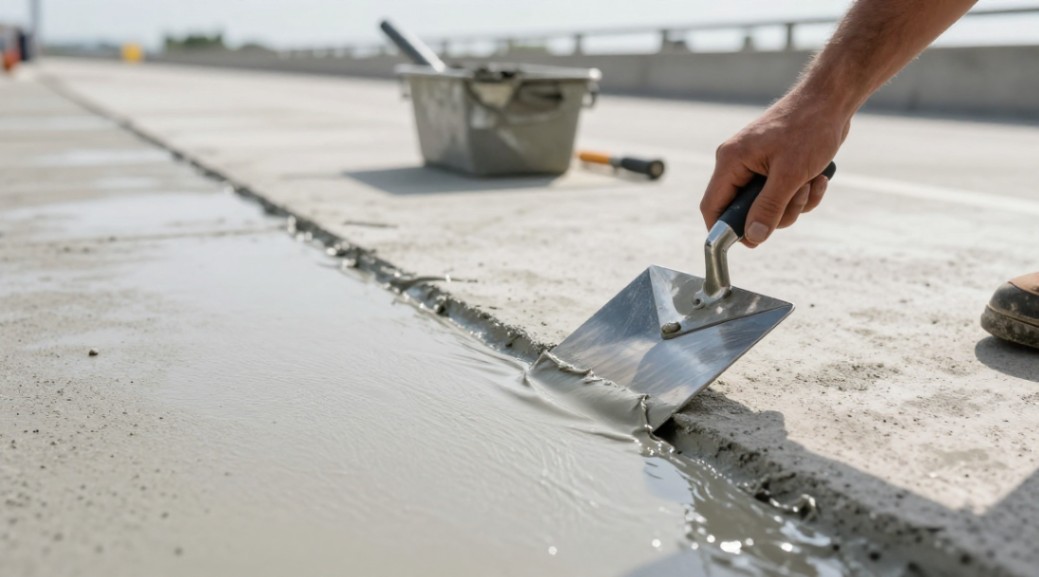
What are the best practices for placing lightweight overlay concrete? Success depends on process control. Use a volumetric mixer or central mix plant with experience in lightweight aggregates. Pumping is often preferred over chuting to minimize segregation. Finishing must begin earlier; the surface will seem ready before it actually is. Use a combination of floating and texturing. Begin curing the instant the surface can bear a curing blanket without marking. Maintain moist curing for a minimum of 7 days.
Is the cost-benefit analysis favorable? Yes, but the payoff is long-term. The initial cost premium for lightweight concrete for bridge deck overlays can be 15-25% over conventional concrete. However, you must factor in the avoided costs of substructure strengthening or total deck replacement. The lifecycle savings from extended service life, reduced maintenance due to better durability, and preserved traffic flow during construction often justify the higher upfront investment.
Making the Final Choice: A Logic-Based Framework
Your decision should follow a simple logic tree.
First, analyze the structure’s load rating. If the existing girders or foundation are at or near capacity, lightweight concrete is the only viable overlay option. Adding conventional concrete is structurally unsafe.
Second, consider the deck’s condition. Is the deterioration deep, requiring a full-depth replacement (2.5 inches or more)? Lightweight concrete excels here. Is it mostly surface-level delamination? A thin LMC overlay might suffice, but weigh the cost.
Third, evaluate project constraints. Is there a tight traffic closure window where rapid strength gain is paramount? LMC may be better. Is the project in a region with extreme temperature cycles? The thermal benefits of lightweight concrete become a significant durability advantage.
The verdict is clear. For bridge decks where dead load is a constraint and long-term, full-depth rehabilitation is the goal, lightweight concrete for bridge deck overlays is the superior technical solution. It solves the fundamental weight problem while providing a durable, high-performance riding surface.
Specify with Confidence: The Next Step
Do not leave the success of your lightweight overlay to chance. Generic specifications lead to field problems. You need a mix design and placement protocol tailored to your specific aggregates, climate, and bridge geometry. This is not a do-it-yourself specification. Based on two decades of field experience, I strongly recommend engaging a specialist engineering firm with a proven portfolio in lightweight bridge decks during the design phase. Their upfront guidance on mix proportionality, testing, and construction sequencing will prevent costly failures and ensure the material performs as intended. Request a consultation with a specialist today to review your next bridge deck rehabilitation project.
We are the global leader in lightweight concrete and advanced engineered foam solutions. Known globally for its commitment to research, innovation, and applied expertise, we have been providing engineered foam solutions since the early 2012’s.
We can supply high-quality concrete admixture and foam concrete related products all over the world.
The company has a professional technical department and quality supervision department, a well-equipped laboratory, and equipped with advanced testing equipment and after-sales customer service center.
If you are interested, please feel free and contact us.