Professional solutions on concrete addtives, Concrete Foaming Agent, Superplasticizer, CLC Blocks Additives, and foaming machine

The Engineer’s Guide: How to Choose & Apply Lightweight Concrete for Bridge Deck Overlays
The Hidden Cost of Dead Weight
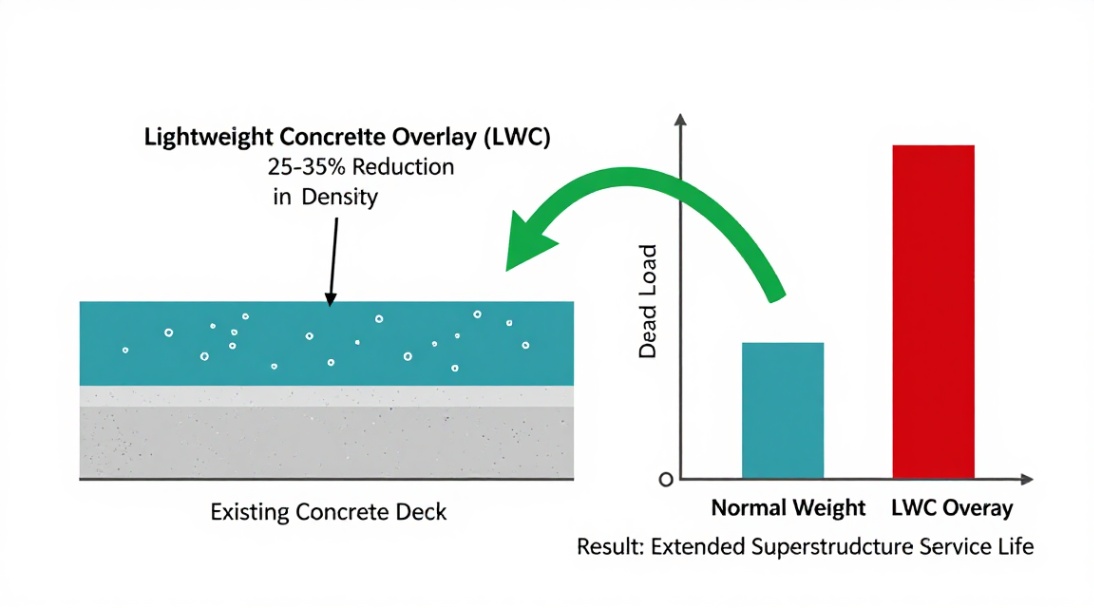
A common misconception is that the primary benefit of lightweight concrete for bridge deck overlays is simply material cost. The real savings are structural. Studies by the Federal Highway Administration (FHWA) show that reducing the dead load of an overlay by 25-35% can extend the service life of the underlying superstructure by decades. This directly postpones multi-million dollar bridge replacement projects. Lightweight concrete isn’t just a deck material; it’s a strategy for long-term asset preservation.
How to Evaluate if a Lightweight Concrete Overlay is Right for Your Bridge
This decision follows a logical, step-by-step process. Do not skip steps.
Step 1: Conduct a Structural Capacity Analysis
The first and most critical step is a detailed review of the existing bridge’s load ratings and structural capacity. Engage a structural engineer to calculate the remaining fatigue life of girders and bearings. The core question: Can the structure support the additional permanent load of a conventional concrete overlay for its intended new service life? If the answer is ‘no’ or ‘it’s borderline’, lightweight concrete becomes the only viable overlay option without costly superstructure strengthening.
Step 2: Specify the Correct Lightweight Aggregate
Not all lightweight aggregates perform the same in an overlay. You must specify a structural-grade, manufactured lightweight aggregate like expanded shale, clay, or slate. These materials provide a closed-pore structure that resists moisture absorption-a key factor for freeze-thaw durability and preventing rebar corrosion. Natural aggregates like pumice are generally unsuitable for this demanding application.
Step 3: Design the Mix for Bonding and Shrinkage Control
This is where field performance is made or broken. A typical lightweight overlay mix design must achieve two conflicting goals: high early strength for traffic reopening and minimal drying shrinkage to prevent delamination. Your mix design should include:
- A low water-cement ratio (typically below 0.40) to ensure durability.
- Supplementary cementitious materials (SCMs) like silica fume or slag cement to enhance density and bond strength.
- A carefully calibrated dosage of a polycarboxylate-based high-range water reducer to achieve a slump of 6-8 inches without segregation.
- A shrinkage-reducing admixture (SRA) to mitigate cracking stresses.
Step 4: Execute a Meticulous Surface Preparation and Placement
Proper execution is non-negotiable. The sequence is rigid.
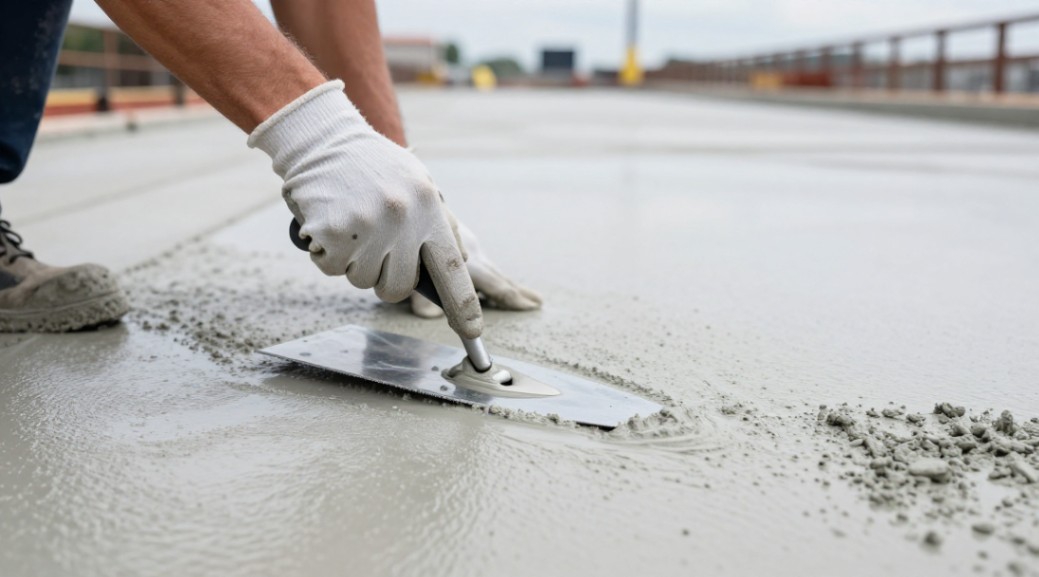
- Surface Preparation: Hydro-demolition or abrasive blasting to remove all unsound concrete and create a uniformly rough surface profile (ICP 3-4). The surface must be saturated surface dry (SSD) at time of placement.
- Bonding Medium: Apply a Portland cement grout slurry or approved epoxy bonding agent immediately before concrete placement. It must not skin over.
- Placement: Place the lightweight concrete using a vibratory screed. Do not over-vibrate, as this causes aggregate segregation. The lower modulus of elasticity requires careful finishing to avoid tearing.
- Curing: Begin curing immediately after finishing. Use wet burlap and polyethylene sheeting or an approved curing compound for a minimum of 7 days. Lightweight concrete loses moisture faster than normal-weight concrete.
Answering Your Top Questions on Lightweight Overlays
Is lightweight concrete for bridge decks less durable?
No. Properly designed and placed, it can be more durable. The reduced density translates to a higher cementitious content per unit volume, which often results in a denser, less permeable paste. Case studies from the Northeast U.S., like the rehab of the Tappan Zee Bridge approaches, show that high-performance lightweight concrete overlays exhibit superior scaling resistance and chloride penetration scores compared to their normal-weight counterparts.
How much weight does it actually save?
A typical normal-weight concrete overlay has a density of 145-150 pcf. A structural lightweight concrete overlay achieves 110-120 pcf. This equates to a 20-25% reduction in dead load. On a 10,000 sq. ft. deck with a 3-inch overlay, that’s a reduction of 450,000 to 560,000 pounds of dead weight the girders must carry.
Do crews need special training to place it?
Yes. The placement and finishing techniques differ. Crews familiar with normal-weight concrete often overwork lightweight concrete, pulling aggregates to the surface. The best results come from contractors with verifiable, recent experience. As one project superintendent noted in a post-project review, ‘It handles differently. You need to trust the mix design and not add water in the field. Once we adjusted our timing, it finished beautifully.’
The Final Verdict: When to Specify It
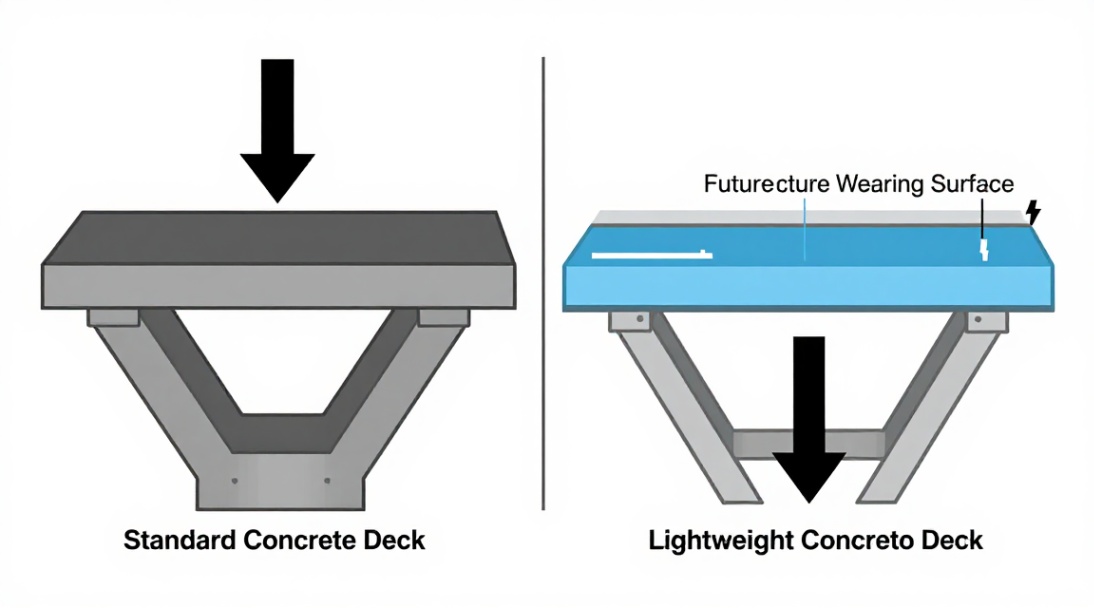
Lightweight concrete for bridge deck overlays is not a universal substitute. It is a precision tool. Specify it when: 1) Structural load capacity is a limiting factor, 2) Adding deck utilities or future wearing surface depth is anticipated, or 3) Seismic retrofitting demands mass reduction. Its higher initial material cost is offset by avoided structural upgrades and extended bridge life.
Do not leave this decision to chance. The lifecycle cost implications are too significant. For your next rehab project, insist on a comparative bid that includes a lightweight concrete overlay option. Demand mix design submittals with trial batch reports and require contractor pre-qualification based on specific, relevant experience. Your agency’s long-term capital plan will thank you.
We are the global leader in lightweight concrete and advanced engineered foam solutions. Known globally for its commitment to research, innovation, and applied expertise, we have been providing engineered foam solutions since the early 2012’s.
We can supply high-quality concrete admixture and foam concrete related products all over the world.
The company has a professional technical department and quality supervision department, a well-equipped laboratory, and equipped with advanced testing equipment and after-sales customer service center.
If you are interested, please feel free and contact us.