Professional solutions on concrete addtives, Concrete Foaming Agent, Superplasticizer, CLC Blocks Additives, and foaming machine

How to Specify and Install Cellular Concrete for Trench Backfill and Void Fill: A Contractor’s Guide
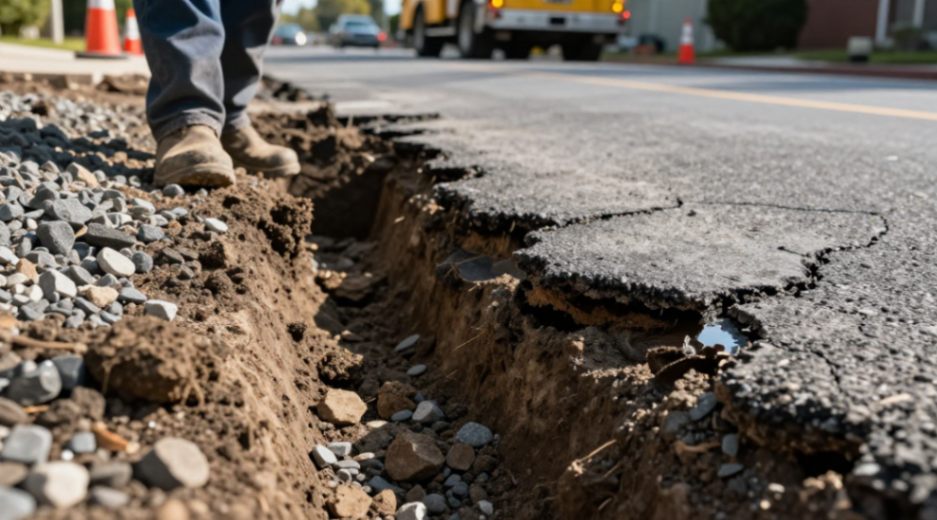
The Problem with Traditional Backfill
A recent study by the National Cooperative Highway Research Program (NCHRP) found that up to 60% of pavement distress at utility cuts can be directly attributed to inadequate compaction of traditional granular backfill. This statistic exposes a fundamental flaw. No matter how skilled the crew, achieving uniform, long-term compaction around complex geometries is nearly impossible. This inconsistency is the root cause of pavement settlement, sinkholes, and costly maintenance callbacks. The construction industry needs a material that eliminates this variable.
What is Cellular Concrete?
Cellular concrete, also known as foam concrete or foamed cement, is a precisely engineered lightweight material. It consists of a slurry of portland cement, water, and a pre-formed stable foam. This controlled introduction of microscopic air bubbles is the key. The foam, generated separately using a synthetic foaming agent, is mechanically blended into the cement slurry. This process creates a closed-cell matrix with a density that engineers can specify, often ranging from 20 to 120 pounds per cubic foot (pcf). For trench backfill and void fill, typical densities fall between 30 and 50 pcf, balancing flowability with sufficient strength.
Core Properties and Direct Advantages
The unique composition of cellular concrete delivers three properties that redefine backfilling and void filling.
Low Density
At one-quarter to one-half the weight of compacted soil, cellular concrete dramatically reduces the dead load on underlying structures and adjacent utilities. This is non-negotiable when backfilling over sensitive pipelines or in areas with poor subgrade conditions.
High Flowability and Self-Leveling
The material acts like a viscous fluid. It flows freely under gravity, filling every void, crevice, and irregular shape without mechanical effort. It completely envelops pipes and conduits, providing uniform, void-free support. This eliminates the need for compaction equipment and the associated labour.
Controlled Strength
Unlike flowable fill (CLSM), which is designed to be excavatable, cellular concrete develops permanent structural strength. Its compressive strength is a direct function of its density. A 40 pcf mix may achieve 100 psi, while a 50 pcf mix reaches 200 psi or more. Engineers select the density-strength profile based on the project’s needs: non-structural fill for abandoned pipes, or higher-strength fill under pavements.
Step-by-Step Application: Trench Backfill
Proper execution is straightforward but requires adherence to process.
- Site and Trench Preparation: Ensure the trench bottom is sound and free of debris. Place and secure all utilities to their final alignment. Install any required warning tapes or marker meshes on top of the primary conduit before pouring.
- Mixing and Pouring: Position the mixing and pumping equipment at the discharge point. Cellular concrete is typically mixed on-site using a continuous process. Begin pumping at the furthest point of the trench and allow the material to flow towards the pump location. A single discharge point can often fill hundreds of linear feet.
- Placement and Curing: Pour continuously to prevent cold joints. The material will self-level. Do not overwork or attempt to spread it. It will begin to set within a few hours, allowing for light traffic typically within 4-6 hours. Full curing follows standard cementitious hydration curves.
Step-by-Step Application: Void Fill and Abandonment
For voids, sinkholes, or abandoning large pipelines, the process is even more direct.
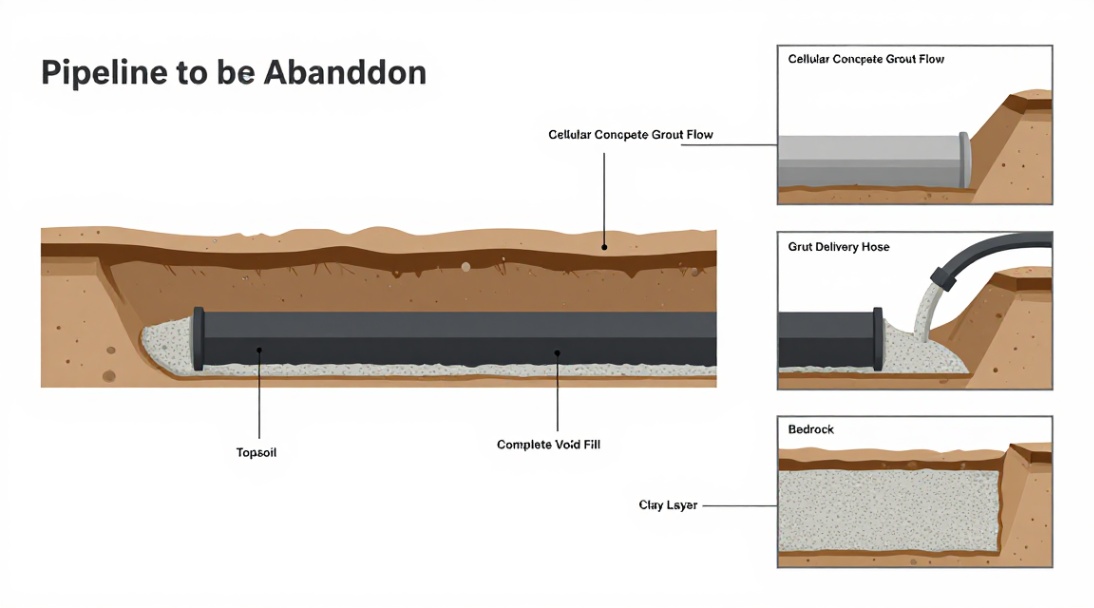
- Access Point Creation: Drill or create injection ports at the highest practical points on the structure or pipeline to be filled. For pipes, this is often at manholes or cleanouts.
- Strategic Pouring: Pump the cellular concrete into the highest port. The material will flow downward and outward, displacing air and water as it fills the cavity from the bottom up. This minimizes trapped air pockets.
- Verification: Continue pumping until the material exits the next sequential port or a designated overflow. This confirms complete filling. Seal the ports after the material has set.
Why It Outperforms: The Data-Driven Case
Comparison with alternatives like compacted granular backfill or flowable fill is stark.
Load Distribution and Lateral Pressure
Cellular concrete’s monolithic nature distributes live loads (like truck traffic) over a wider area, reducing point stress on underlying utilities. Its low fluid pressure during placement, typically less than 50 lbs/sq ft per foot of depth, minimizes lateral pressure on trench walls and existing structures. Granular backfill can exert pressures exceeding 100 lbs/sq ft/ft.
Project Timeline Compression
Projects consistently report a 50-70% reduction in backfilling time. There is no waiting for material delivery in layers, no compaction testing, and no rework. The trench can be backfilled from end to end in one operation, immediately after utility placement. This directly accelerates the critical path to pavement restoration.
Life-Cycle Cost Analysis
While material costs per cubic yard may be higher, the total installed cost is frequently lower. Factor in eliminated equipment (rollers, tampers), reduced labor, zero testing for compaction, and-most significantly-the near elimination of future settlement repair costs. A 2018 infrastructure report calculated a 5:1 return on investment over 10 years when using cellular concrete under pavements due to reduced maintenance.
Sustainability and Material Efficiency
Cellular concrete uses less cement per volume than structural concrete. It can incorporate approved industrial by-products like fly ash. It requires no quarrying of virgin aggregate, preserving natural resources. There is zero material waste from onsite processing or rejection due to failed density tests.
Critical Specification and QC Factors
Success depends on proper specification and oversight.
- Mix Design: Specify by wet density (e.g., 40.0 ± 2.0 pcf) and required compressive strength at 28 days. This is non-negotiable.
- Pre-Pour Testing: Require trial batching to verify density and flow characteristics before production begins.
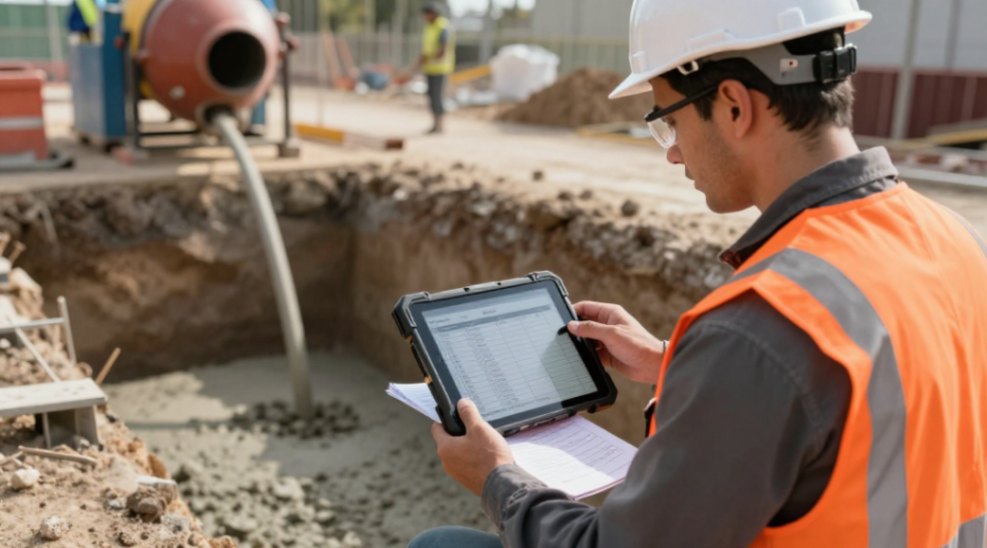
- Production Control: The foam generation system must be calibrated and stable. Continuous monitoring of slurry flow and foam injection rates is standard for reputable operators.
- Field Verification: Perform frequent wet density checks using a pressurized mud balance (weight per gallon cup) during production. One test per 50 cubic yards or per hour is a common frequency.
Making the Objective Decision
Cellular concrete is not a universal substitute for all fill. Use compacted select granular fill for large, simple embankments where heavy equipment access is easy. Choose cellular concrete for complex, confined, or critical applications: utility trenches under high-traffic pavements, void fill beneath slabs, abandonment of large-diameter pipes, or backfill adjacent to historic foundations. The material solves specific, expensive problems with precision. Evaluate your next project based on total installed cost, schedule impact, and long-term performance risk. The data supports its use. Consult with a qualified geotechnical engineer and an experienced cellular concrete producer to develop project-specific specifications. Their expertise will ensure the mix design and placement method deliver the structural and economic benefits this engineered material promises.
We are the global leader in lightweight concrete and advanced engineered foam solutions. Known globally for its commitment to research, innovation, and applied expertise, we have been providing engineered foam solutions since the early 2012’s.
We can supply high-quality concrete admixture and foam concrete related products all over the world.
The company has a professional technical department and quality supervision department, a well-equipped laboratory, and equipped with advanced testing equipment and after-sales customer service center.
If you are interested, please feel free and contact us.