Professional solutions on concrete addtives, Concrete Foaming Agent, Superplasticizer, CLC Blocks Additives, and foaming machine

Trench Backfill Showdown: Why Cellular Concrete Beats Compacted Dirt Every Time
The Core Choice: Engineered Fill vs. Hope-Based Compaction
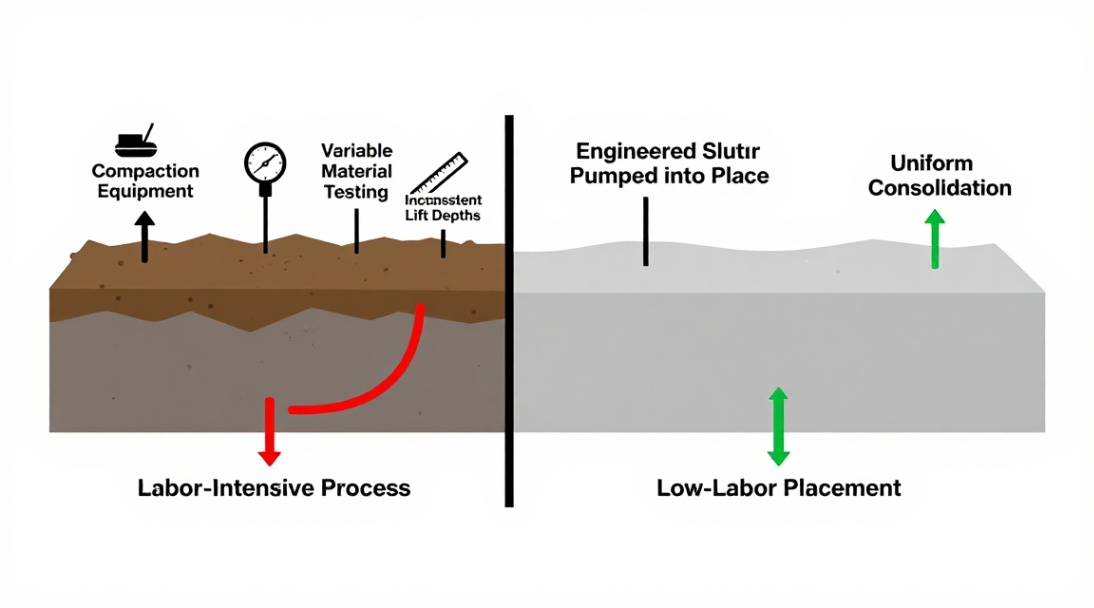
You have two options for backfilling a critical utility trench or stabilizing a void. The first method relies on variable soil quality, layers of compaction machinery, constant testing, and human diligence. The second method is a controlled, engineered material pumped into place with near-zero labor for consolidation. The choice is not a technical dilemma; it’s a stark contrast between an archaic, unreliable process and a modern engineered solution. Cellular concrete for trench backfill and void fill fundamentally redefines what ‘backfill’ means.
Breaking Down the Contenders
Let’s dissect the two approaches based on the core demands of a trench or void: structural stability, speed, cost, and long-term performance.
The Traditional Method: Compacted Select Fill
- What it is: Native or imported soil placed in lifts (typically 6-12 inch layers) and mechanically compacted.
- Process: Excavate, stockpile material, place lift, compact with machinery (e.g., rammer, plate compactor, roller), perform density/moisture test (e.g., nuclear gauge), repeat. This cycle continues until the trench is full.
- Promised Advantages: Low upfront material cost, perceived simplicity.
The Engineered Method: Cellular Concrete
- What it is: A controlled slurry of cement, water, and pre-formed foam, creating a low-density, high-flowability concrete.
- Process: Mix at a plant or on-site batch plant, pump via hose directly into the trench or void in a single, continuous pour. It self-levels and hardens.
- Promised Advantages: Structural fill, monolithic placement, zero compaction, and minimal labor.
The Direct Comparison: Where Cellular Concrete Wins
Speed & Labour
Compacted fill is sequential and labor-intensive. You wait for each lift to be placed, compacted, and tested before proceeding. Cellular concrete is a continuous operation. A crew can pour hundreds of cubic yards in a single day, often completing backfill in hours versus days. The labour force shrinks from a team of equipment operators and technicians to a pump operator and a few hose handlers.
Quality Control & Risk
This is the critical failure point of traditional methods. Compaction quality depends on soil moisture, lift thickness, operator skill, and testing frequency. A missed spot, a rain shower, or a rushed test creates a hidden sinkhole. Cellular concrete quality is determined at the batching plant. The density (typically 20-50 pcf) and strength (20-100 psi range) are engineered into the mix design. What you specify is what you get, everywhere. It eliminates the entire ‘compaction testing’ variable and its associated risk of failure.
Structural Performance
Compacted soil is a granular material that applies lateral earth pressure to pipe walls and structures. Its settlement is inevitable. Cellular concrete behaves as a lightweight, monolithic solid. It provides uniform, predictable lateral support and virtually eliminates settlement. This is not backfill; it is a structural encasement that protects pipes from point loads and bending stress.
Total Project Cost
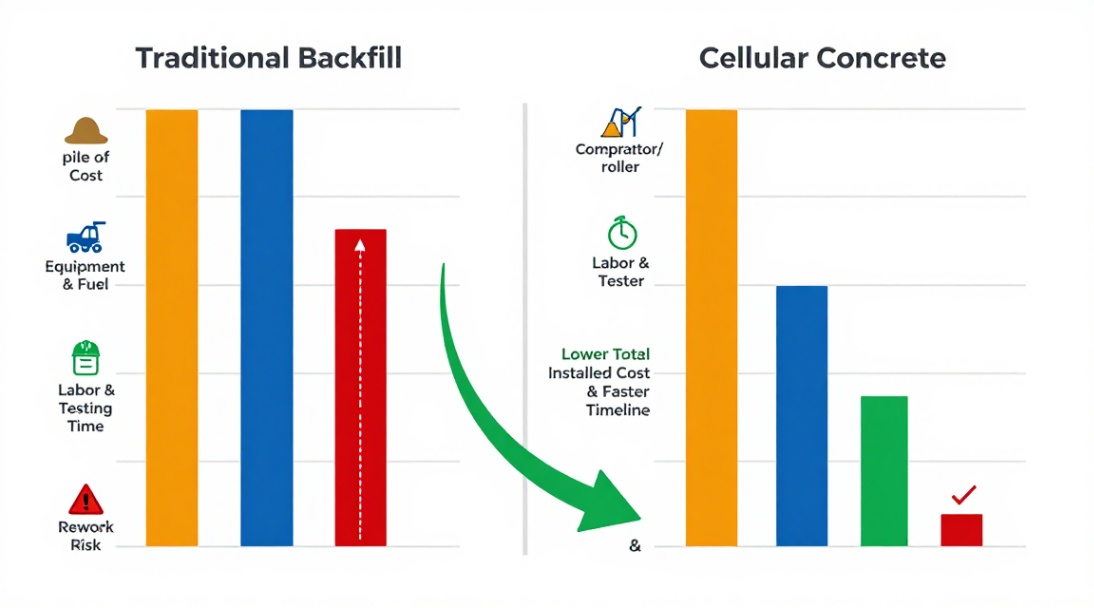
Focusing only on the per-cubic-yard material cost is a fatal error. You must calculate cost-in-place. Factor in equipment rental (compactors, rollers), fuel, testing crew time, potential rework from failed tests, and the extended project timeline. Cellular concrete often has a higher material cost but slashes every other line item. The total installed cost is frequently lower, and the project finishes faster, freeing resources for the next job.
The Ideal Use Cases: Where It’s Not Even a Contest
For certain applications, cellular concrete is the only rational choice. Deep, narrow utility trenches where compaction is physically impossible. Backfilling around sensitive pipelines where mechanical compaction risks damage. Filling abandoned tanks, sewers, or mine shafts (void fill) where safe access for traditional methods doesn’t exist. Stabilizing voids under slab-on-grade foundations where any future settlement is unacceptable. In these scenarios, the ‘comparison’ ends. Cellular concrete is the default solution.
Dispelling the Myths
Some resist because they think ‘lightweight’ means ‘weak.’ The required strength for backfill is minimal-it must support overburden and traffic loads. A 30 pcf cellular concrete mix with 50 psi compressive strength massively exceeds the bearing capacity of any compacted soil. Others worry about permeability. Properly designed cellular concrete is a closed-cell system, making it an excellent flowable fill that resists water migration. The material is proven, with decades of performance data in buried, load-bearing applications.
The Logical Conclusion
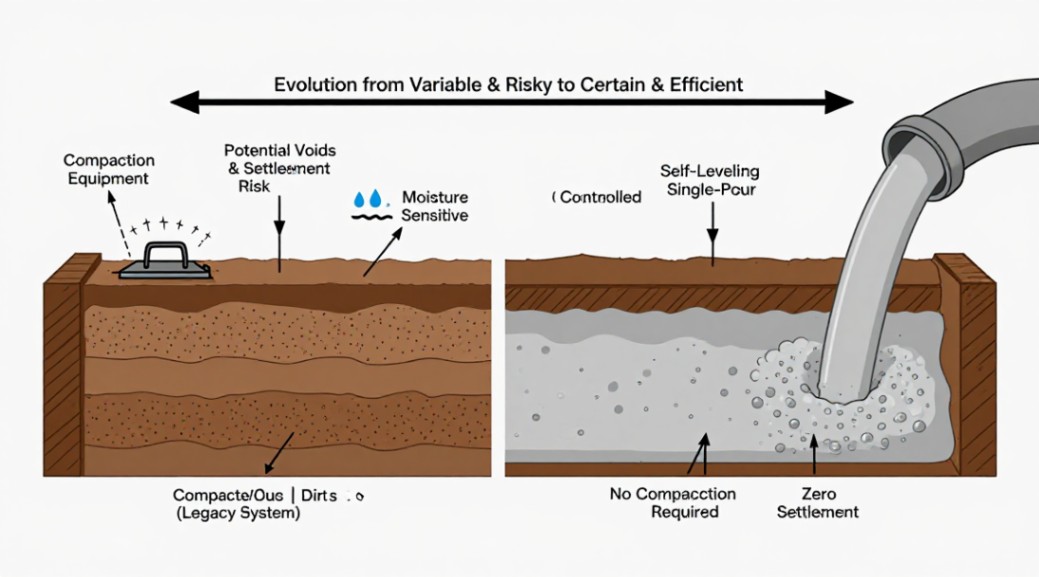
The comparison is clear. Compacted fill is a legacy process plagued by variables and hidden costs. Cellular concrete for trench backfill and void fill is an engineered product defined by certainty and efficiency. This isn’t about a marginal improvement. It’s about replacing a flawed system with a superior one. The decision logic is straightforward: if your project’s success depends on reliable, stable, and rapid fill placement, the traditional method introduces unacceptable risk. Cellular concrete removes that risk. It is the definitive choice for modern, responsible construction.
Stop compromising your project integrity with outdated methods. The engineering logic is irrefutable. To specify, purchase, or get a technical consultation for your next trench or void fill project, contact a professional cellular concrete supplier today. Make the smart choice from the start.
We are the global leader in lightweight concrete and advanced engineered foam solutions. Known globally for its commitment to research, innovation, and applied expertise, we have been providing engineered foam solutions since the early 2012’s.
We can supply high-quality concrete admixture and foam concrete related products all over the world.
The company has a professional technical department and quality supervision department, a well-equipped laboratory, and equipped with advanced testing equipment and after-sales customer service center.
If you are interested, please feel free and contact us.