Professional solutions on concrete addtives, Concrete Foaming Agent, Superplasticizer, CLC Blocks Additives, and foaming machine

Lightweight Concrete Overlays: The Bridge Engineer’s Ultimate Solution for Weight Reduction and Long-Term Durability
The most compelling argument for lightweight concrete in bridge deck overlays isn’t subtlety; it’s physics. This material directly confronts the twin challenges of our aging infrastructure: dead load and deterioration. By swapping dense natural aggregates for expanded shale, clay, or slate, you achieve a 25-35% reduction in concrete density. This isn’t a marginal gain. It translates directly into increased live load capacity for existing structures, eliminates the need for costly substructure reinforcement in new designs, and fundamentally changes the economic equation of a bridge project. The weight saved is dead weight you never have to carry again, for the entire lifespan of the structure.
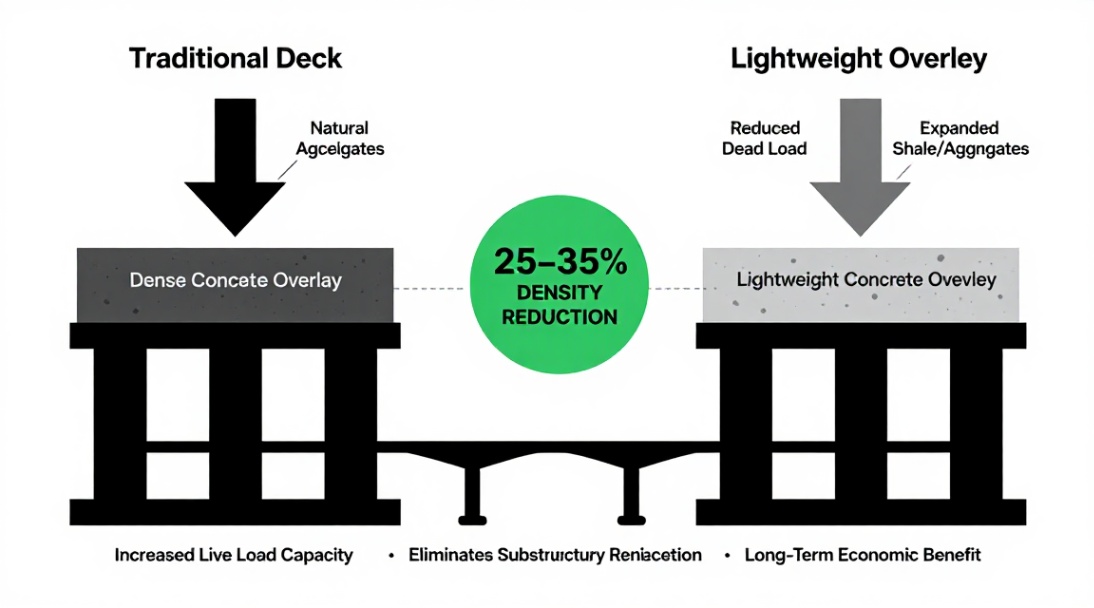
Engineers on forums like Reddit and Structural Engineering boards consistently highlight this primary benefit. Many report that specifying lightweight concrete for overlays was the decisive factor in retrofitting historic bridges, where adding any significant weight would have mandated a full substructure rebuild. The feedback is clear: this isn’t just an alternative material; it’s an enabling technology for complex rehabilitation projects. The conversation has moved beyond ‘if’ to ‘how best to implement.’
The Core Mechanics of a Superior Overlay
Success with lightweight concrete hinges on understanding its unique properties, not treating it as a simple drop-in replacement. The key lies in the aggregate. These kiln-expanded particles are porous, rigid, and significantly lighter than stone. They create a concrete matrix with a higher paste-to-aggregate volume. This demands precise mix design. Water demand is different. Admixture dosages require adjustment. A quality mix delivers compressive strengths meeting or exceeding conventional concrete specifications, typically in the 4,000 to 6,000 psi range for deck applications, but with that crucial reduced density. The focus shifts from pure compressive strength to an optimized balance of strength, durability, and weight. You trade absolute density for a more efficient material.
Durability: The Silent Long-Term Advantage
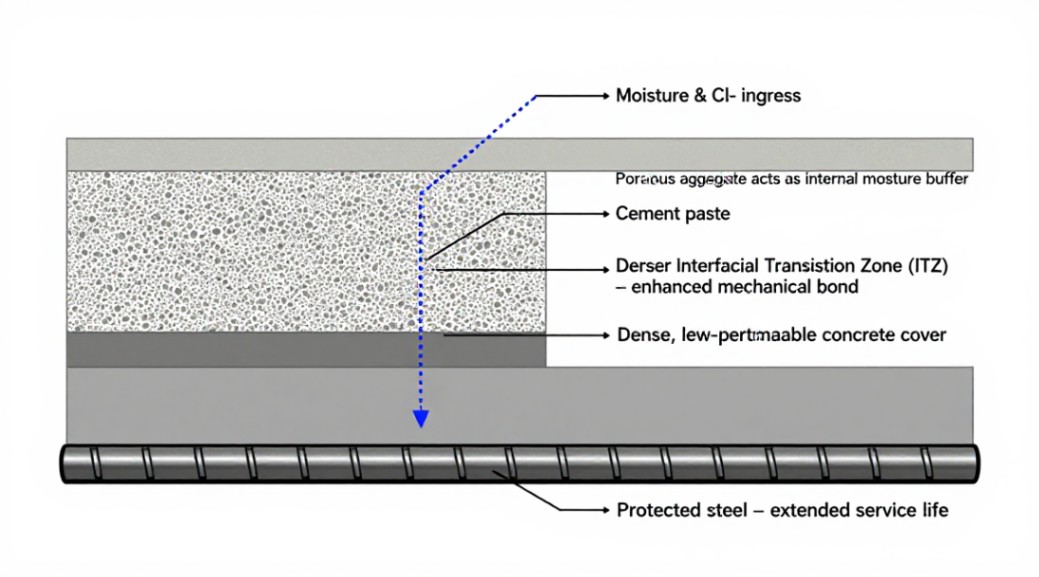
The true value of a lightweight overlay unfolds over decades, not just during construction. Its enhanced durability stems from two intrinsic factors. First, the internal pore structure of lightweight aggregate acts as a moisture buffer, reducing the rate of water and chloride ion ingress-the primary drivers of steel rebar corrosion. Second, these aggregates create a better mechanical bond with the cement paste, minimizing microcracking at the critical interfacial transition zone. This results in a denser, less permeable concrete cover over the reinforcing steel. Think of it as built-in corrosion protection. The result is extended service life, reduced maintenance cycles, and significantly lower lifecycle costs. Data from long-term performance studies consistently shows slower chloride penetration profiles compared to standard concrete overlays.
Navigating Installation and Specification
Placing lightweight concrete requires respect for its character. Its lower modulus of elasticity and different finishing properties are manageable with experienced crews. The mix tends to be stickier and requires adjusted vibration practices to avoid segregation. Curing is non-negotiable and must be meticulous and immediate to prevent plastic shrinkage cracking due to the material’s different moisture release characteristics. From a codes and specifications standpoint, ACI 213R, “Guide for Structural Lightweight-Aggregate Concrete,” and ACI 318 provide the foundational requirements. Bridge-specific guidance is embedded in AASHTO LRFD Bridge Design Specifications, which include provisions for reduced density and associated modulus adjustments. The learning curve is shallow but mandatory. Properly executed, the placement yields a monolithic, high-performance wearing surface.
The Sustainable and Economic Imperative
The narrative around lightweight concrete now includes a powerful sustainability chapter. The production of expanded aggregates often utilizes recycled materials and requires less energy per unit volume than mining and transporting natural gravel. The extended service life and reduced need for future repairs or replacements lower the overall carbon footprint of the bridge. Furthermore, the reduced weight means fewer truckloads are required to deliver the same volume of material to the site, cutting transportation emissions. This aligns with modern green infrastructure initiatives and provides a tangible benefit for projects pursuing sustainability certifications. The economic argument is complete: lower initial structural costs, reduced long-term maintenance, and a positive environmental profile.
The evidence is conclusive. If your project involves bridge deck rehabilitation, widening, or new construction where weight is a premium, lightweight concrete is not merely an option; it is the objectively superior technical solution. It delivers immediate structural benefits and guarantees long-term performance. Stop evaluating and start specifying. To transform your next bridge deck project with a proven, high-performance overlay system, you need a partner with expertise in lightweight concrete mix design and placement. Contact a specialist supplier today. Review your next bridge deck plan with the weight-saving, durability-extending potential of lightweight concrete as the central design criterion. The future of your structure depends on the decisions you make now.
We are the global leader in lightweight concrete and advanced engineered foam solutions. Known globally for its commitment to research, innovation, and applied expertise, we have been providing engineered foam solutions since the early 2012’s.
We can supply high-quality concrete admixture and foam concrete related products all over the world.
The company has a professional technical department and quality supervision department, a well-equipped laboratory, and equipped with advanced testing equipment and after-sales customer service center.
If you are interested, please feel free and contact us.