Professional solutions on concrete addtives, Concrete Foaming Agent, Superplasticizer, CLC Blocks Additives, and foaming machine

Aerated Autoclaved Concrete (AAC) Block Specifications: The Definitive Technical Guide
Aerated Autoclaved Concrete (AAC) Block Specifications: The Definitive Technical Guide
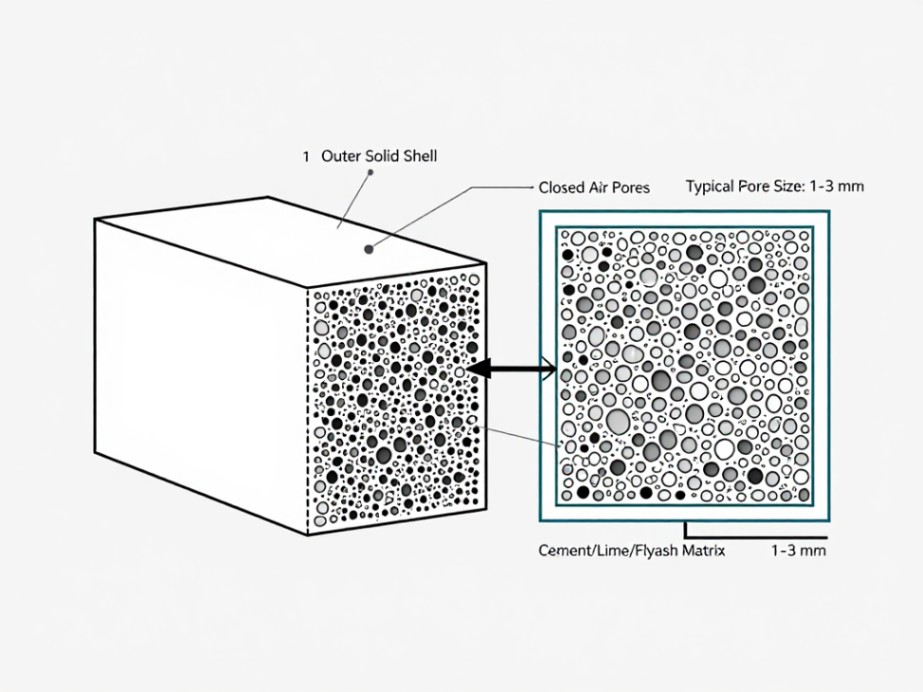
Aerated Autoclaved Concrete (AAC) block specifications provide the standardized technical framework for a versatile, high-performance building material. AAC is a precast, lightweight concrete composed of cement, lime, fly ash, gypsum, and aluminum powder, which expands during autoclaving to create a highly porous, strong cellular structure. These specifications govern everything from raw materials to final performance, ensuring consistent quality, structural safety, and energy efficiency. Engineers, architects, and builders rely on them for accurate design and procurement. Understanding AAC specifications is non-negotiable for successful project execution.
Core Material Composition and Physical Properties
The performance of AAC begins with its recipe. Cement and lime act as the primary binders. Fly ash, a recycled industrial byproduct, contributes to long-term strength and sustainability. Gypsum controls the setting time, and a minuscule amount of aluminium powder reacts to generate hydrogen gas. This reaction creates millions of uniform, non-interconnected air pores, which define AAC’s core characteristics: lightness, insulation, and workability.
Specifications classify AAC blocks primarily by two linked properties: dry density and compressive strength. Density directly influences structural capacity, thermal performance, and dead load. Strength determines load-bearing suitability.
| Density Class (kg/m³) | Typical Compressive Strength (N/mm²) | Primary Application Focus |
|---|---|---|
| 400 – 500 | 2.5 – 3.5 | Thermal insulation, non-load bearing infill |
| 600 – 700 | 4.0 – 5.0 | Standard load-bearing and non-load bearing walls |
| 700 – 800 | 5.0 – 7.0+ | Higher load-bearing walls, floors, roof panels |
Always confirm the declared compressive strength for structural calculations. Standard dimensions and tolerances are also strictly defined. Common block thicknesses range from 75mm to 300mm. Length and height tolerances are typically within ±1.5mm to ±3mm, ensuring level, plumb walls with minimal mortar joints.
Performance Specifications: Thermal, Fire, and Acoustics
AAC excels in performance. Its porous structure provides inherent, permanent insulation. Unlike added insulations that can degrade or settle, AAC’s thermal resistance is integral to the material. The thermal conductivity (λ-value) ranges from approximately 0.10 to 0.20 W/mK, depending on density. A 200mm thick AAC wall can achieve a U-factor below 0.30 W/m²K, often meeting modern energy codes without additional cladding.
Fire resistance is exceptional. AAC is inorganic and non-combustible. Specifications reference standardized fire tests (e.g., ASTM E119, EN 1363-1). Blocks achieve fire ratings from 2 to 6 hours for load-bearing elements, depending on thickness and density. A 100mm thick block typically provides 2-hour fire resistance. This performance is a material property, not a coating.
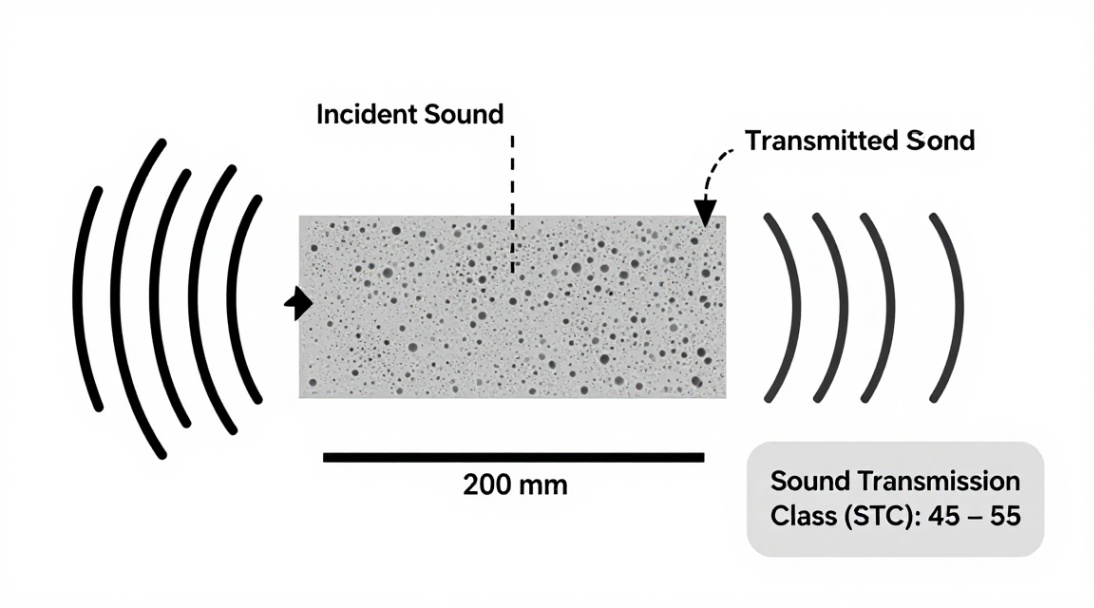
Acoustic insulation follows predictable mass law principles but is enhanced by the material’s damping characteristics. Sound Transmission Class (STC) ratings for a 200mm thick solid AAC wall typically range from STC 45 to 55, effectively attenuating speech and common household noise.
Structural and Construction Specifications
Structural design with AAC requires adherence to specific material standards. Key specifications include allowable compressive stress, modulus of elasticity (typically 1,500 to 2,500 kN/mm²), and shear bond strength with thin-bed mortar. Design standards like ASTM C1693 or EN 1996-1-1 provide the calculation frameworks. AAC is suitable for load-bearing walls up to 2-3 stories in low-rise construction and as infill in framed structures.
On-site handling specifications emphasize workability. AAC blocks are easily cut, chased, and shaped with standard woodworking tools. This allows for precise modifications for conduits, pipes, and fittings. Specifications also govern water absorption, which is higher than dense concrete but is managed through proper surface protection and rendering. The material’s breathability helps regulate indoor humidity.
Relevant Standards and Sustainable Benefits
Project specifications must cite recognized standards. These define test methods and minimum requirements, ensuring global consistency.
- ASTM C1693: Standard Specification for Autoclaved Aerated Concrete (AAC)
- EN 771-4: Specification for masonry units – Part 4: Autoclaved aerated concrete masonry units
- IS 2185 (Part 3): Autoclaved cellular concrete blocks
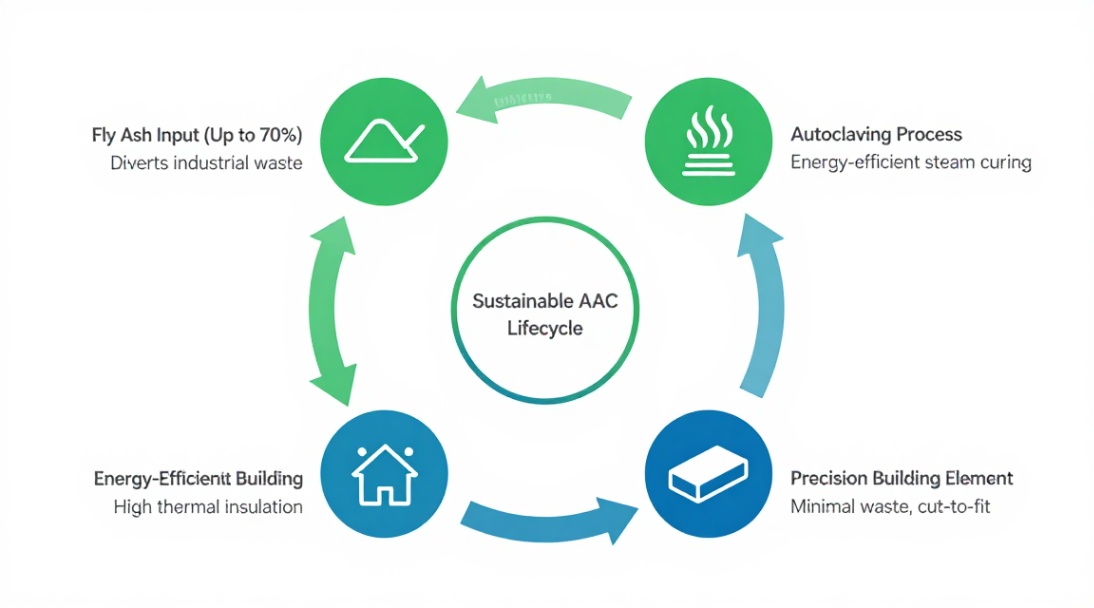
Sustainability is embedded in the AAC specification. The high use of fly ash (up to 70% by mass) diverts industrial waste from landfills. The autoclaving process uses steam energy efficiently. The finished product yields minimal waste due to its precision and cutability. AAC’s thermal mass and high insulation reduce operational energy consumption in buildings, contributing directly to green building certifications like LEED and BREEAM.
Applying AAC Specifications to Your Project
Specifications are a tool, not a substitute for professional judgement. Start by defining the project’s primary drivers: is it load-bearing capacity, thermal efficiency, or fire separation? Select the density and strength class accordingly. Reference the correct national or international standard in your bill of materials and quality control plans. Verify supplier test certificates against the declared specifications. For structural walls, engage a qualified structural engineer to perform calculations based on the specific AAC block’s certified properties. For partitions and infill, focus on dimensional tolerances, fire rating, and acoustic requirements. Proper specification eliminates guesswork and ensures the material performs as intended, delivering durable, efficient, and safe buildings.
We are the global leader in lightweight concrete and advanced engineered foam solutions. Known globally for its commitment to research, innovation, and applied expertise, we have been providing engineered foam solutions since the early 2012’s.
We can supply high-quality concrete admixture and foam concrete related products all over the world.
The company has a professional technical department and quality supervision department, a well-equipped laboratory, and equipped with advanced testing equipment and after-sales customer service center.
If you are interested, please feel free and contact us.