Professional solutions on concrete addtives, Concrete Foaming Agent, Superplasticizer, CLC Blocks Additives, and foaming machine

The Essential Guide to Choosing Industrial Foam Generating Equipment for Your Precast Plant
Choosing the Right Foam Generating System Starts with Your Concrete Density, Not a Sales Brochure
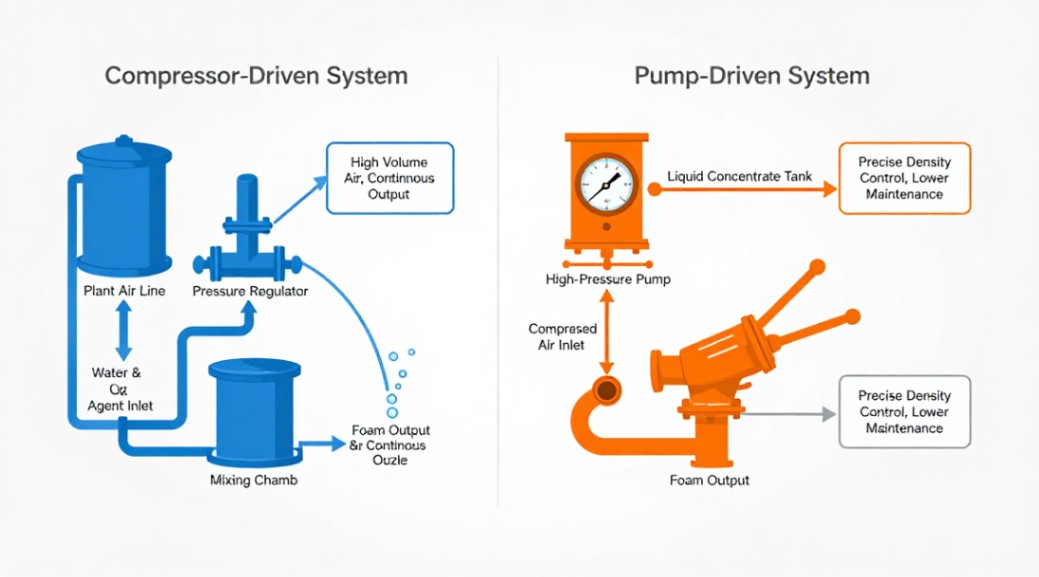
In the world of industrial foam generating equipment for precast plants, the defining battle isn’t between brands-it’s between compressor-driven and pump-driven systems. Both generate stable, consistent foam, but your plant’s daily reality determines the winner. Let’s walk through that decision. Imagine you run a high-volume plant producing architectural cladding or hollow-core slabs. Your batching sequence is relentless. For you, a compressor-driven system is likely the workhorse. It pulls air directly from the plant line, offering tremendous, continuous output. As a 2023 industry benchmark from the Precast Concrete Institute noted, these units can deliver over 200 cubic feet of finished foam per minute, seamlessly keeping pace with a fast-cycle mixer. The foam density is controlled by a simple air-to-liquid ratio valve. It’s robust. It’s simple. But listen closely to that compressor. It adds constant noise to your floor and consumes significant power even at standby. Its strength-massive output-is also its weakness for smaller, specialized operations.
The Quiet Precision of the Pump-Driven Alternative
Now, picture a different scenario. Your plant focuses on specialty products: insulated wall panels, lightweight topping slabs, or complex geometric pieces where every cubic yard of material counts. Here, the pump-driven foam generator shines. This system uses a dedicated, positive-displacement pump to inject air into the foaming agent solution under pressure. The process is notably quieter. More importantly, it provides exquisite control over bubble structure. You dial in density with precision, often down to variations of less than 0.5 pounds per cubic foot, which translates directly into predictable compressive strength and thermal performance. Maintenance shifts from compressor rebuilds to pump seals. The trade-off is raw output speed; these units typically excel in the 50 to 100 cubic feet per minute range. So, your choice crystallizes. Need high-volume, consistent density for standard products? Lean compressor. Need precise, quiet, and adjustable foam for high-value mixes? Lean pump-driven.
Beyond the Generator: The System That Ensures Your Success
Focusing solely on the foam generator is the most common mistake I see. This equipment is the heart, but the circulatory system-the controls, integration, and support components-keeps the whole operation alive. True quality in industrial foam generating equipment for precast plants is defined by repeatability. That comes from automation. A modern system should be governed by a PLC that stores mix designs. With the push of a button, it calls up the exact air pressure, liquid flow rate, and dosing sequence for your 30 pcf cellular concrete mix. It eliminates operator guesswork. This isn’t just a convenience; it’s a direct line to reduced waste and material cost savings. Inconsistent foam leads to rejected panels, a sin in precast. When evaluating any system, demand to see the control interface. Is it a simple dial or a digital touchscreen with recipe memory? The latter pays for itself by protecting your profit margin on every truckload of lightweight concrete.
Integration and the Realities of Plant Life
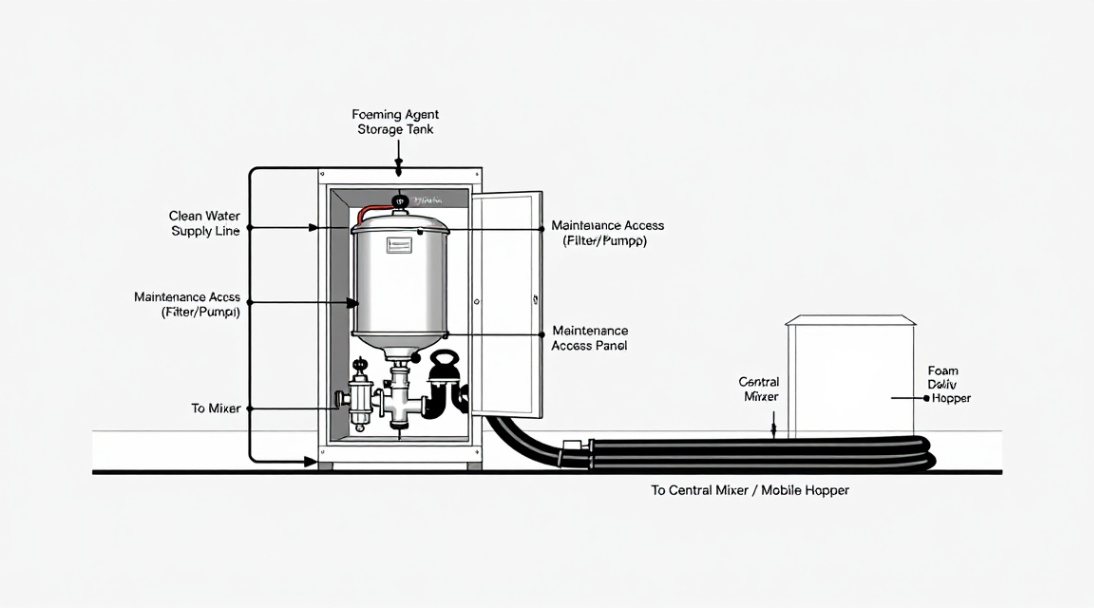
How does this equipment live in your plant? The best units are designed for integration, not as an afterthought. You need clear points for connection: a clean water supply line, a dedicated storage tank for foaming agent, and a direct feed line to your central mixer or a mobile hopper. The foam delivery hose must be durable, chemical-resistant, and long enough to reach your mixing stations without creating a tripping hazard. Consider placement for maintenance access to filters and pumps. Durability is non-negotiable. The cabinet should be steel, rated for a wet, dusty environment. Internal components-the pump, sensors, valves-must be industrial-grade, not light-duty. Ask about the service life of the foaming agent proportioning pump. It’s the part that will wear. A good supplier will have a clear maintenance schedule: “Lubricate the air compressor motor every 500 hours. Inspect the sintered stone diffuser in the foam chamber monthly for mineral buildup.” This specificity shows they understand a production environment.
A Practical Comparison: Foam vs. Traditional Lightweight Methods
Why go through this at all? Let’s compare. For decades, plants created lightweight concrete using expanded shale, clay, or slate aggregates. These are excellent materials. They provide solid strength. But they are heavy to ship, costly to purchase, and can be harsh on mixing equipment. Most critically, they offer limited density reduction. Foam concrete technology changes the equation entirely. You introduce microscopic, stable air bubbles directly into your sand-cement slurry. The aggregate is air. This gives you precise control over the final unit weight, from 20 to 120 pounds per cubic foot. The impact is profound. You drastically reduce the dead weight of your precast products, slashing transportation costs. You improve thermal and acoustic insulation properties inherently. You reduce wear on your mixer and molds. The trade-off is a learning curve. Your mix design becomes paramount. The quality of your foam-its stability and uniform bubble size-directly governs the structural properties of the finished panel. This is why your choice of industrial foam generating equipment is a foundational business decision, not just a machinery purchase.
| Consideration | Compressor-Driven System | Pump-Driven (Proportioning) System |
|---|---|---|
| Core Strength | Very high output volume (>200 CFM common) | Superior density control and bubble uniformity |
| Ideal For | High-volume production of standard lightweight elements | Specialty mixes, precise density requirements, lower noise |
| Operational Cost | Higher energy consumption, compressor maintenance | Lower energy use, focus on pump and seal maintenance |
| Integration Note | Requires robust plant air supply | Requires clean water and agent supply lines |
Your Path to a Confident Decision
So, where do you start? First, honestly assess your production volume and product mix. Map out your target concrete densities. Then, approach suppliers with these operational questions, not just a price request. Ask for a performance specification sheet that lists the exact foam output in cubic feet per minute at various densities. Request data on foam stability-how long the generated foam maintains its volume before collapsing. Insist on seeing the PLC controls and understanding how recipes are saved and executed. Finally, demand references from precast plants running a similar product line. Listen to what they say about daily reliability and support. The right equipment becomes a silent, reliable partner in your production line, turning a precise mix design into a flawless, lightweight panel, batch after batch. Your focus can then stay where it belongs: on designing and selling exceptional precast concrete products.
We are the global leader in lightweight concrete and advanced engineered foam solutions. Known globally for its commitment to research, innovation, and applied expertise, we have been providing engineered foam solutions since the early 2012’s.
We can supply high-quality concrete admixture and foam concrete related products all over the world.
The company has a professional technical department and quality supervision department, a well-equipped laboratory, and equipped with advanced testing equipment and after-sales customer service center.
If you are interested, please feel free and contact us.