Professional solutions on concrete addtives, Concrete Foaming Agent, Superplasticizer, CLC Blocks Additives, and foaming machine

Sulfate Resistant Cement for Marine Environments: A Practical Guide to Choosing the Right Defense
Why Your Marine Concrete is Crumbling: The Silent Sulfate Attack
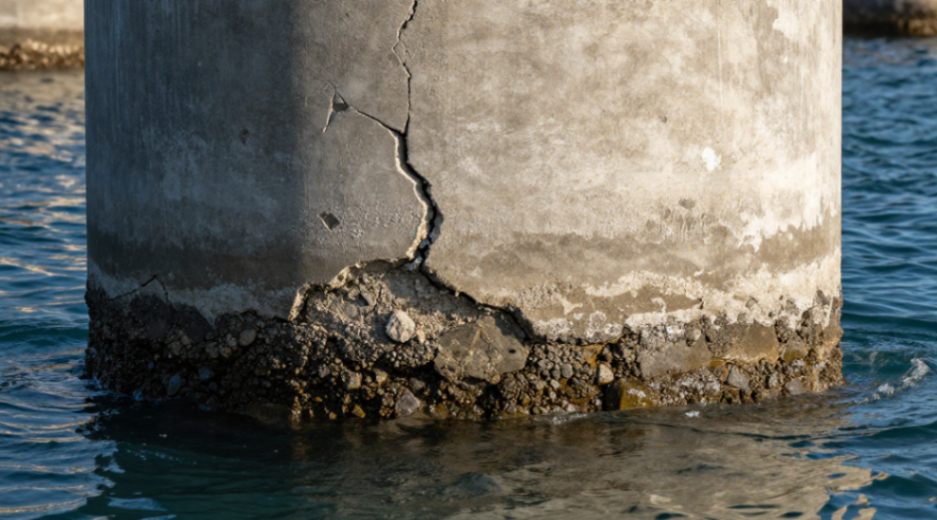
Have you ever inspected a marine structure-a pier, a sea wall, a wastewater outfall-and found the concrete strangely swollen, cracked, and soft? It feels like the very bones of the structure are disintegrating. You followed the codes, used high-strength mix designs, but the seawater still won. This is the signature of sulfate attack, a chemical war waged below the waterline. We’ve seen it too many times. The good news? You can stop it. The solution starts with choosing the right weapon: sulfate resistant cement for marine environments.
Understanding the Enemy: How Sulfates Destroy Concrete
Seawater is a complex, aggressive chemical soup. It contains high concentrations of sulfate ions (SO₄²⁻), primarily from magnesium and sodium sulfates. These ions infiltrate the concrete’s pores. Inside, they react with two key compounds: calcium hydroxide (a byproduct of cement hydration) and tricalcium aluminate (C3A, a core component of cement). This reaction forms a new mineral called ettringite. Ettringite crystals occupy more space. They create immense internal pressure. This pressure leads to micro-cracking, expansion, loss of strength, and ultimately, structural failure. The process is slow but relentless.
The Core Defense: Low-C3A Cement
Sulfate resistant cement fights back by removing the primary target. Its defining characteristic is a drastically reduced tricalcium aluminate (C3A) content. Less C3A means fewer sites for the destructive ettringite reaction to occur. Think of it as building a fortress with materials the enemy’s explosives cannot detonate. This isn’t a surface coating; it’s an inherent, bulk material property. It provides defense throughout the entire concrete mass, not just at the surface.
Sulfate Resistant Cement vs. The Alternatives: Your Decision Matrix
Choosing protection for a marine environment isn’t one-size-fits-all. You have several options, each with distinct trade-offs between performance, cost, and complexity. The table below breaks down the critical comparison to cut through the noise and help you make an informed, project-specific choice.
| Protection Method | How It Works | Best For | Key Advantages | Key Limitations |
|---|---|---|---|---|
| Sulfate Resistant Cement (Type V/ASTM C150) | Inherent chemical resistance via low C3A (<5%). Bulk material defense. | Permanent structures fully immersed in seawater: harbor walls, piles, submerged foundations, offshore platforms. | Full-depth, permanent protection. No maintenance required. Simplifies construction-it’s just concrete. Excellent long-term track record. | Higher initial material cost than OPC. Does not protect against chloride-induced rebar corrosion on its own. Requires careful attention to low permeability through mix design. |
| Ordinary Portland Cement (OPC) with Protective Coatings | Relies on a physical barrier (epoxy, polyurethane) applied to the concrete surface. | Areas above the splash zone, or structures where aesthetics/colour are critical. Retrofit repairs. | Lower initial cement cost. Can be visually customized. Effective if intact. | Barrier is vulnerable to mechanical damage (abrasion, impact). Requires rigorous surface prep. Periodic inspection and re-application are mandatory. Creates a long-term maintenance liability. |
| Blended Cement (e.g., with Slag or Fly Ash) | Partial cement replacement with supplementary materials that densify the matrix and consume calcium hydroxide. | Moderate exposure zones, tidal/splash zones where multiple deterioration mechanisms are present. | Reduces permeability significantly. Can improve resistance to both sulfates and chlorides. Often cost-effective and sustainable. | Performance depends heavily on the quality and proportion of the blend. May have slower early strength gain. Requires stricter quality control during batching. |
| High-Performance Concrete with OPC | Uses very low water-cement ratios, superplasticizers, and meticulous curing to create an extremely dense, impermeable concrete. | Projects where material specification is highly controlled and execution is near-perfect. Precast elements. | Can achieve excellent durability through physical density alone. Uses widely available OPC. | Extremely sensitive to workmanship and curing. Any cracking compromises the entire system. The “defence” is physical, not chemical. |
The Nuts and Bolts: Specifying and Using SR Cement Correctly
Choosing sulfate resistant cement is only half the battle. Using it correctly seals the victory. For marine environments, we recommend a holistic approach.
Material Specifications and Mix Design
Adhere to ASTM C150 Type V or the equivalent in your regional standards (e.g., EN 197-1 SR cement types). Remember, SR cement is not magic fairy dust. Its resistance is compromised if the concrete is porous. You must design for low permeability. This means specifying a maximum water-cementitious ratio (w/cm) of 0.40 or lower. Use chemical admixtures like superplasticizers to achieve workability without adding water. Consider further enhancing durability by replacing a portion of the cement with a proven supplementary material like slag, which refines the pore structure.
Critical Application Practices
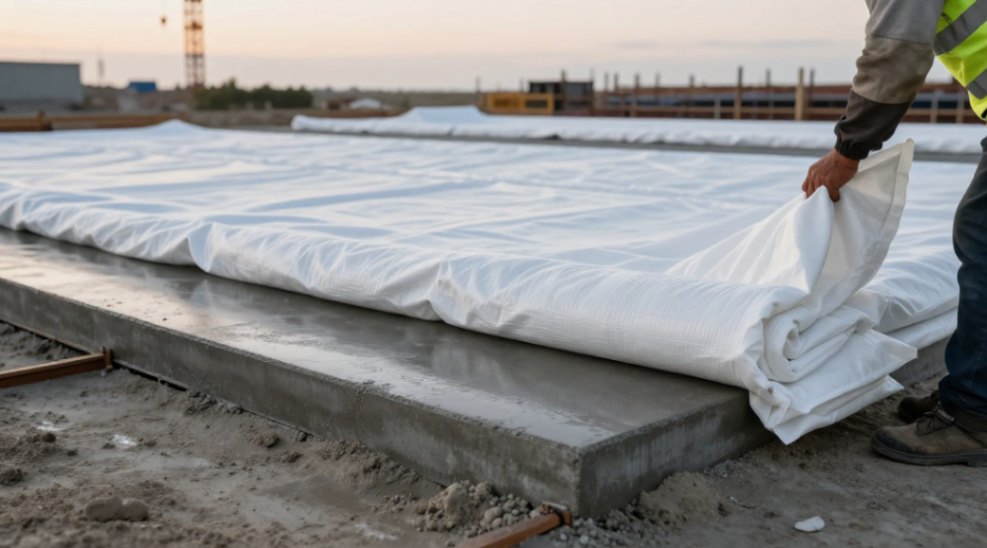
Proper placement and curing are non-negotiable. Poor practices create weak, permeable concrete that will fail regardless of cement type. Ensure adequate consolidation to eliminate honeycombing and voids. Begin curing immediately after finishing to prevent plastic shrinkage cracks. Maintain concrete in a moist condition for a minimum of 7 days-this is critical for the cement to develop its full density and protective microstructure. For marine pours, consider using curing compounds or insulating blankets to maintain proper conditions.
Making the Final Call: A Logic-Based Cost-Benefit Analysis
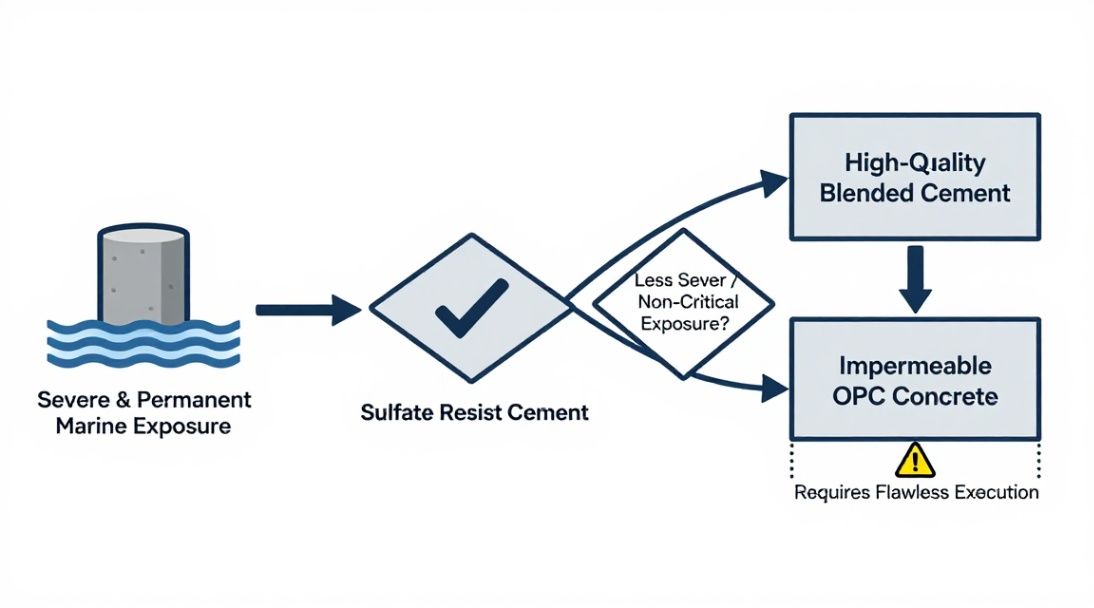
Let’s be practical. SR cement costs more per ton than standard OPC. So when does the investment pay off? Use this logic flow.
For a submerged foundation in seawater, the choice is clear. The cost of failure-including demolition, environmental remediation, redesign, and reconstruction-dwarfs the 10-20% premium for SR cement. The material cost is a small fraction of the total project cost. Protecting the primary structural element is paramount. Here, SR cement is not an expense; it’s cheap insurance.
For a seawall in the aggressive tidal splash zone, the analysis deepens. The structure faces wet-dry cycles, freezing and thawing, and physical wave action. A blended system using SR cement as a base, combined with a carefully selected slag or fly ash addition, often provides the most robust and economical defence against the combined assault of sulfates and chlorides.
The decision hinges on life-cycle cost, not initial cost. Specify sulfate resistant cement for marine environments where the structure is critical, repair is prohibitively expensive or dangerous, and the exposure is severe and permanent. For less severe exposures or non-critical elements, a high-quality blended cement or impermeable concrete with OPC may suffice, provided execution is flawless.
Your Next Step: From Decision to Durable Reality
The table gives you the comparison. The logic provides the framework. Now, you need the precise specifications for your specific site conditions, wave loads, and design life. Don’t just copy a generic spec. Engage with your materials supplier early. Review local case studies of successful marine projects. Most importantly, translate the chosen strategy into rigorous, enforceable quality control plans for batching, placement, and curing. The best sulfate resistant cement in the world cannot compensate for poor concrete practice. Your goal is a durable, low-maintenance structure that stands the test of time and tide. Start by getting the foundation of your material choice right.
We are the global leader in lightweight concrete and advanced engineered foam solutions. Known globally for its commitment to research, innovation, and applied expertise, we have been providing engineered foam solutions since the early 2012’s.
We can supply high-quality concrete admixture and foam concrete related products all over the world.
The company has a professional technical department and quality supervision department, a well-equipped laboratory, and equipped with advanced testing equipment and after-sales customer service center.
If you are interested, please feel free and contact us.