Professional solutions on concrete addtives, Concrete Foaming Agent, Superplasticizer, CLC Blocks Additives, and foaming machine

Choosing a Mid-Range Water Reducer for Concrete Slabs: The Professional’s Guide to Optimal Workability & Durability
Why a Mid-Range Water Reducer is Your Most Pragmatic Choice for Slabs
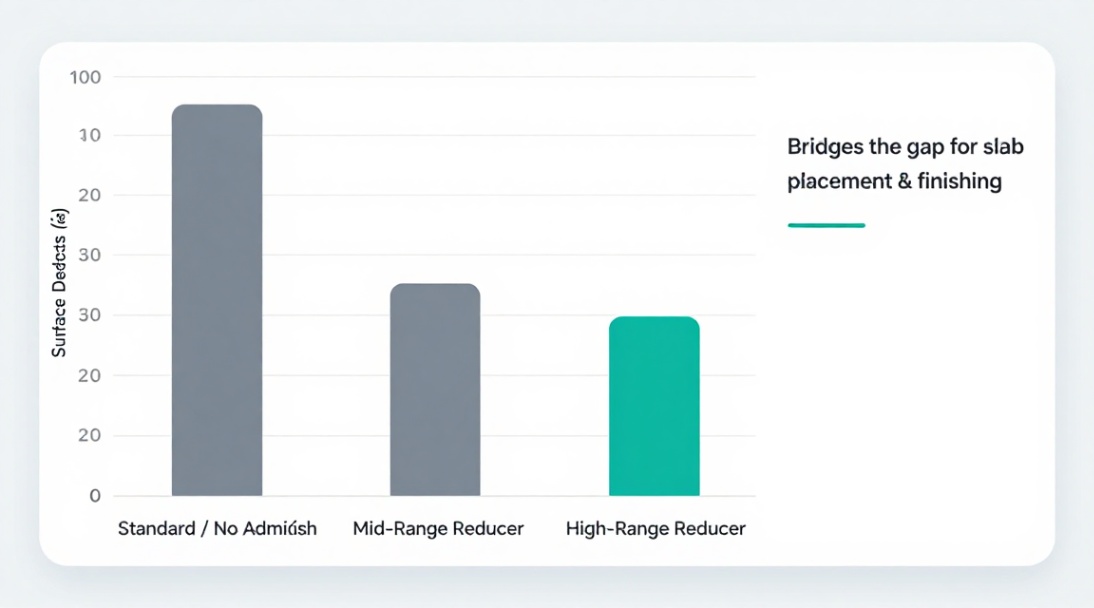
Conventional wisdom suggests you either need a little workability boost or a high-performance solution. The data shows a different story. Projects using a properly specified mid-range water reducer for concrete slabs report a 30-50% reduction in finishing-related surface defects versus mixes using only a standard water reducer or none at all. This statistic points to a critical but often misunderstood tool in concrete construction. A mid-range admixture bridges the gap between basic needs and over-engineering, offering a balanced solution specifically tuned for the demands of slab placement and finishing.
1. Defining the Mid-Range Water Reducer’s Role in Slab Concrete
A mid-range water reducer is a chemical admixture designed to reduce the water content of a concrete mix by 6% to 12%, with a moderate effect on setting time. For slabs, this balance is crucial. It provides meaningful improvements in workability and strength without the dramatic set delays or cost associated with high-range water reducers (superplasticizers).
1.1. How Mid-Range Reducers Differ from Standard & High-Range Products
The choice hinges on performance level. Understanding the spectrum prevents costly misapplication.
- Standard Water Reducers (ASTM C494 Type A): Offer minimal water reduction (typically 5%). Their primary function is to maintain slump with less water, providing a small strength gain. They offer little to no improvement in finishability for complex slab placements.
- Mid-Range Water Reducers (ASTM C494 Type A, or often Type F): Deliver that 6-12% water reduction. This range is the ‘sweet spot’ for slabs. It significantly improves workability for easier placement and superior finishing, reduces surface defects (crusting, plastic shrinkage cracking), and provides a substantial strength increase by lowering the water-cement ratio. Set time is typically extended by 45 to 90 minutes, which is manageable for most slab operations.
- High-Range Water Reducers/Superplasticizers (ASTM C494 Type F & G): Provide 12-30%+ water reduction. They create highly flowable concrete, but often with significant set retardation (hours). For slabs, this can lead to finishing delays, increased susceptibility to surface crusting, and higher costs. They are overkill for most flatwork.
2. Core Advantages of Mid-Range Water Reducers for Slab Construction
2.1. Enhancing Workability, Finishability, and Surface Quality
The primary benefit for finishers is tangible.
- Superior Workability: Concrete with a mid-range water reducer flows more easily into place and around reinforcement, reducing labor effort during placement.
- Improved Finishability: The mix remains cohesive and less sticky. Bleeding is often reduced and more uniform, allowing finishers to time their operations more precisely. This directly minimizes trowel burn, crusting, and other surface blemishes.
- Reduced Plastic Shrinkage Cracking: By lowering the water content, the mix has less free water to evaporate from the surface. This reduces the rate of plastic shrinkage, a major cause of early-age cracking in slabs.
2.2. Boosting Strength and Long-Term Durability
The structural benefits are a direct result of mix design physics.
- Increased Compressive & Flexural Strength: Reducing the water-cement ratio is the most effective way to increase concrete strength. A 10% water reduction can yield a 20-25% increase in 28-day compressive strength, a critical factor for slab load capacity.
- Reduced Permeability: Lower water content creates a denser, less porous cement paste. This significantly improves the slab’s resistance to water, chloride, and sulfate ingress, extending its service life in exterior or industrial applications.
3. Practical Application: Dosage, Batching, and Compatibility
Correct implementation is non-negotiable. The following table summarizes key operational parameters based on typical manufacturer guidelines and field experience.
| Parameter | Typical Range / Specification | Critical Consideration for Slabs |
|---|---|---|
| Optimal Dosage | 130 – 390 mL per 100 kg (2 – 6 fl oz per 100 lb) of cementitious material | Start at the manufacturer’s recommended mid-point. Dosage is adjusted for desired slump and set time, not arbitrarily increased for more workability. |
| Water Reduction | 6% – 12% | This reduction directly calculates a lower water-cement ratio for the mix design. Verify the new w/c meets project specifications. |
| Set Time Extension | 45 – 90 minutes (vs. control mix) | Plan crew scheduling accordingly. In hot weather, this retardation is beneficial. In cold weather, monitor closely. |
| Batching Procedure | Add with the mixing water or immediately after. | Ensure uniform dispersion. Never add undiluted admixture directly to dry cement. |
| Compatibility with Air-Entrainers | Generally excellent, but ALWAYS pre-test. | Combining admixtures can affect air-void system stability. Perform trial batches to confirm air content and spacing factor (ASTM C457). |
3.1. Common Pitfalls and Mitigation Strategies
- Overdosing: Excessive dosage leads to severe retardation, excessive bleeding, and segregation. Stick to the recommended range. If more workability is needed, consider a slight water adjustment or a true high-range reducer.
- Temperature Effects: High temperatures accelerate set, which can offset the admixture’s retardation. Cold temperatures synergize with retardation, potentially delaying set by several hours. Adjust placement timing and protection measures.
- Placement Timing: Do not rely on the extended set time for indefinite workability. Place and consolidate concrete promptly after discharge. The clock starts at batching.
4. Scenario-Based Selection: Which Slab Project is it For?
Choosing the right tool requires matching its strengths to the project profile.
4.1. Commercial Building Slabs-on-Grade
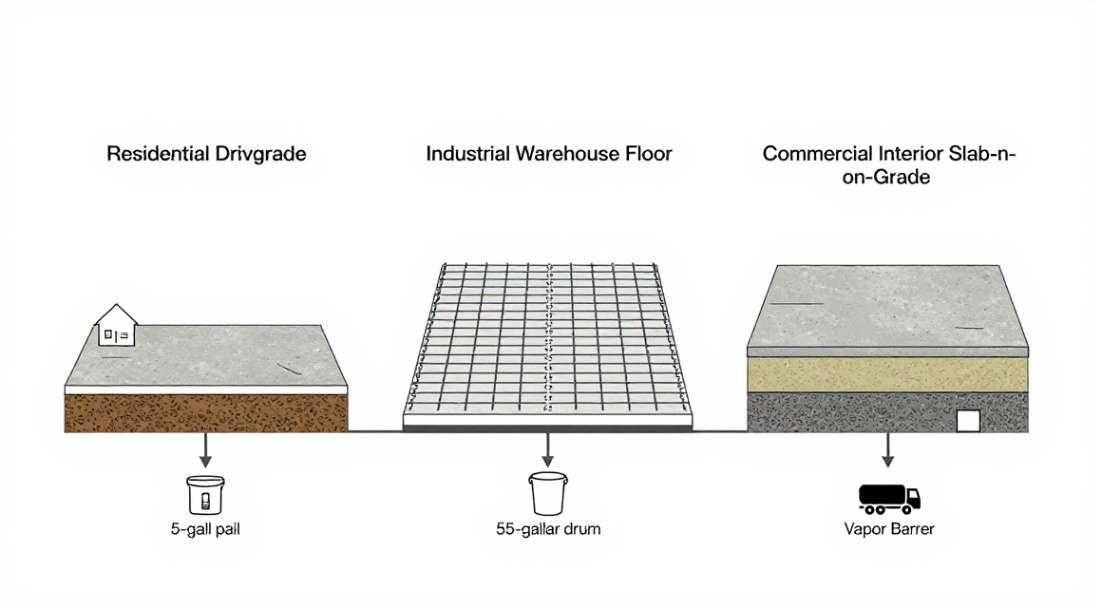
A mid-range water reducer for concrete slabs is the default choice. It provides the necessary workability for placing around dense rebar mats, improves surface quality for floor coverings, and enhances durability for long-term performance. The cost-benefit analysis strongly favors its use over a standard reducer.
4.2. Residential Driveways and Patios
For colored or stamped concrete, a mid-range reducer is invaluable. It produces a denser surface that accepts colour and stamping patterns better, with reduced risk of paste sticking to tools. The improved finishability allows for sharper details.
4.3. Industrial Floor Slabs
For slabs demanding high abrasion resistance and durability, the strength and permeability benefits are primary. A mid-range reducer, often used at the higher end of the dosage range, is essential for achieving low-permeability, high-strength concrete without the placement complexities of a superplasticized mix.
5. Making the Final Decision: Key Specifications to Review
Before sourcing, verify the product’s technical data sheet aligns with your needs. Focus on these specifications:
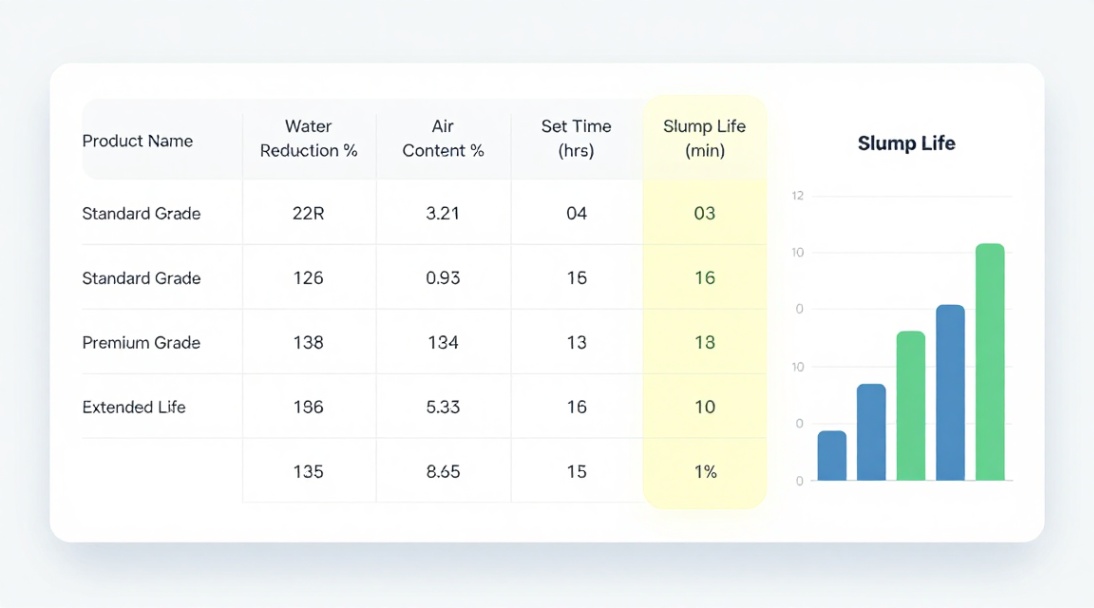
- ASTM C494 Compliance: Ensure it meets Type A (water-reducing) or Type F (water-reducing, high-range) with mid-range properties.
- Water Reduction Claim: Must be in the 6-12% range.
- Set Time Profile: Confirm the stated retardation range (e.g., ‘extends set by 1-2 hours’) is suitable for your climate and crew size.
- Chloride Content: Must be ‘Chloride-Free’ or meet ASTM C1012 standards to prevent corrosion of embedded steel.
- Sustainability Impact: By enabling a reduced cement content for the same strength, a mid-range water reducer directly lowers the mix’s carbon footprint. This is a significant, often overlooked, environmental advantage.
The logical choice for most slab work is clear. A mid-range water reducer provides a disproportionate return on investment through improved constructability, superior finished quality, and enhanced long-term performance. Its balanced performance profile eliminates the compromises inherent in using either a standard or a high-range admixture for this specific application. Specify it, batch it correctly, and finish with confidence.
We are the global leader in lightweight concrete and advanced engineered foam solutions. Known globally for its commitment to research, innovation, and applied expertise, we have been providing engineered foam solutions since the early 2012’s.
We can supply high-quality concrete admixture and foam concrete related products all over the world.
The company has a professional technical department and quality supervision department, a well-equipped laboratory, and equipped with advanced testing equipment and after-sales customer service center.
If you are interested, please feel free and contact us.