Professional solutions on concrete addtives, Concrete Foaming Agent, Superplasticizer, CLC Blocks Additives, and foaming machine

Non-Structural Lightweight Concrete for Backfill: A Better, Smarter Solution
What is Non-Structural Lightweight Concrete for Backfill?
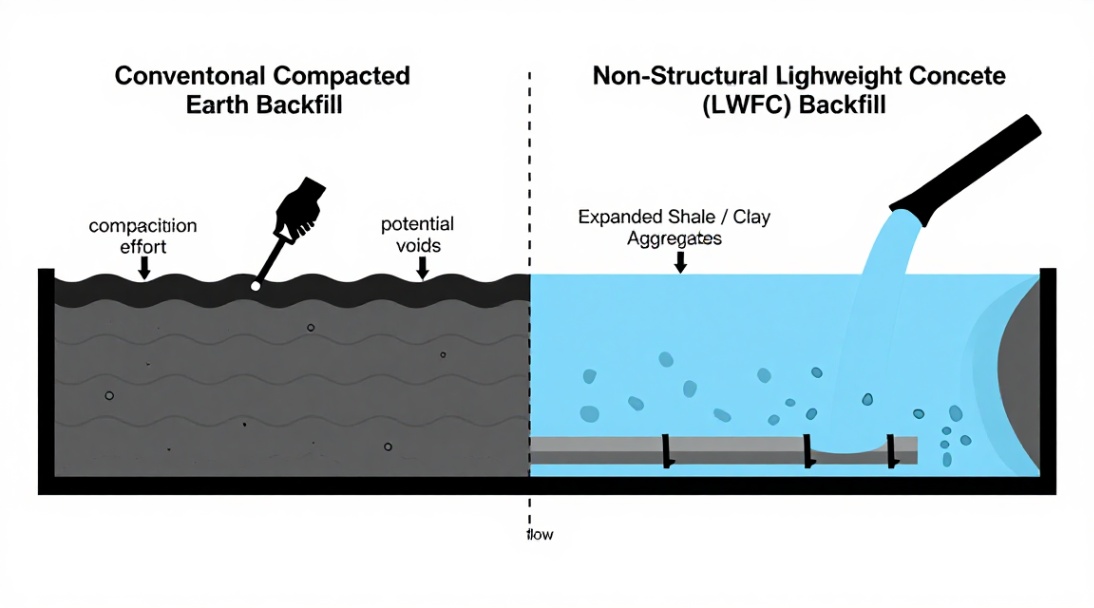
Think of non-structural lightweight concrete for backfill as a controlled, fluid soil replacement. We use it where conventional compacted earth backfill fails. It’s a cementitious slurry mixed with lightweight aggregates like expanded shale or clay. This mixture flows into place, cures into a stable mass, and provides predictable, long-term support without the heavy weight.
Why would you use this instead of dirt?
Two main reasons: weight and pressure. Traditional soil is heavy and requires careful compaction. Lightweight concrete backfill is roughly half the weight or less. This radically reduces the lateral pressure on walls, pipes, and foundations. We eliminate the risk of poor compaction and future settlement. The result is a permanent, monolithic fill.
Your Questions, Our Field Experience
1. What are the primary benefits for my project?
You gain predictable performance. The weight savings directly translate to safer designs for retaining walls and bridge abutments. You no longer worry about settlement damaging pipes or slabs. Installation is faster. We place it via pump or chute, which means less labor and machinery in tight spaces. The long-term stability saves on maintenance and call-backs.
2. What materials are in the mix?
The heart of the mix is the lightweight aggregate. We typically use rotary-kiln expanded materials: shale, clay, or slate. These are fired to create a hard, ceramic-like particle with internal pores. Sometimes we use foam glass from recycled materials. We combine this with Portland cement, water, and sometimes fly ash or a flow agent. The aggregate gives it the low density.
3. How strong does it need to be?
This is the critical distinction. For non-structural backfill, we are not building a column. Compressive strengths are typically low, often in the 50 to 300 psi range. The target is stability, not structural capacity. The unit weight is far more important, usually ranging from 30 to 90 pcf, compared to 120-135 pcf for standard soil. We engineer the flowability so it fills every void without vibration.
4. Where is it commonly used?
- Bridge Abutments & Retaining Walls: The number one application. Reducing lateral earth pressure allows for more slender, cost-effective wall designs.
- Pipe Bedding & Encasement: Provides uniform, non-settling support for utility trenches, protecting pipes from point loads.
- Culvert Backfill: Eliminates the “haunching” problem, ensuring the soil under the culvert doesn’t wash away or settle.
- Foundation Slab Backfill: Used over unstable soils or voids to create a stable platform for slabs-on-grade.
5. How is it installed?
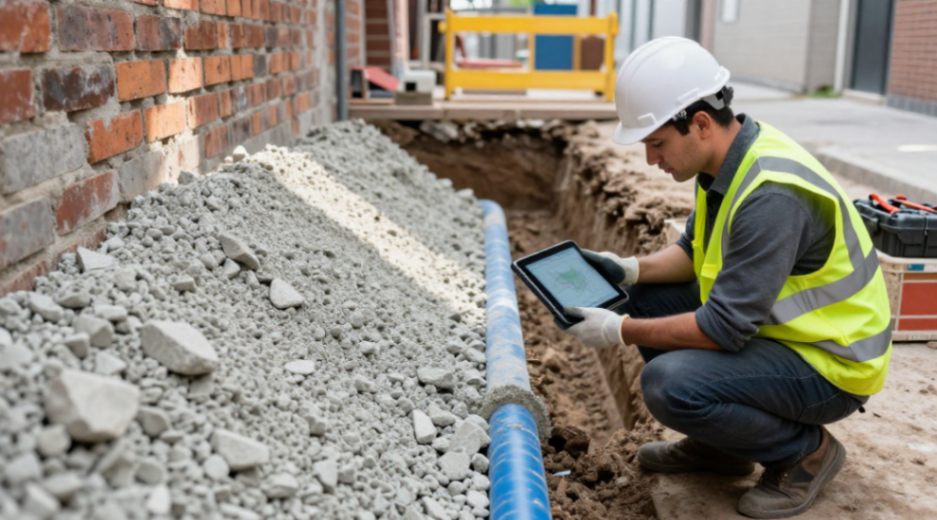
Placement is straightforward. We often pump it directly from the ready-mix truck into the excavation. For shallower placements, we might use a chute. The key is controlling the flow to prevent segregation. We place it in lifts, but there’s no compaction needed. The material self-levels and encapsulates any embedded utilities. Curing is similar to regular concrete, though strength gain is less critical.
6. Is it cost-effective?
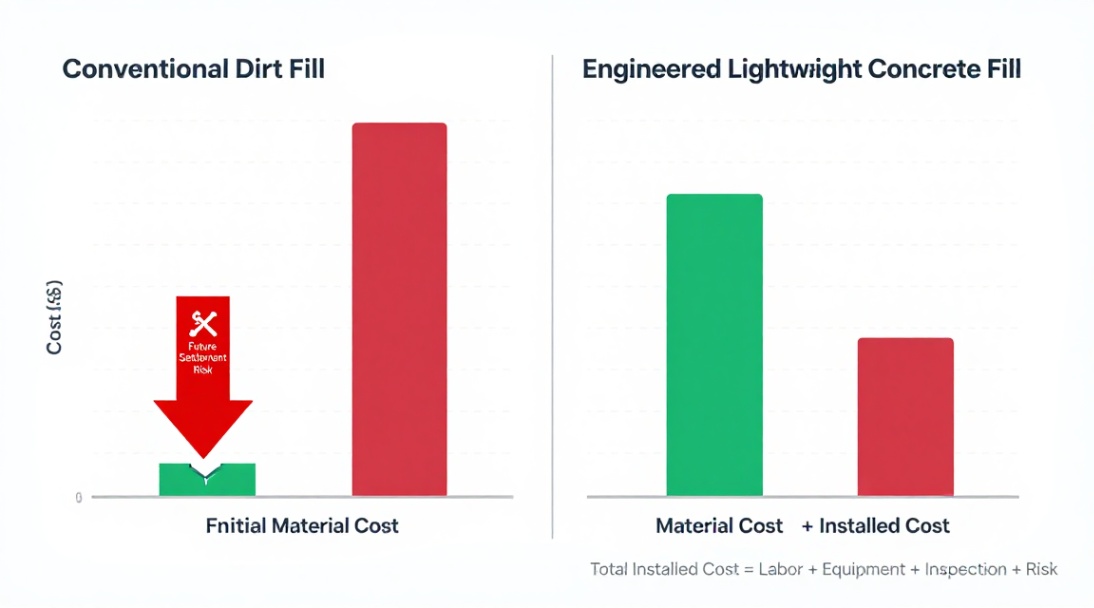
You must look at total installed cost. The material cost per cubic yard is higher than free dirt. That’s the upfront comparison. But you save massively on labor, compaction equipment, inspection time, and imported select fill. Most importantly, you eliminate the risk and cost of future settlement repairs. For critical applications, the long-term value and risk mitigation make it the economical choice.
7. What should an engineer specify?
Focus on performance. Specify the maximum density (e.g., 90 pcf) and a minimum flowability (slump flow). Define the maximum compressive strength to ensure it remains non-structural. Require certified lightweight aggregates. Provide placement rate and lift height guidelines. A good spec ensures you get the lightweight, flowing, stable material you designed for.
8. How does it perform over time?
It’s durable. The cement matrix protects the aggregates. It does not biodegrade like organic soils. It’s resistant to water erosion and freeze-thaw cycles when properly designed. Unlike soil, it won’t settle or consolidate further after curing. We treat it as a permanent, inert geomaterial. Its properties on day one are essentially its properties decades later.
The Bottom Line
Stop fighting unstable soil and unpredictable compaction. Non-structural lightweight concrete for backfill is a proven solution we use to turn a variable, problematic site condition into a known, engineered constant. It simplifies construction and guarantees performance.
The math is clear. If your project involves a sensitive wall, a critical utility line, or backfill in a confined space, traditional soil is your biggest risk. This material is the control. Don’t just backfill an hole. Engineer the void.
Ready to specify it? Contact a local producer with experience in lightweight mixes. Provide them your density and flow requirements. For your next retaining wall or pipe trench project, make non-structural lightweight concrete your standard specification. It’s the decision that protects your design from the ground up.
We are the global leader in lightweight concrete and advanced engineered foam solutions. Known globally for its commitment to research, innovation, and applied expertise, we have been providing engineered foam solutions since the early 2012’s.
We can supply high-quality concrete admixture and foam concrete related products all over the world.
The company has a professional technical department and quality supervision department, a well-equipped laboratory, and equipped with advanced testing equipment and after-sales customer service center.
If you are interested, please feel free and contact us.