Professional solutions on concrete addtives, Concrete Foaming Agent, Superplasticizer, CLC Blocks Additives, and foaming machine

Beat the Freeze: The Truth About Early Strength Admixtures for Cold Weather Concreting
The Core Definition
An early strength concrete admixture for cold weather is a chemical accelerator dosed into the concrete mix. Its sole purpose is to violently override the decelerating effects of cold. It forces hydration to happen faster, generating enough internal heat and strength gain in the first 24 hours to resist permanent damage from freezing water within the concrete matrix.

The Critical Questions
How does it actually work in the cold?
Cold cripples standard concrete. Chemical reactions slow to a crawl. An early strength accelerator acts like a catalyst, aggressively jump-starting the reaction between cement and water (hydration). This generates critical heat earlier and drives compressive strength development at a rate that outpaces temperature drop.
What’s the main chemical choice? Chloride vs. Non-Chloride.
This is the industry’s dirty secret. Chloride-based accelerators (calcium chloride) are cheap and brutally effective. But they are a ticking time bomb for corrosion in any reinforced or prestressed concrete. Non-chloride accelerators (nitrates, nitrites, alkanolamines) cost more but protect the structural integrity of the steel. The rule is absolute: never use chlorides near steel.
What are the real, tangible benefits?
- Defeat Freeze-Thaw Destruction: The primary win. Concrete reaches a “safe” strength (typically 3.5 to 5 MPa / 500 psi) before internal water can freeze and expand, causing micro-cracks and dusting.
- Slash Formwork Stripping Time: Gain 12-24 hours of strength in half the time. Remove forms and reshore faster. This is where you save massive labor costs.
- Accelerate Project Schedules: Follow-on trades (masons, framers) can start work days earlier. This compression of the critical path is the biggest economic driver for large projects.
- Reduce Initial Curing Burden: While protection is still mandatory, the window of extreme vulnerability is significantly shorter.
What temperature range does it cover?
These admixtures are not magic. They are a tool for the “difficult” range, roughly from +5°C down to -5°C (41°F to 23°F). Below -5°C, you must combine them with heated materials, insulated enclosures, and possibly supplementary heating. The admixture alone cannot overcome deep freeze conditions.
What about dosage and mixing with other chemicals?
Follow the manufacturer’s data sheet to the letter. Overdosing can cause flash set—concrete that hardens in the mixer drum. Underdosing is a waste of money and invites failure. Compatibility with other admixtures, especially water-reducers and superplasticizers, is not guaranteed. You must perform site trials with your exact mix design and combination of chemicals before the pour.
Does it replace standard cold weather practices?
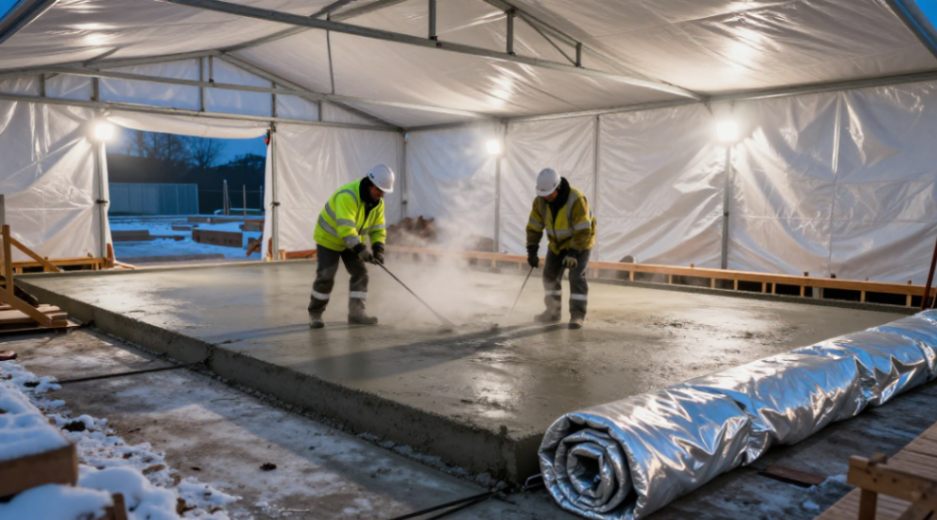
Absolutely not. It is a force multiplier for good practice, not a substitute. You still must: use warm water to heat the mix, protect aggregates from icing, place concrete at the recommended minimum temperature, and implement proper curing with insulated blankets or heated enclosures immediately after finishing. The accelerator buys you time and safety margin; it does not grant immunity.
What’s the economic argument?
Compare two costs: the extra $2-$5 per cubic yard for a quality non-chloride accelerator versus the cost of a delayed schedule. Labor idle time, extended equipment rental, and missed milestones dwarf the admixture cost. For a contractor, it’s insurance. For an owner, it’s schedule certainty.
Is there proof it works on real sites?
Search any construction forum. The consensus is clear. One project manager on a specialized subreddit noted: “We used a nitrate-based accelerator on a December garage pour. Ambient was 28°F. We pulled forms at 18 hours, tested at 4,000 psi. Without it, we’d have been tenting for three days.” Another warned: “We tried a cheap chloride blend on a bridge deck patch (against spec). Six months later, spalling started. The repair cost 50x the ‘savings.'”
How do you handle it safely?
Treat it as an industrial chemical. Wear PPE: gloves, goggles. Prevent skin contact. Ensure good ventilation in batch plants. Store in accordance with the SDS (Safety Data Sheet). Never confuse or mix different admixture types in the same storage tank without a thorough flush.
The Bottom Line & Next Step
An early strength concrete admixture for cold weather is non-negotiable for winter concreting. It is a precision chemical tool that mitigates the fundamental physical risk of freezing. The choice between chloride and non-chloride defines the long-term durability of your structure. Stop gambling with the weather and hoping blankets are enough. Your next action is to test. You need performance data specific to your cement, your mix, your local conditions. Contact a reputable admixture supplier today, request a technical data sheet for their premium non-chloride accelerator, and schedule a lab trial or site demonstration pour. The cost of the test is trivial compared to the cost of a failed slab.
We are the global leader in lightweight concrete and advanced engineered foam solutions. Known globally for its commitment to research, innovation, and applied expertise, we have been providing engineered foam solutions since the early 2012’s.
We can supply high-quality concrete admixture and foam concrete related products all over the world.
The company has a professional technical department and quality supervision department, a well-equipped laboratory, and equipped with advanced testing equipment and after-sales customer service center.
If you are interested, please feel free and contact us.