Professional solutions on concrete addtives, Concrete Foaming Agent, Superplasticizer, CLC Blocks Additives, and foaming machine

Foam Density Testing: The Definitive Guide to Predictable Concrete Performance
The Core of Lightweight Concrete Stability
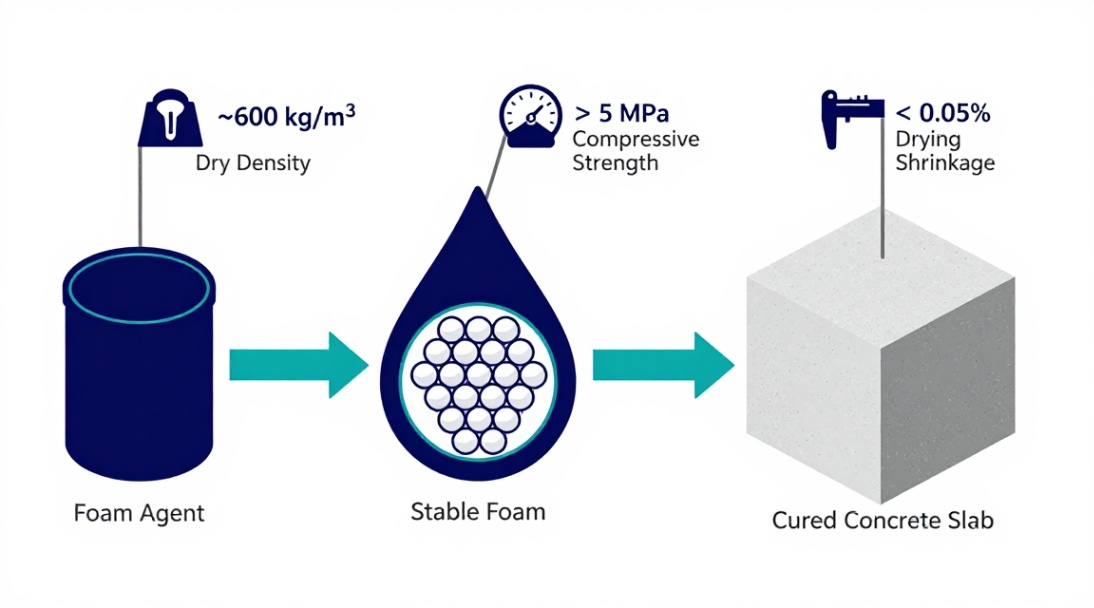
Foam density is the single most critical factor determining the stability of cellular concrete. It governs the hardened concrete’s compressive strength, drying shrinkage, and overall durability. Precise foam density testing provides the essential data link between the foam agent you mix and the final performance of your lightweight concrete slab. Without this verification, you are building on unstable ground.
Why Foam Density Dictates Stability
Think of foam as the architect of your concrete’s internal structure. The density of the foam directly controls the volume and distribution of air voids in the cured mix. High-quality, stable foam creates a uniform, closed-cell matrix. This structure provides predictable strength and minimal water absorption. Unstable foam, with inconsistent or collapsed bubbles, creates a weak, interconnected pore network. This leads to excessive shrinkage, cracking, and compromised structural integrity. Testing foam density for concrete stability is not optional; it is the fundamental quality checkpoint.
Essential Equipment for Reliable Testing
Accurate testing requires simple, dedicated tools. A calibrated foam generator that produces consistent bubble structure is non-negotiable. You also need a standard density cup, typically a 1-liter cylindrical container with a known volume. A precision scale accurate to 0.1 grams completes the core kit. Do not use makeshift containers. Their inaccurate volume will corrupt every calculation, making your test results meaningless for ensuring project specifications.
The Step-by-Step Density Test Procedure
Follow this procedure meticulously. Consistency in method is as important as the result. We base this on the principles of standards like ASTM C796 and C869, adapted for field and plant control.
- Prepare the Equipment. Clean and dry the density cup. Tare the scale with the empty cup.
- Generate Sample Foam. Run your foam generator until it produces a stable, dry foam stream. Fill the cup completely in one continuous motion, allowing foam to overflow the rim.
- Level and Weigh. Use a straight edge to strike off the excess foam, creating a perfectly level surface. Weigh the full cup immediately.
- Calculate Wet Density. Subtract the tare weight of the cup. Divide the net foam weight (in grams) by the cup’s volume (in liters). The result is your wet foam density in grams per litre (g/L).
Record this number. It is your primary quality indicator for the foam batch.
From Foam Density to Concrete Performance
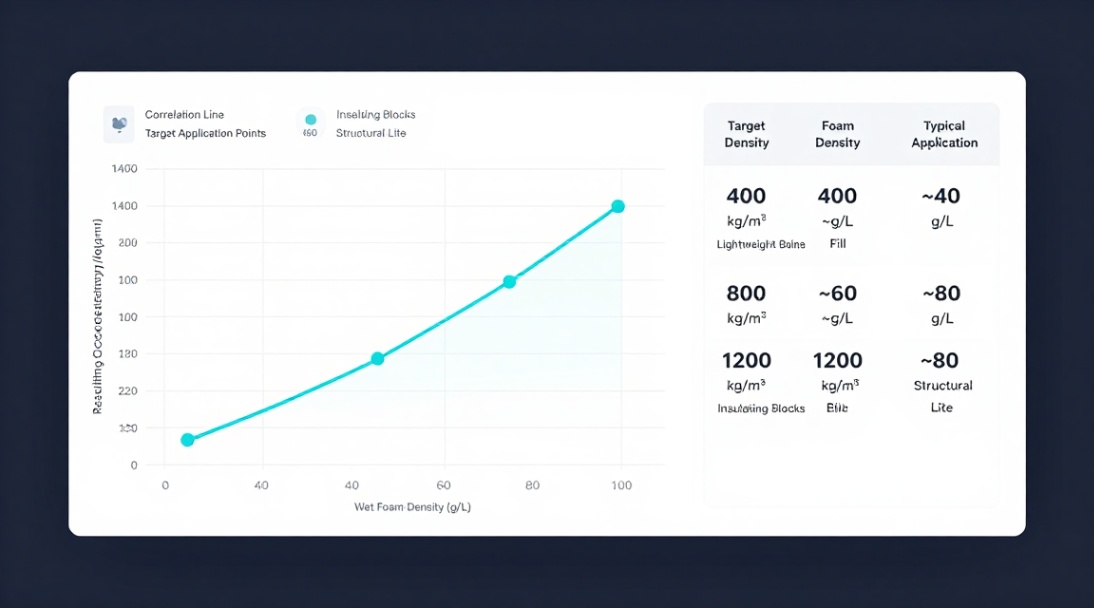
The wet foam density is your control knob. It directly predicts the wet density of the lightweight concrete mix. For example, foam at 40 g/L will yield a significantly lighter concrete than foam at 80 g/L. This relationship allows you to dial in precise target densities for different applications. Use the table below as a general guide.
| Application | Typical Target Wet Density Range |
|---|---|
| Insulating Roof Screeds | 300 – 600 kg/m³ |
| Lightweight Floor Fill | 800 – 1200 kg/m³ |
| Structural Lightweight Elements | 1200 – 1600 kg/m³ |
Higher foam density (meaning heavier foam) generally correlates with higher compressive strength but reduced thermal insulation. Your mix design must balance these properties.
Troubleshooting Common Foam Issues
If your density readings are inconsistent or your foam collapses, diagnose systematically.
- Foam Collapse in the Mix: This usually points to a low-quality foam agent or an incorrect water-cement ratio in the base slurry. The harsh alkaline environment destroys weak bubbles. A robust, protein-based or synthetic surfactant foam agent is crucial for stability.
- Erratic Density Readings: Check your foam generator first. Inconsistent air pressure or surfactant dilution rates create foam of varying quality. Then, verify your mixing procedure. Adding foam to the slurry too quickly can burst bubbles.
Treat foam as a key component, not just an additive. Its quality is as vital as your cement.
Integrating Testing into Your Quality Control
Do not test once and assume consistency. Make foam density testing a routine checkpoint. Establish a frequency: for example, test the first batch of the day and every subsequent 50 cubic meters. Document every result. This log becomes your proof of compliance and your first line of defense against costly callbacks for cracked or failing slabs. Specify the required foam density range and test frequency in your project’s quality control plan. This objective data removes guesswork and ensures every truck delivers the material you designed.

Mastering foam density testing transforms lightweight concrete from a risky alternative into a predictable, high-performance material. The process is straightforward, but its impact on project stability is profound. Start your next pour with confidence, knowing the foundation of your foam is solid.
We are the global leader in lightweight concrete and advanced engineered foam solutions. Known globally for its commitment to research, innovation, and applied expertise, we have been providing engineered foam solutions since the early 2012’s.
We can supply high-quality concrete admixture and foam concrete related products all over the world.
The company has a professional technical department and quality supervision department, a well-equipped laboratory, and equipped with advanced testing equipment and after-sales customer service center.
If you are interested, please feel free and contact us.