Professional solutions on concrete addtives, Concrete Foaming Agent, Superplasticizer, CLC Blocks Additives, and foaming machine

Why Your Lightweight Concrete Failed: Mastering the Concrete Foaming Agent
Have You Ever Watched Your Fresh Foam Collapse?
You mixed the batch. You saw the beautiful, airy foam. Then, an hour later, it was gone. Just a watery mess. You’re not alone. Many users on Reddit share this exact frustration. They followed the label but ended up with a dense, heavy slab. The promise of lightweight concrete felt like a lie. The culprit? It’s almost always a misunderstanding of your Concrete Foaming Agent.
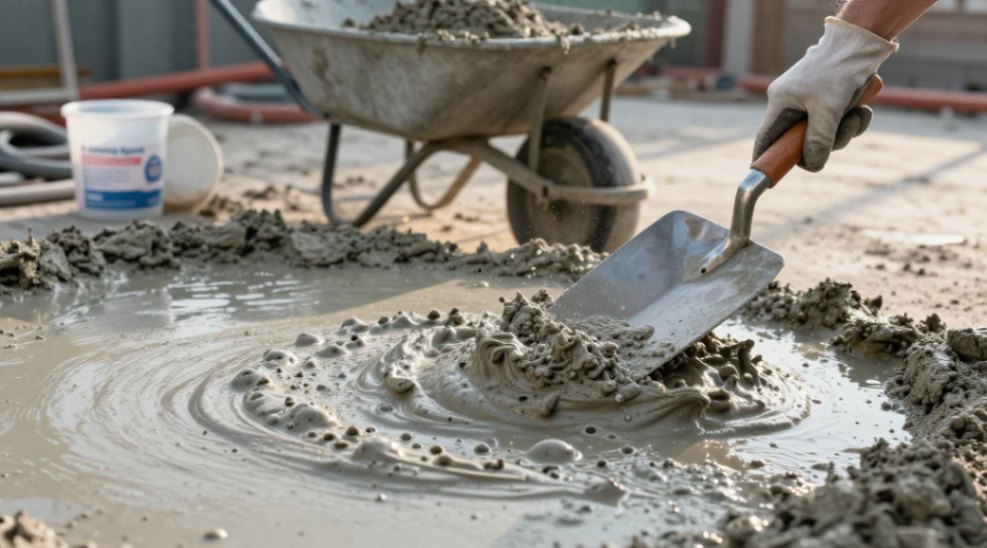
This isn’t just another additive. It is the heart and soul of lightweight cellular concrete (LCC). Getting it right transforms a project. Getting it wrong wastes time, material, and money. Let’s fix that today.
1. What Exactly Is a Concrete Foaming Agent?
Think of it as a bubble factory. A Concrete Foaming Agent is a highly concentrated surfactant. When mixed with water and air in a Foam Generator, it creates millions of tiny, stable air bubbles. These bubbles are then blended into a slurry of cement, water, and sometimes Special Cement or Superplasticizer.
The magic happens because of surface tension. The foaming agent reduces the surface tension of the water. This allows the air to be trapped into a foam structure. The foam, once mixed into the concrete, displaces the heavy aggregate. The result? Light weight Concrete that is strong, insulating, and easy to work with.
1.1 The Mechanism: From Liquid Foam to Solid Strength
Here is the step-by-step process inside your mixer:
- Foam Generation: You dilute the Concrete Foaming Agent with water (typically a ratio of 1:30 to 1:50 by volume, depending on the manufacturer). This solution goes into the Foam Generator with compressed air.
- Bubble Formation: The generator forces the liquid through a series of nozzles or a porous medium. This shears the liquid into stable, uniform air cells. A good generator produces foam with a density of 40-80 g/L.
- Integration: The stiff foam is then blended into your cementitious base (cement, water, Concrete Water Reducer, and Fiber if needed). You must fold it in gently. Over-mixing kills the bubbles.
- Setting: The cement hydrates around the foam bubbles. The bubbles remain as voids in the hardened matrix. This gives you the cellular structure.
2. Two Roads to Bubbles: Synthetic vs. Protein-Based Agents
Choosing the wrong type is a classic mistake. Here is the breakdown you need.
| Feature | Synthetic Surfactants | Protein-Based Agents |
|---|---|---|
| Cost | Generally lower cost per liter | Higher cost, more concentrated |
| Stability | Good, but sensitive to mixing time | Excellent, very robust bubbles |
| Strength Contribution | Neutral (no added strength) | Can slightly improve cohesive strength |
| Best Use Case | Non-structural fill, thermal insulation, trench filling | Structural lightweight blocks, sound barriers, roofing panels |
| Density Range | Can achieve very low densities (300-800 kg/m³) | Produces moderate densities (500-1200 kg/m³) |
My advice? If you need high strength and a uniform pore structure, pay the premium for a protein-based agent. For bulk filling and insulation where compressive strength is secondary, synthetics work perfectly.
3. The Real-World Applications
Understanding where to use Foamed Concrete saves you from design headaches.
- Thermal Insulation: The trapped air makes it a brilliant insulator for roof screeds and floor underlays.
- Geofoam and Trench Filling: It is self-leveling. Pour it into trenches for pipes or as a lightweight void fill. No compaction needed.
- Lightweight Blocks: Replace heavy clay or dense aggregate blocks with foamed concrete blocks. They saw, cut, and nail like timber.
- Structural Lightening: Use it in high-rise buildings to reduce the dead load on the foundation. Every kilogram you remove from the structure saves money on steel and concrete in the columns below.
4. Dosage and Mixing: The Devil Is in the Details
This is where we make or break the job. Forget eyeballing it. Here is a precise operational method.
- Prepare the Base Mix: Your base is Portland cement, water, and any admixtures like Early Strength Agent or Concrete Defoamer (if you accidentally use too much air later). The water-to-cement ratio should be between 0.4 to 0.6.
- Dilute the Foaming Agent: Mix 1 part Concrete Foaming Agent concentrate with 40 parts water (1 liter concentrate + 40 liters water).
- Generate the Foam: Run the diluted solution through your Foam Generator. Measure the foam density. It must be between 50 g/L and 80 g/L. If it’s higher than 80 g/L, the foam is too wet and will collapse.
- Introduce the Foam: For every cubic meter (1000 liters) of finished concrete, you need between 300 and 600 liters of pre-formed foam. Start with the lower end. Mix gently for 2-3 minutes. Overmixing for 5+ minutes will destroy the foam.
- Check Fresh Density: Weigh a known volume of the fresh concrete (e.g., a 1-liter measure). Target density is typically 600-1200 kg/m³. Adjust your foam volume up or down for the next batch.
5. Quality Control: How to Stop the Collapse
I see failures happen for three reasons. Let’s fix each one.
5.1 Foam Instability
Your bubbles must survive until the cement sets. If they pop, you lose volume and gain density. Solution: Use a Concrete Foaming Agent with a higher viscosity modifier. Adding Hydroxypropyl Methyl Cellulose or Hydroxyethyl Cellulose to your mix water (0.1% of cement weight) thickens the liquid film around the bubbles. This dramatically improves stability.
5.2 Uneven Density
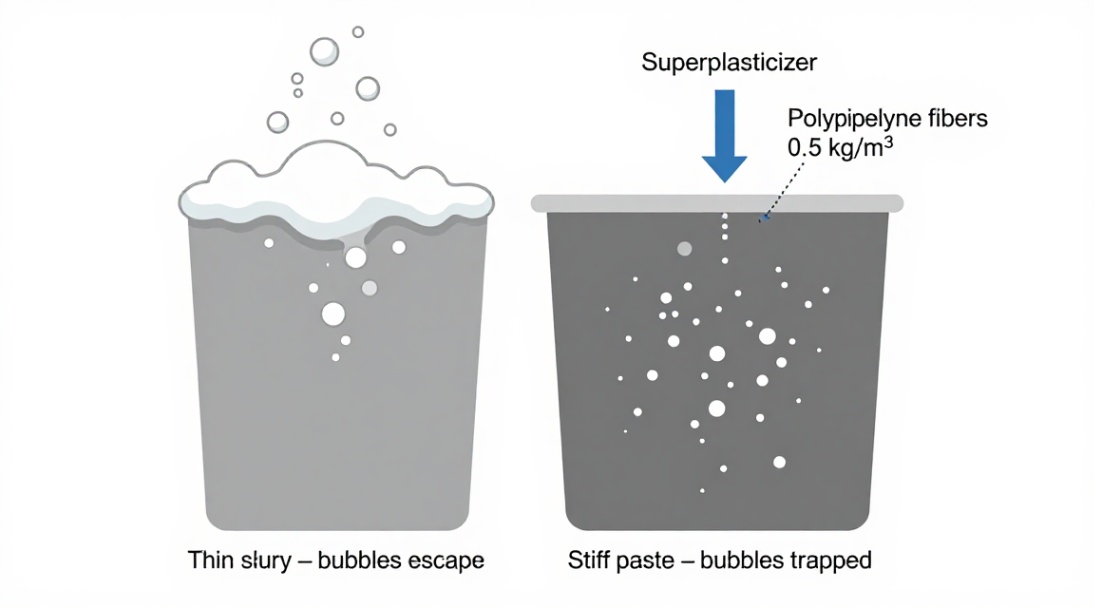
Heavy foam rising to the top is bad. It means your base slurry is too thin. Solution: Increase the viscosity of the cement paste. Use a Superplasticizer to reduce water content while maintaining flow. A stiffer paste holds the bubbles in suspension. Another trick is to add Nano-modifier or fine Fiber (like polypropylene fibers at 0.5 kg/m³) to create a physical network that traps the bubbles.
5.3 Gypsum and Additive Conflicts
Some cements have high sulfate content. Protein foaming agents can react badly with this. Solution: Test a small batch first. If the foam collapses quickly, switch to a synthetic surfactant. Also, ensure your Concrete Release Agent for your forms is compatible. Silicone-based release agents can act as a Concrete Defoamer and destroy your foam at the surface.
6. A Cost and Sustainability Reality Check
Is it cheaper than regular concrete? No, not on a per-cubic-meter basis. The Concrete Foaming Agent and the Foam Generator cost money.
Is it cheaper on the whole project? Yes, absolutely. Here is why:
- Less structural steel: Lighter loads mean lighter foundations.
- Faster labor: You can pump it long distances. No heavy vibration.
- Reduced material: Using Foamed Concrete means you need less aggregate. For a 1-meter thick fill, you use 30-40% less raw material by weight.
- Carbon footprint: Less cement and aggregate mean a lower embodied carbon. Modern projects spec Sodium Silicate or Potassium Silicate as a partial cement replacement to further lower the CO₂ emissions of the foamed mix.
The economics work for large-scale insulation, road fills over soft ground, and multi-story building leveling. For small DIY projects, the cost of renting a Foam Generator may not be worth it unless you have a large volume to pour.
7. Storage and Handling: Don’t Kill Your Agent Before It Starts
I once saw a contractor leave a 200-liter drum of Concrete Foaming Agent in direct sunlight for three months. The product separated. He used it anyway. The foam was terrible.
Follow these rules:
- Temperature: Store concentrates between 5°C and 30°C. Freezing will destroy the surfactant. High heat will cause biological growth in protein-based agents.
- Shelter: Keep containers sealed. Evaporation changes the concentration.
- Shelf Life: Most synthetic agents last 18 months. Protein-based agents last 12 months. Write the date on the drum.
- Mixing Water: Use clean water. Chlorinated water or water with high metal content can destabilize the foam. If in doubt, test with a small sample first.
8. Your Next Step: Test, Don’t Guess
You now have the technical blueprint. You know the difference between synthetic and protein. You know the dilution rates. You understand the enemies of foam stability.
But reading this is only the first step. The second step is to order a small sample of a high-quality Concrete Foaming Agent. Buy a liter. Rent a Foam Generator for a day. Mix a 50-liter test batch. Measure your fresh density. Pour a cube. Test it after 7 days.
That physical experience is worth a thousand articles. You will feel the foam texture. You will see the collapse warning signs. You will learn how to adjust your mix.
Don’t gamble on your next big pour. Master the agent first. Your lightweight concrete will thank you.
We are the global leader in lightweight concrete and advanced engineered foam solutions. Known globally for its commitment to research, innovation, and applied expertise, we have been providing engineered foam solutions since the early 2012’s.
We can supply high-quality concrete admixture and foam concrete related products all over the world.
The company has a professional technical department and quality supervision department, a well-equipped laboratory, and equipped with advanced testing equipment and after-sales customer service center.
If you are interested, please feel free and contact us.