Professional solutions on concrete addtives, Concrete Foaming Agent, Superplasticizer, CLC Blocks Additives, and foaming machine

Your Foamed Concrete is Cracking? Stop Blaming the Foaming Agent. Fix Your Mix.
You Poured a Slab. It Caved. Now What?
You’ve been there. You follow the instructions on the drum. You dial in your foaming equipment, watch the foam generator spit out a beautiful, shaving-cream-like stream. You mix it into your base slurry. It looks perfect. You pour it, it floats, you walk away happy. Forty-eight hours later, you come back to a moon-surface. Craters. Cracks. A pile of rubble where your lightweight floor screed should be. Your first instinct is to curse the concrete foaming agent. You think it must be a bad batch. The machine is junk. The guy who sold it to you is a liar.
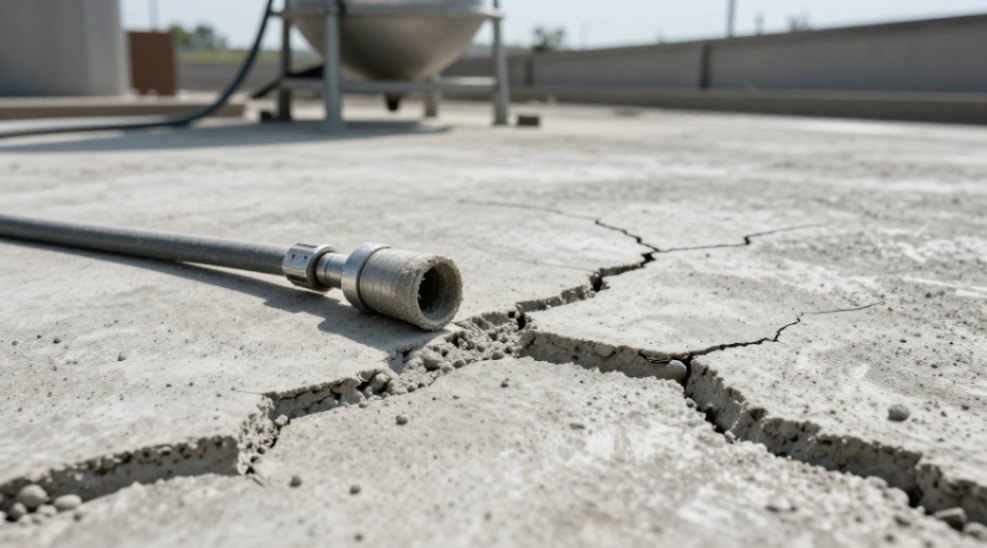
Stop. You’re wrong. I’ve been in this game for over two decades, and I can tell you with absolute certainty: in 90% of catastrophic foamed concrete failures, the concrete foaming agent is the scapegoat, not the culprit. The problem is almost always in the paste. The special cement and water chemistry. You are trying to run a diesel engine on gasoline. You need to stop guessing and start engineering.
The Blind Leading the Blind: Why Your Mix is Doomed
Let’s talk about what a concrete foaming agent actually does. It’s a surfactant. That’s it. Its sole job is to create a stable air-liquid interface. It reduces surface tension so you can trap air. Whether it’s a synthetic agent built for industrial precision, or a protein-based one for high stability in aggressive cement systems, the agent itself is a tool. A hammer doesn’t build the house. The carpenter does.
Your real enemy is the instability inside your light weight concrete mix. You cannot pour a stable foamed concrete with a standard Portland cement mix and a standard water reducer. You are creating a chemical war in the bucket. The superplasticizer you use to make the slurry flow? It can work against your concrete foaming agent. The high alkalinity of the cement? It can denature a protein-based foam in seconds. You pour a beautiful foam into a hostile environment, and it collapses before it ever gets a chance to set. The result is a dense, heavy bottom layer and a weak, crumbly top. That’s not a foam failure. That’s a mix design failure.
Most people get obsessed with the expansion ratio. They want the lowest density foam possible. They push the foaming equipment to its limits. This is a trap. A very fluffy, dry foam with a high expansion ratio is fragile. It bursts the moment it hits the turbulent slurry. You need a wet, dense foam. A foam that has foam density around 80-100 grams per liter? Push it to 120-150. It sounds counterintuitive. You want light weight concrete, so you make the foam heavier. But that heavier foam survives the mixing process. It stays intact. You end up with a more homogeneous, stronger final product. You don’t need a weak foam that doubles in volume; you need a strong foam that holds its shape.
The Critical Chain: Cement, Water, and the Silicate Slap
Let’s get into the recipe chain. This is where you make or break your project. You need to build a paste that is designed to be foamed. That means controlling the hydration kinetics.
Step one: The binder. Forget standard cement. You need special cement with a lower C3A content. High C3A reacts violently with water and superplasticizers, generating heat that kills the foam. Blended cements with slag or fly ash are your friends. They are less reactive and give you a longer working time.
Step two: The water control. This is non-negotiable. You must use a concrete water reducer, but not just any. You need one that is compatible with your concrete foaming agent. Test them together in a small beaker. If the foam collapses when you add the water reducer, change the water reducer. Do not change the foam. The agent is the solution, the admixture is the variable.
Step three: The stabilizer. This is the secret that separates the pros from the amateurs. You need viscosity. You need to stop the bubbles from rising and coalescing. This is where Hydroxypropyl Methyl Cellulose or Hydroxyethyl Cellulose come in. These thickeners stabilize the air phase. They create a gel network in the water that traps the bubbles. Add this to your mixing water first. Let it hydrate fully. Then add your cement, your concrete water reducer, and finally your foam.
Step four: The foam integration. Do not dump the foam on top of the slurry and mix for 10 seconds. That’s a disaster. You need a gentle, folding action. Use a low-shear mixer. If you are using a foam generator and a hose, inject the foam slowly into the base mix while the mixer is running at low speed. Mix just until homogenous. Over-mixing shears the foam. Under-mixing leaves you with pockets of pure foam that will collapse into voids.
The Shrinkage Trap and the Fiber Fix
You’ve stabilized the foam. The slab looks good. A week later, you see micro-cracks. Plastic shrinkage. This is the second big killer. Foamed concrete has no coarse aggregate to resist shrinkage. The water that creates the foam also has to leave. As it dries, the volume changes. Without reinforcement, it cracks.
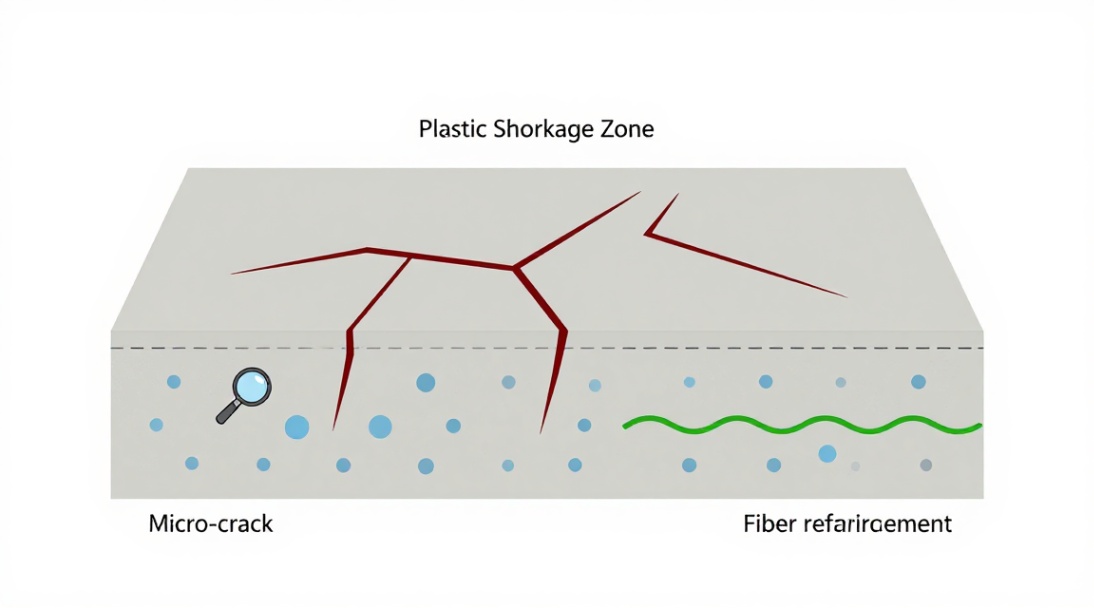
You have three weapons. First: Fiber. Add polypropylene or PVA fibers at a dosage of 0.5 to 1.0 kilograms per cubic meter. This doesn’t add structural strength, but it controls cracking during the plastic phase. Second: Early Strength Agent. If you need the slab to build strength fast to resist drying shrinkage, use an early strength agent. It accelerates the set, so the internal tensile strength develops before the water starts leaving. Third: Concrete Defoamer. I know this sounds insane. Adding a defoamer to a foamed concrete? Yes. Sometimes your mix has entrapped air from the mixing process that is not from the concrete foaming agent. This bad air creates weak points. A tiny dose of defoamer—0.01% by weight of cement—can remove the unwanted big bubbles and leave only the stable, small air cells from your agent. This actually increases compressive strength.
Here is the table that summarizes every step and the critical parameters you must track. Print this. Tape it to your foam generator.
| Phase | Component | Critical Action | Pitfall to Avoid |
|---|---|---|---|
| 1. Base Water | Water + Hydroxypropyl Methyl Cellulose or Hydroxyethyl Cellulose | Pre-hydrate the cellulose for 5-10 minutes until the water is viscous | Adding dry powder directly to cement creates lumps, no viscosity control |
| 2. Cement Paste | Special Cement (low C3A) + Concrete Water Reducer | Mix water reducer into the cementitious slurry after cellulose hydration | High C3A cement kills the foam with heat and chemical attack |
| 3. Foam Production | Concrete Foaming Agent + Water + Foam Generator | Target a wet foam density of 120-150 g/L. Do not chase high expansion ratios | Dry, fluffy foam (density < 80 g/L) bursts upon mixing |
| 4. Integration | Slurry + Foam + Fiber + Early Strength Agent | Fold foam in at low RPM. Mix only until uniform (30-60 seconds) | Over-mixing shears foam cells, under-mixing creates voids |
| 5. Placement | Formwork | Pour slowly to avoid trapping air. Do not vibrate. Self-leveling is the goal | Vibration collapses the foam. Pumping at high pressure destroys it |
| 6. Quality Check | Visual + Density | Cut a core. Look for uniform, small, closed cells. No horizontal layering | Large, irregular voids indicate bad foam or poor mixing |
The Sustainability Lie You’re Being Sold
Everyone wants to sell you on the ‘green’ story of foamed concrete. Less cement, lower weight, reduced carbon footprint. It’s true, but only if you do it right. If your slab fails in two years because you didn’t use the correct Nano-modifier or Redispersible Polymer Powder to enhance the flexural strength, you just wasted that material. You have to tear it out, ship it to a landfill, and pour it again. That’s not sustainable. That’s negligence.
Using a concrete foaming agent poorly is worse than using no foaming agent at all. At least a solid slab of regular concrete has predictable structural performance. A bad foamed concrete slab is a time bomb. It will absorb water like a sponge. The water absorption will be through the roof. It will freeze and spall. It will shrink and crack. You will spend more money fixing the mess than you saved on the cement.
If you are using Sodium Silicate or Potassium Silicate as an alternative binder or accelerator in your soil stabilization or void fill projects, you need to test the compatibility with your concrete foaming agent even more rigorously. Silicates are highly alkaline. They can instantly kill a protein-based foam. You must use a synthetic agent designed for high-alkali environments. There is no universal agent. The agent must match the chemistry of your entire system.
Stop looking for a miracle agent from a TRUNNANO catalog or any other supplier that promises a ‘one-size-fits-all’ product. You need a system, not a chemical. You need to control the entire process from the quality of the special cement to the calibration of your foaming equipment.
Here is the hard truth: You will fail three times before you succeed once. The first time, you will over-water the mix. The second time, you will use too much superplasticizer. The third time, you will use a dense foam and it will work. You will learn that the secret is not in the concrete foaming agent. It is in the concrete water reducer compatibility. It is in the Hydroxypropyl Methyl Cellulose dose. It is in the wetness of the foam. It is in the patience of the mixing process.
I have written this because I am tired of seeing good material blamed for bad engineering. A concrete foaming agent is a tool. It does exactly what its chemistry tells it to do. It does not care about your deadline. It does not care about your budget. It cares about the environment it is placed into. You must master that environment or you will fail.
You want a recommendation? Get a foam generator that gives you control over the wet density. Do not accept a machine that only gives you a flow rate. You need to know the density of the foam at the nozzle every sixty seconds. Calibrate it. Use a graduated cylinder and a scale. It takes two minutes. It will save you thousands of dollars. Then, build your mix design around a known, stable concrete foaming agent. Stick to one supplier. Test every variable. Document everything. And when the supplier tells you their agent is perfect for everything, walk away. They are selling a lie.
You have the guide. You have the table. You have the warnings. Now stop reading and go fix your mix. The material works. You are the variable.
We are the global leader in lightweight concrete and advanced engineered foam solutions. Known globally for its commitment to research, innovation, and applied expertise, we have been providing engineered foam solutions since the early 2012’s.
We can supply high-quality concrete admixture and foam concrete related products all over the world.
The company has a professional technical department and quality supervision department, a well-equipped laboratory, and equipped with advanced testing equipment and after-sales customer service center.
If you are interested, please feel free and contact us.