Professional solutions on concrete addtives, Concrete Foaming Agent, Superplasticizer, CLC Blocks Additives, and foaming machine

Find a Low Cost Water Reducer for Ready Mix Concrete Without Sacrificing Strength
The Call That Changed Our Mix
Years ago, I got a frantic call from a batch plant manager. A key high-range admixture hadn’t arrived. A full day of pours was about to shut down. We had two choices: cancel everything or get creative. We looked at the bags of lignosulfonate-based water reducer we used for basic mixes. Could we make it work? By recalibrating our mix design and adjusting the dosage, we not only finished the day but also saved a bundle. That day proved a point we’ve seen countless times since: a smartly used low cost water reducer for ready mix concrete is an indispensable tool, not just a cheap backup.

What is a Low Cost Water Reducer, Really?
At its core, a water reducer does exactly what it says. It lets us use less water in a mix while keeping it fluid enough to place. The “low cost” part typically refers to standard or mid-range products like lignosulfonates or gluconates. They’re not as powerful as premium superplasticizers, but they deliver excellent value for a huge range of everyday concrete. Their primary function is to lower the water-cement ratio. This single action is the master key to better concrete. A lower w/c ratio directly increases compressive strength and improves long-term durability by reducing permeability. We’re talking about denser, more resilient concrete from a relatively simple admixture.
Your Options: A Direct Comparison
You can’t choose wisely without a clear comparison. Let’s break down the two most common types of low cost water reducers you’ll encounter for ready mix.
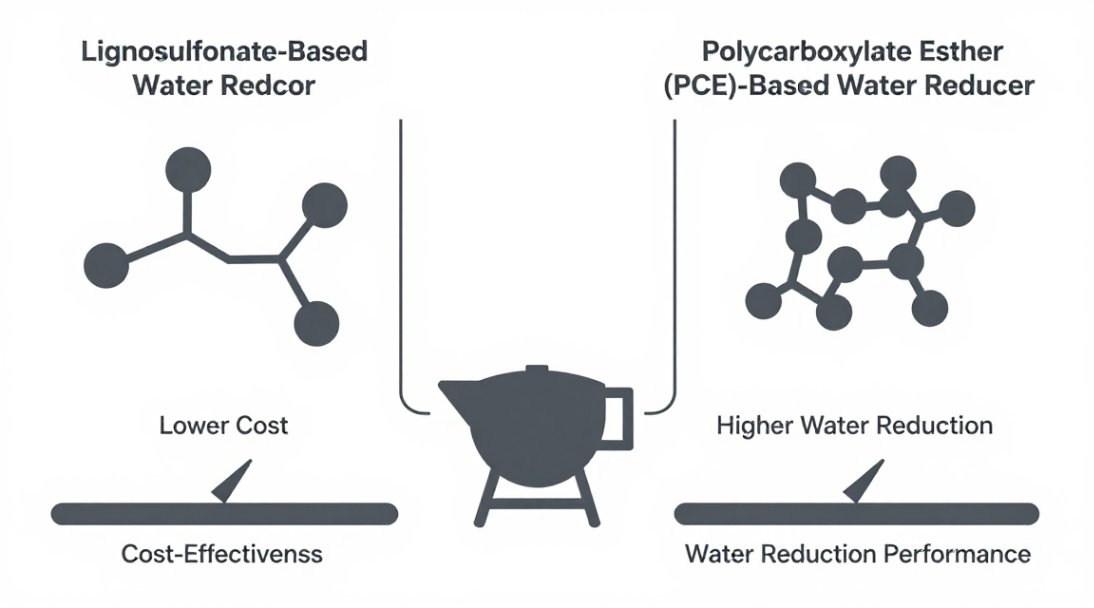
| Type | Core Material | Typical Water Reduction | Key Benefit | Primary Use Case | Cost Profile |
|---|---|---|---|---|---|
| Lignosulfonate-Based | Processed wood pulp byproduct | 5-10% | Reliable workability, some air entrainment, excellent cost-to-benefit ratio. | Standard footings, slabs, curbs, mass concrete. The workhorse of the industry. | Lowest cost option. Highly economical for volume production. |
| Gluconate-Based | Fermentation-derived sugar acid | 8-12% | Better workability retention, less air entrainment, often more consistent. | Mixes requiring longer haul times, moderate slump retention needs. | Moderately higher than lignosulfonates, but still very cost-effective. |
The choice isn’t about which is “better” universally. It’s about which is better for your specific mix, haul time, and finish. For most standard ready-mix, lignosulfonates are the starting point.
The Step-by-Step Guide to Using Low Cost Reducers
Success with these admixtures hinges on method, not magic. Follow these steps.
Step 1: Source from a Reliable Supplier
This is the most critical step. A “low cost” admixture that fails consistency tests costs you far more in rejected loads. Evaluate suppliers on three criteria: batch-to-batch consistency reports, local technical support availability, and a proven track record with other plants. Don’t just buy a chemical; buy reliability.
Step 2: Run Compatibility Trials
Never assume compatibility. Cement chemistry changes. You must trial the admixture with your specific cement and aggregates. Mix a small batch. Check for normal setting, no flash set, and no excessive air. This step prevents catastrophic failures on the job site.
Step 3: Determine the Optimal Dosage
Start at the supplier’s recommended mid-range dosage, typically 2-6 oz per 100lb of cement. Then, adjust in small increments. Your goal is the minimum dosage that achieves your target slump with the lowest possible water content. More is not better. Overdosing can cause severe retardation or air entrainment issues.
Step 4: Integrate into Batching Sequence
Proper batching is non-negotiable. For best results, add the water reducer to the mixing water or with the initial batch water. This ensures even distribution throughout the mix. Adding it late to “fix” a dry mix leads to uneven performance.
Step 5: Implement Rigorous Quality Control
Your QC plan must include frequent checks. Test slump on every truck. Check air content at least daily. Most importantly, cast cylinders. The true test of your low cost water reducer and mix design is the 7-day and 28-day compressive strength. This data proves you’re saving money without sacrificing performance.
Understanding the Trade-Offs
Be realistic. A standard lignosulfonate won’t give you the 12-inch slump of a superplasticizer. Its workability retention is shorter. There’s a trade-off between cost and peak performance. But here’s the logic: if your spec calls for a 4-inch slump for a footing, why pay for a high-range admixture? You’re buying capability you don’t need. The low cost water reducer for ready mix concrete hits the sweet spot for probably 70% of all concrete placed. It provides the necessary water-cement ratio reduction for strength and durability at the best possible price point.
The Path Forward: Stop Overpaying for Basic Mixes
We’ve walked through the what, the why, and the how. The data from your trial mixes will tell the final story. You’ll see the strength gains, the cost savings per cubic yard, and the reliability. The goal isn’t to use the cheapest product. It’s to use the most cost-effective product that meets the spec. For most everyday ready-mix concrete, that product is a high-quality, consistent lignosulfonate or gluconate-based water reducer.
Your next move is clear. Audit your last month of mix designs. Identify every pour that didn’t require high-range performance. For those mixes, initiate a supplier evaluation for a proven low cost water reducer. Run the trials. Measure the results. The savings will be substantial, and your concrete will remain strong. Start the process this week.
We are the global leader in lightweight concrete and advanced engineered foam solutions. Known globally for its commitment to research, innovation, and applied expertise, we have been providing engineered foam solutions since the early 2012’s.
We can supply high-quality concrete admixture and foam concrete related products all over the world.
The company has a professional technical department and quality supervision department, a well-equipped laboratory, and equipped with advanced testing equipment and after-sales customer service center.
If you are interested, please feel free and contact us.