Professional solutions on concrete addtives, Concrete Foaming Agent, Superplasticizer, CLC Blocks Additives, and foaming machine

Why Non-Toxic Biodegradable Release Agents Are Now the Standard in Professional Concrete Work
The Chemical Barrier Redefined
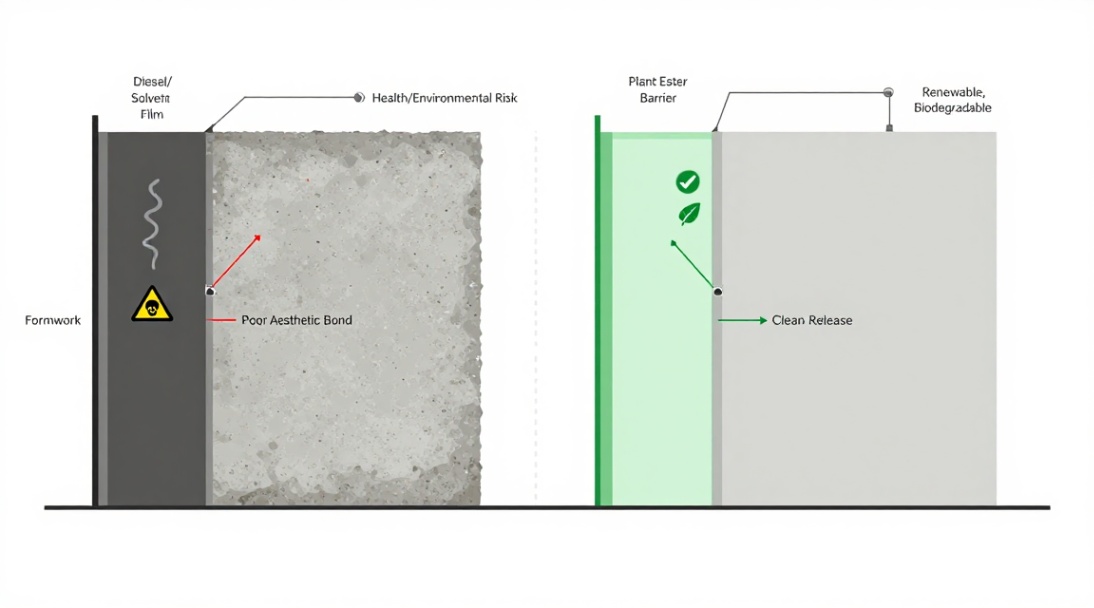
A non-toxic biodegradable concrete release agent is a chemically engineered barrier. Its purpose remains foundational: to prevent fresh concrete from bonding to formwork or molds. The difference lies in its composition and consequences. Traditional agents rely on diesel fuel, solvents, or heavy petroleum oils. These legacy products leave a film that can compromise surface aesthetics and pose significant health and environmental risks. The modern alternative uses plant esters, seed oils, and other renewable resources. This shift is not merely a trend. It is a fundamental correction to a long-standing industrial process, driven by stricter regulations and demonstrable performance advantages.
Deconstructing the Formula
You cannot understand the product without analyzing its ingredients. Traditional solvent-based agents are simple. They are hydrocarbons designed to evaporate. Petroleum-based agents are heavier, lingering on the concrete surface. Both categories contain volatile organic compounds (VOCs) and are classified as hazardous materials. Non-toxic biodegradable formulas are complex. Their primary active ingredients are derivatives of soybean, canola, or sunflower oil. These undergo transesterification and other processes to achieve specific molecular weights and surface tensions. Additives enhance lubricity, anti-corrosion properties, and drying times. The result is a stable emulsion that provides a clean, consistent release without contaminating the concrete pore structure or the job site.
Performance is the Proof
The industry transition is data-driven, not ideological. On Reddit and professional forums, concrete finishers and precast plant managers report clear patterns. A common thread: “Switching to a premium biodegradable agent eliminated the blotchy, oily stains on our architectural panels. Our rejection rate for surface defects dropped by an estimated 60%.” Benchmarks are critical. First, stripping time. A high-performance biodegradable agent should facilitate early form removal equal to or better than its petroleum counterpart. Second, surface finish quality. It must produce a uniform matte or gloss finish without pitting, discoloration, or “burn” marks. Third, corrosion prevention. The film should actively protect steel and aluminum forms from rust and oxidation, extending their service life.
The Site Safety and Compliance Advantage
Environmental claims are secondary to on-the-ground realities. Worker safety is paramount. Solvent fumes in enclosed spaces like precast beds or tunnel forms are a severe health hazard. They cause headaches, dizziness, and long-term organ damage. Non-toxic agents have negligible VOCs. Workers can apply them without respirators in most scenarios. Spill response changes completely. A spill of a biodegradable agent is a cleanup task. A spill of diesel or solvent is a hazardous materials incident requiring emergency protocols and costly remediation. This directly impacts insurance premiums and project liability. Certifications to demand include NSF/ANSI/CAN 61 for contact with drinking water, USDA BioPreferred labeling, and compliance with local VOC regulations like California’s CARB.
Application Truths and Economic Logic
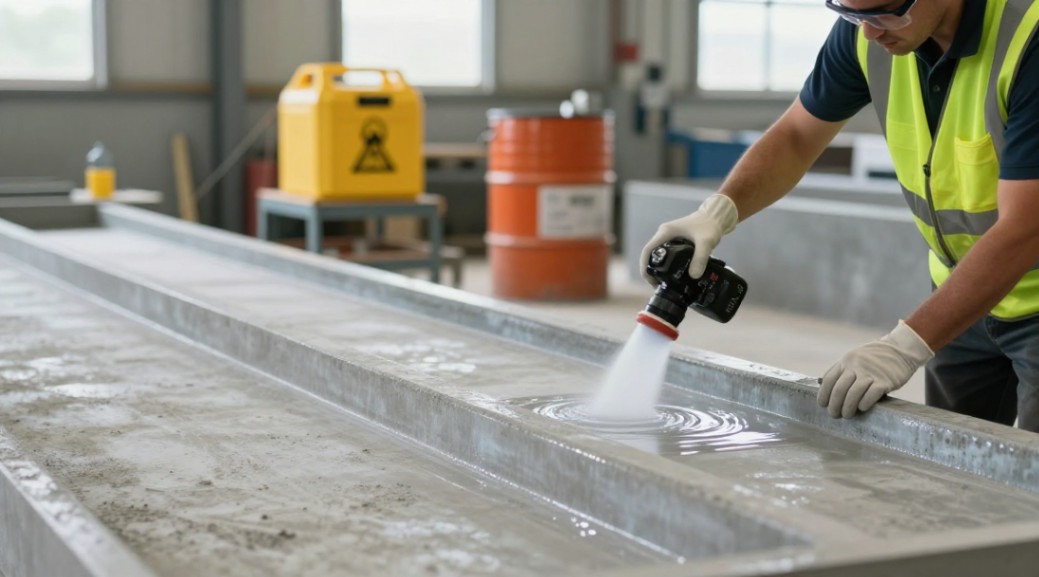
Application methods differ. Biodegradable agents are typically water-emulsifiable. You apply them via sprayer at a dilution ratio specified by the manufacturer-often between 1:4 to 1:10 with water. Uniform, thin coverage is essential; a heavy, puddled application will perform poorly. For stamped concrete, a light mist is often sufficient to prevent tool sticking without affecting integral colour. The cost analysis requires a full-cycle view. Yes, the concentrate may carry a 10-20% higher price per gallon than a cheap diesel blend. However, its dilutability makes the cost per square foot of coverage competitive or lower. Factor in reduced concrete waste, eliminated solvent purchase for cleanup, lower disposal costs, and extended formwork life. The long-term value proposition becomes unambiguous.
Storage and the Future of Formwork
Proper storage is non-negotiable. Store containers in a cool, dry place. Prevent freezing. Because these are biological products, prolonged storage in extreme heat can promote microbial growth. Use clean, dedicated equipment. Contamination with old petroleum-based agents will ruin the emulsion. The industry trend is irreversible. Sustainable construction ratings like LEED and BREEAM now award points for using low-impact chemicals. Major infrastructure projects and government contracts increasingly mandate non-toxic, biodegradable solutions. This is not a niche product for specialty architectural work. It is becoming the default specification for all concrete applications, from mass-produced precast culverts to intricate architectural façades. The performance, safety, and economic data have settled the debate.
Beyond the Product Spec Sheet
The move to non-toxic biodegradable release agents reflects a mature industry. It prioritizes predictable results, human safety, and long-term asset preservation over short-term, superficial cost savings. For the project manager, it simplifies compliance and mitigates risk. For the concrete finisher, it delivers a superior, consistent surface with less rework. For the formwork carpenter, it means tools and molds that last for years, not seasons. The core takeaway is operational excellence. The correct release agent is not an ancillary consumable; it is a critical process variable that influences quality, schedule, safety, and profit. Evaluate your current agent against these benchmarks. The gap you identify will dictate the necessity and urgency of your switch.
We are the global leader in lightweight concrete and advanced engineered foam solutions. Known globally for its commitment to research, innovation, and applied expertise, we have been providing engineered foam solutions since the early 2012’s.
We can supply high-quality concrete admixture and foam concrete related products all over the world.
The company has a professional technical department and quality supervision department, a well-equipped laboratory, and equipped with advanced testing equipment and after-sales customer service center.
If you are interested, please feel free and contact us.