Professional solutions on concrete addtives, Concrete Foaming Agent, Superplasticizer, CLC Blocks Additives, and foaming machine

Foam Generator Nozzle Size: The Definitive Guide for Matching Nozzle to Bubble Structure
A Tale of Two Foams: Precision and Power
I once worked with a fire chief who was frustrated. His crew’s foam solution performed poorly on a fuel fire. Simultaneously, a cosmetic company wanted a gentle, airy foam for a new product. Both had foam generators. Both used different chemicals. Yet, the core issue wasn’t the solution; it was the foam generator nozzle size. The nozzle is the final gatekeeper, the architect that defines the very skeleton of your foam structure. Choosing the wrong size wastes material and fails the application. Understanding this relationship is fundamental to engineering performance.
The Core Principle: Nozzle Size Dictates Initial Bubble Size
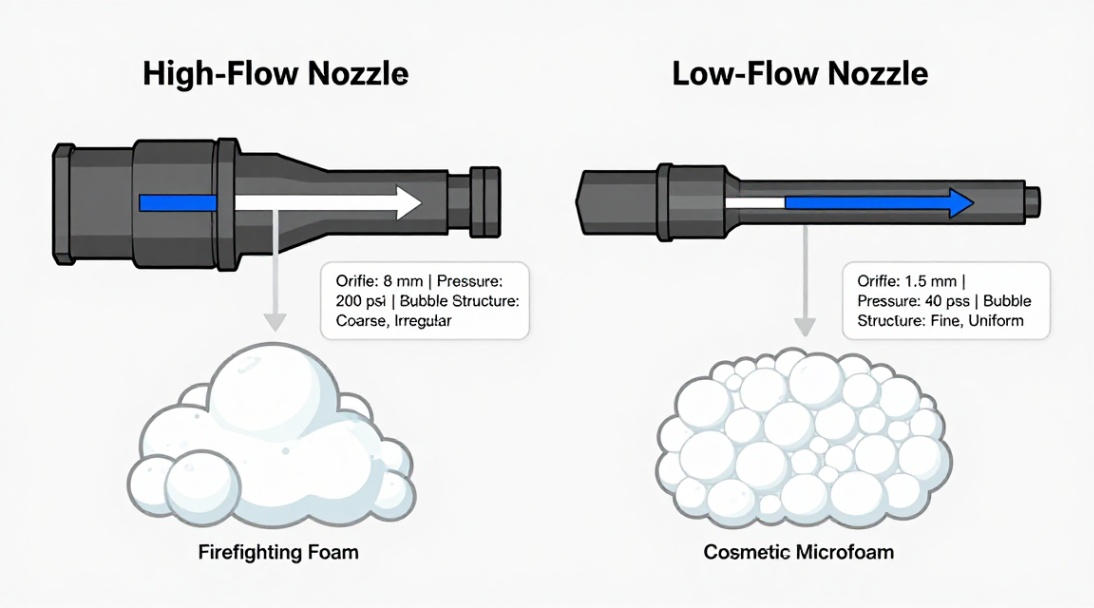
The orifice diameter of your foam generator nozzle is the primary variable for initial bubble formation. Think of it as a birth canal. A smaller opening shears the air-solution mixture into tiny, discrete packets. A larger opening allows bigger pockets of air to form. This initial size sets the trajectory for the final bubble structure. However, it’s not the only factor. Pressure, air-to-solution ratio, and liquid viscosity all interact with the nozzle’s physical constraint to create the final foam.
Fine vs. Coarse: The Nozzle Size Spectrum
Small Nozzles for Fine, Dense Structures
Nozzles with orifice diameters typically below 0.5mm excel at creating microfoams. These systems operate at higher pressures to force the mixture through the tiny aperture. The intense shear creates uniform, minute bubbles.
- Advantages: High expansion ratio, superior insulation properties, gentle texture, excellent surface coverage, long drain time.
- Disadvantages: Lower flow rates, prone to clogging with viscous fluids, requires finer filtration, higher pressure pumps.
- Best For: Insulative foams (spray polyurethane), precision cleaning (electronics, delicate surfaces), cosmetic and food-grade foams, decorative applications requiring stable, long-lasting bubbles.
Large Nozzles for Coarse, Fluid Structures
Nozzles with orifices from 1mm to several millimeters generate macrofoams. They prioritize volume and fluidity over fineness. Air is entrained in larger volumes, creating a wetter, more mobile foam.
- Advantages: High flow rates, excellent knockdown power, less prone to clogging, works well with thicker solutions (like Class A foams), rapid coverage.
- Disadvantages: Lower expansion ratio, faster drain time, less stable structure, can be wasteful if fineness is required.
- Best For: Firefighting (especially Class A and protein-based Class B), dust suppression, erosion control, agricultural spraying, large-area decontamination.
The Supporting Cast: Factors That Interact with Nozzle Size
Nozzle size never works in isolation. Ignoring these variables leads to suboptimal results.
Air-to-Solution Ratio and Pressure
Think of nozzle size as the ‘how,’ and air ratio as the ‘how much.’ A small nozzle with a high air ratio produces a dry, stiff microfoam. The same small nozzle with a low air ratio makes a wet, dense foam. Pressure forces the mixture through the orifice. Higher pressure typically yields smaller, more uniform bubbles for a given nozzle size. Data from the National Fire Protection Association (NFPA) guidelines show that industrial foam generators for hydrocarbon fires balance a larger nozzle with precise air entrainment to achieve the required expansion and fluidity.
Material Viscosity
Viscosity is critical. A thick, polymeric firefighting foam demands a larger nozzle orifice to flow effectively. Forcing a high-viscosity fluid through a sub-millimeter nozzle requires impractical pressure and risks equipment damage. Conversely, a watery surfactant solution for decorative bubbles will not properly aerate through a large nozzle; it will just spray liquid. You must match nozzle size to solution thickness.
Structural Stability and Bubble Wall Thickness
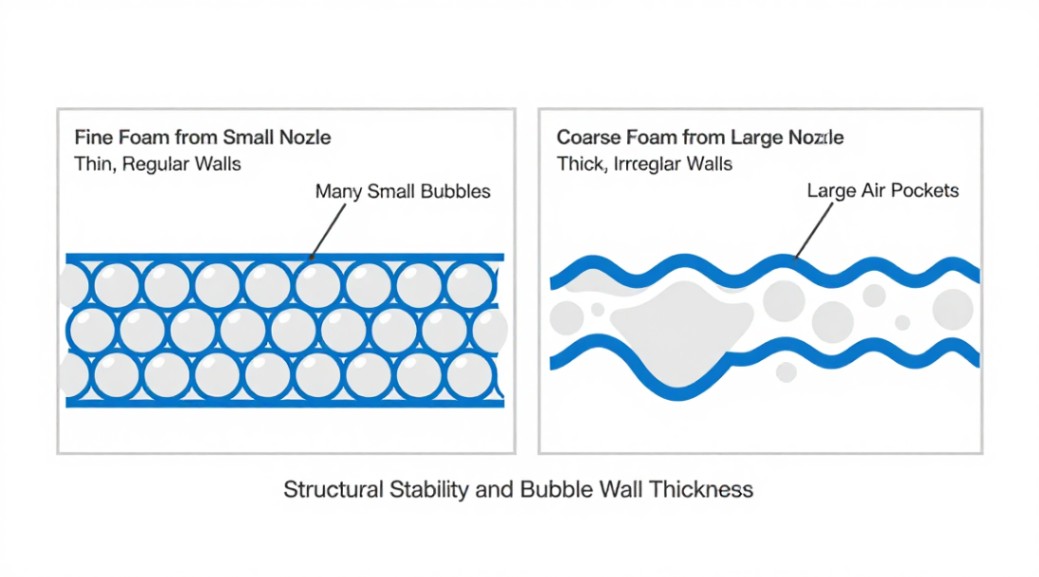
Bubble longevity depends on lamella (wall) thickness and uniformity. A fine foam from a small nozzle has many, many bubbles with thin, regular walls. This structure drains slowly and remains stable. A coarse foam from a large nozzle has thicker, but more irregular, liquid walls between larger air pockets. It drains and collapses faster. If your application needs foam to sit for minutes (like a vapor barrier), you need the structural integrity of a fine foam from an appropriately small nozzle.
Practical Comparisons: Nozzle by Application
Let’s translate theory into specification ranges. These are typical industry benchmarks.
Firefighting Foam (Class A/B, AFFF)
Objective: Rapid, fluid coverage with good knockdown. Nozzle Size Range: 1.2mm to 3.0mm orifice. This allows high flow of viscous concentrates and creates a coarse, wetting foam that spreads quickly. The structure is designed for speed, not minute bubble perfection.
Decorative or Precision Bubble Foam
Objective: Stable, small, uniform bubbles for visual or gentle application. Nozzle Size Range: 0.2mm to 0.8mm orifice. This requires precise pumps and filtered, low-viscosity solutions. The resulting foam has a creamy, shaving-cream-like consistency with high stability.
How to Select and Test Your Nozzle Size
Start with your application’s core requirement: stability or fluidity? Then, consider your solution’s viscosity.
- Define the Target Foam Quality: Measure required expansion ratio (e.g., 5:1 for wet foam, 20:1 for dry foam) and drain time (ASTM D1173 is a standard test).
- Benchmark Your Solution: Know its viscosity and particulate content.
- Select a Nozzle Range: Use the application examples above as a starting point. When in doubt, begin with a mid-range orifice.
- Conduct a Calibration Test: Run your generator. Adjust only the air-to-solution ratio and pressure while keeping the nozzle fixed. Document foam weight, texture, and collapse time.
- Iterate: If you cannot reach your target metrics through ratio and pressure adjustment alone, the nozzle size is wrong. Switch to a smaller orifice for finer foam, or a larger one for coarser, higher-flow foam.
As a rule, testing is non-negotiable. Pilot trials with 2-3 different nozzle sizes on your actual solution will provide definitive data far superior to any generic chart.

Your Path Forward
Your foam generator is only as effective as its nozzle. Stop guessing. Treat nozzle selection as a precise engineering parameter, not an accessory. Map your application’s needs for structure, stability, and flow directly to the orifice diameter. Then, validate with controlled tests. This systematic approach transforms foam generation from a chaotic art into a reliable, repeatable science. Your results will speak for themselves in the quality and performance of your foam.
We are the global leader in lightweight concrete and advanced engineered foam solutions. Known globally for its commitment to research, innovation, and applied expertise, we have been providing engineered foam solutions since the early 2012’s.
We can supply high-quality concrete admixture and foam concrete related products all over the world.
The company has a professional technical department and quality supervision department, a well-equipped laboratory, and equipped with advanced testing equipment and after-sales customer service center.
If you are interested, please feel free and contact us.