Professional solutions on concrete addtives, Concrete Foaming Agent, Superplasticizer, CLC Blocks Additives, and foaming machine

Forget the Manual: The Brutally Honest Guide to Your Foam System’s Lifeline
The Day Our System Failed
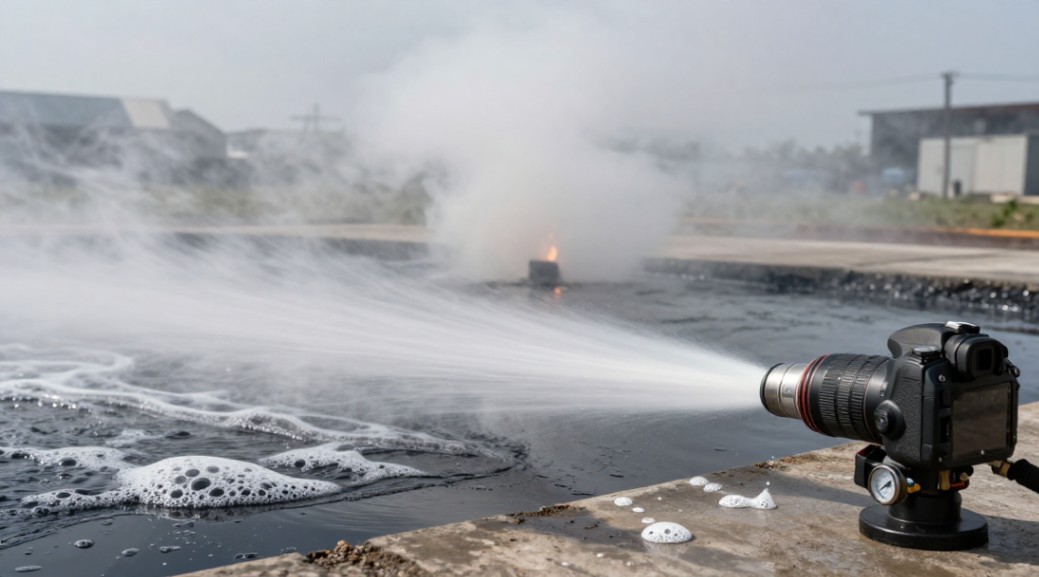
It wasn’t a drill. Smoke poured from a Class B fuel spill drill, but our foam blanket was a thin, pathetic bubble bath. The system had passed its “weekly check.” The pressure gauge looked fine. Yet, there we were, facing a simulated disaster with a failing piece of kit. The problem? A maintenance schedule built on compliance, not comprehension. This is the guide I wish I had 20 years ago.
Your Schedule is Your Strategy
Let’s be blunt. A calendar-based schedule is wrong. Your foam system‘s maintenance needs depend on three things: usage, environment, and component stress. A system in a humid, salty coastal firehouse needs more attention than one in a dry, inland storage facility. Treat them the same, and you invite failure.
The Decision Matrix: Task vs. Frequency
Standard checklists are useless without context. Here’s a side-by-side comparison of common approaches versus what actually works.
Daily/Pre-Use Check: Perception vs. Reality
The Standard List: “Check pressure, inspect for leaks.” It’s vague. Technicians tick the box without understanding the ‘why.’
The Operational Reality: This is a tactical mission briefing. Don’t just look at the pump. Listen to it. A high-pitched whine from the proportioner could mean air ingress, destroying your foam concentrate’s expansion ratio before it even leaves the nozzle. Your daily log should note sound, vibration, and discharge time, not just ‘OK.’
Weekly Battles: The Seals and Hoses War
The Standard List: “Inspect seals and hoses.”
The Reality Cheque: Hoses don’t fail in the middle. They fail at the couplings. Weekly, you must aggressively flex each hose near its end connections, looking for micro-cracks. Seals on the proportioner aren’t just ‘checked’-they are assessed for weeping, which indicates wear long before a catastrophic leak. A dry, slightly chalky O-ring is a failure in progress.
Monthly Deep Dive: Function, Not Just Form
The Standard Temptation: A visual inspection and a quick flow test.
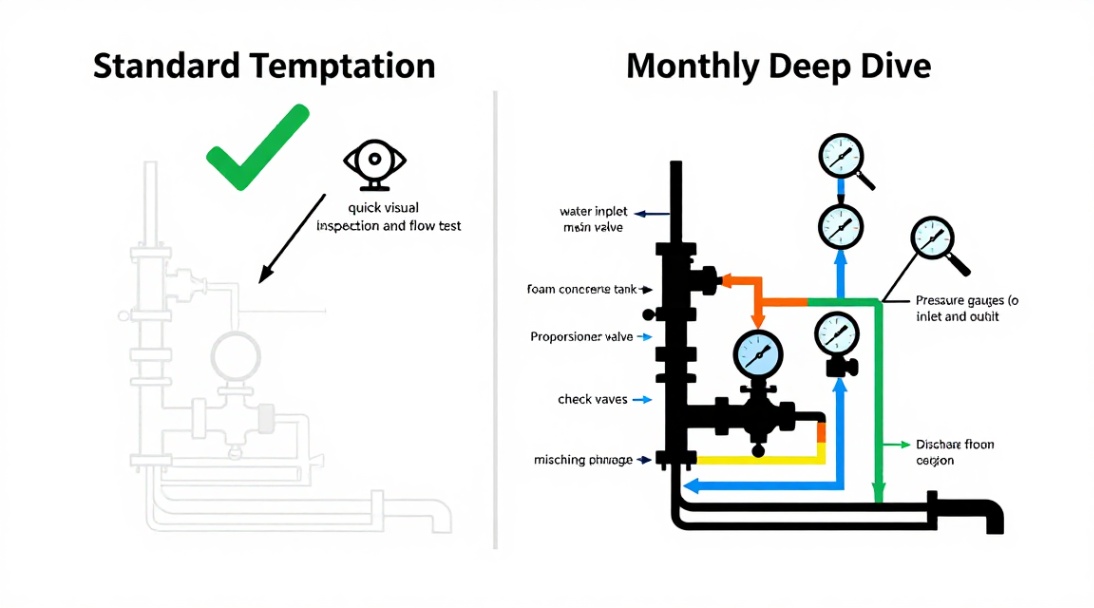
The Expert Mandate: This is your system’s stress test. You must verify proportioning accuracy with a refractometer or dedicated test kit. Guessing is negligence. Flush the system with clean water and verify complete drainage to prevent concentrate degradation and bacterial growth in the tank-a common, smelly culprit of system clogging.
The Annual Reckoning: Beyond the Sticker
The Complacent Path: Getting the certification sticker from a third-party.
The Authority Path: The annual service is an autopsy on a living system. Demand ultrasonic thickness testing on foam tanks to check for internal corrosion. Require full flow performance data from the service provider, not just a pass/fail. As per NFPA 11 and 25, this is when you validate that the entire system, from intake to nozzle, performs at its original design specification. If your provider can’t give you that data, find a new one.
The Cost of Compromise: A Simple Equation
Industry data from Fire Apparatus Manufacturers’ Association (FAMA) reports shows a direct correlation: systems on a rigorous, performance-based maintenance schedule have a 60% lower total cost of ownership over 15 years. They avoid the two biggest budget killers: emergency breakdown repairs and premature full-system replacement due to undetected component degradation.
Who Touches Your System?
Here’s an uncomfortable truth. A general mechanic cannot maintain your foam system. The personnel performing these tasks require specific training on foam chemistry, hydraulic dynamics of proportioning systems, and the relevant NFPA standards. Their competency is your first and most critical layer of defence.
Your Next Move
Stop following a generic calendar. Today, pull your maintenance logs. Cross-reference them with any minor operational issues-slow priming, slight pressure drop. That’s your starting point. Build a dynamic schedule that prioritizes the components under the most stress. Your foam system isn’t just equipment; it’s your last line of defense. Treat its care with the seriousness that deserves.
We are the global leader in lightweight concrete and advanced engineered foam solutions. Known globally for its commitment to research, innovation, and applied expertise, we have been providing engineered foam solutions since the early 2012’s.
We can supply high-quality concrete admixture and foam concrete related products all over the world.
The company has a professional technical department and quality supervision department, a well-equipped laboratory, and equipped with advanced testing equipment and after-sales customer service center.
If you are interested, please feel free and contact us.