Professional solutions on concrete addtives, Concrete Foaming Agent, Superplasticizer, CLC Blocks Additives, and foaming machine

Superplasticizer for SCC: 5 Critical Mistakes to Avoid for Stable, Segregation-Free Concrete
Are You Sabotaging Your SCC with Your Superplasticizer?
Have you ever watched a carefully designed self-consolidating concrete SCC mix bleed, segregate, or stiffen prematurely on site? The root cause is often a fundamental misunderstanding of the superplasticizer for self-consolidating concrete SCC. As a material engineer with two decades of field experience, I’ve seen the same critical errors repeated. This is not theoretical. This is a practical warning against common, costly failures.
The Core Principles: What You Must Get Right
A superplasticizer for self-consolidating concrete SCC is not just a water reducer. It is the single most critical component enabling the concrete to flow under its own weight while maintaining a homogeneous, stable suspension of particles. Its primary role is to provide electrostatic or steric hindrance, dispersing cement particles. This allows for the extreme fluidity required without adding excess water, which would destroy strength and durability.
Q1: What’s the biggest mistake when choosing a superplasticizer type?
Using an outdated naphthalene or melamine-based superplasticizer. These older formulations lack the precise control needed for modern SCC. Polycarboxylate ether PCE superplasticizers are the industry standard for a reason. Their molecular structure is tunable. You can engineer the polymer’s backbone and side chains to control slump flow, viscosity, and setting time independently. This precision is non-negotiable for achieving a robust, stable SCC that resists segregation.
Q2: Why does my SCC slump flow collapse after 30 minutes?
This is slump loss. You are likely using a PCE with poor compatibility or an incorrect dosage. PCE superplasticizers adsorb onto cement particles. If the chemistry clashes, they can be consumed too quickly or incompletely, losing their dispersing power. The result is rapid stiffening. The solution is rigorous compatibility testing with your specific cement and supplementary materials before the pour. Never assume a PCE that worked on one project will perform identically on another.
Q3: How do I prevent segregation and bleeding in high-flow SCC?
By understanding the balance between slump flow and plastic viscosity. A superplasticizer alone cannot prevent segregation. You must design the entire paste and mortar phase to provide adequate yield stress and viscosity. The superplasticizer for self-consolidating concrete SCC gives you flow. The fines content (cement, SCMs, fillers) and a viscosity-modifying admixture VMA provide the stability. Adding a PCE to a poorly graded, coarse mix will always result in separation. Stability is a system property, not an admixture feature.
Q4: Is there a “correct” dosage for PCE superplasticizers?
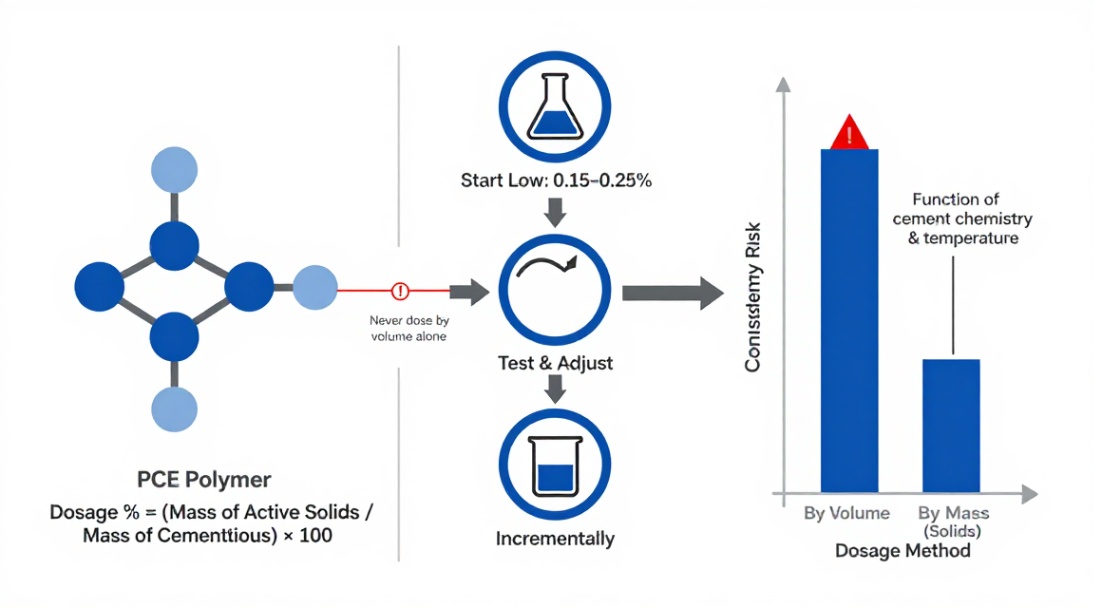
No universal correct dosage exists. It is a function of your cement chemistry, temperature, and desired workability retention. The cardinal sin is adding PCE by volume without regard to solids content. Always dose by mass of active polymer solids, typically as a percentage of the total cementitious materials weight. Start low, around 0.15% to 0.25% solids by weight of cement, and adjust incrementally. Overdosing can cause excessive retardation, air entrainment, or even rheology reversal.
Critical Batching and Mixing Protocol
Improper batching sequence is a silent killer of SCC performance. Follow this logic.
- Introduce 75-90% of the mix water first.
- Add all powders (cement, SCMs, fillers) and aggregates. Mix briefly to wet all materials.
- Add the majority of your PCE superplasticizer (e.g., 80%) to the remaining mix water, then introduce this solution.
- Mix for the full duration specified for high-performance concrete, typically 3-5 minutes in a central mixer.
- Assess slump flow. Add the reserved PCE solution in small increments (e.g., 0.02% solids increments) to reach target flow, mixing for at least 1 minute after each addition.
This method ensures uniform dispersion and prevents local overdosing, which can destabilize the mix.
Q5: What is the single most overlooked factor in superplasticizer selection?
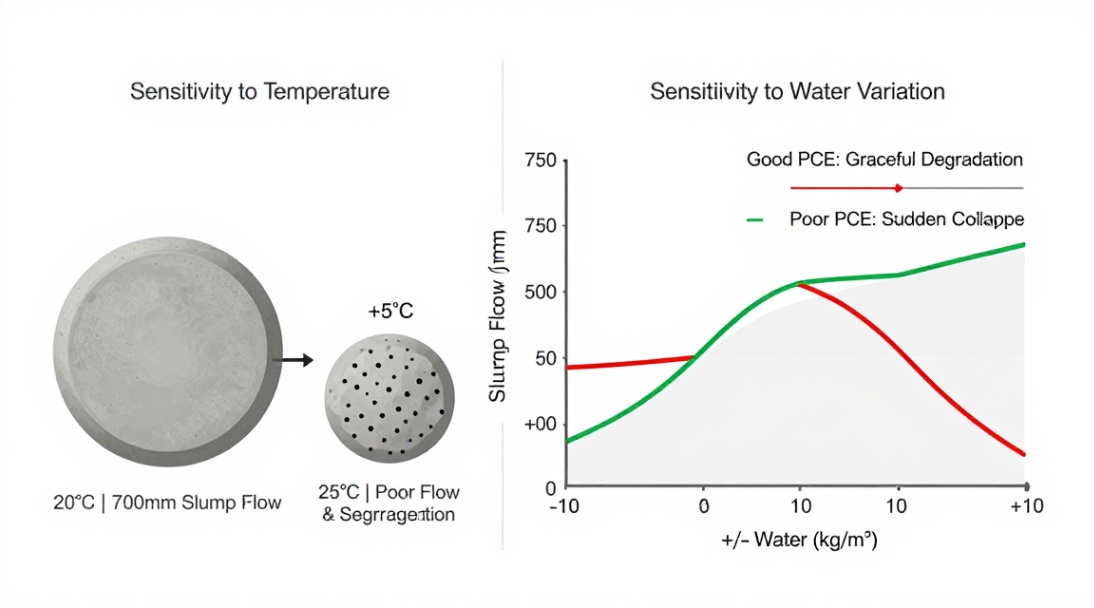
Sensitivity to minor mix variations. A “good” superplasticizer for self-consolidating concrete SCC provides a wide performance window. It should tolerate small changes in aggregate moisture, ambient temperature, or cement batch without catastrophic failure. A superplasticizer that delivers perfect 700mm slump flow at 20°C but seizes at 25°C is a liability. During selection, test your mix design at temperature extremes and with +/- 10kg/m³ variation in water content. The right PCE will show graceful degradation, not sudden collapse.
The Path to Reliable SCC
Avoiding these pitfalls requires a shift in perspective. View the superplasticizer for self-consolidating concrete SCC not as a magic fluid, but as a sophisticated chemical tool that interacts with every other component. Success lies in systematic testing, precise dosing by mass, and respecting the chemistry. Your next step is to conduct a full-scale trial batch using your exact materials and the protocols outlined here. Measure slump flow, viscosity, and air content over 90 minutes. Only then will you have the data-driven confidence to proceed. Trust the process, not the promise.
We are the global leader in lightweight concrete and advanced engineered foam solutions. Known globally for its commitment to research, innovation, and applied expertise, we have been providing engineered foam solutions since the early 2012’s.
We can supply high-quality concrete admixture and foam concrete related products all over the world.
The company has a professional technical department and quality supervision department, a well-equipped laboratory, and equipped with advanced testing equipment and after-sales customer service center.
If you are interested, please feel free and contact us.