Professional solutions on concrete addtives, Concrete Foaming Agent, Superplasticizer, CLC Blocks Additives, and foaming machine

Lightweight Concrete Overlays: The Bridge Engineer’s Secret Weapon for Lifespan & Loads
The Brutal Truth: Why Lightweight Concrete Wins the Overlay Game
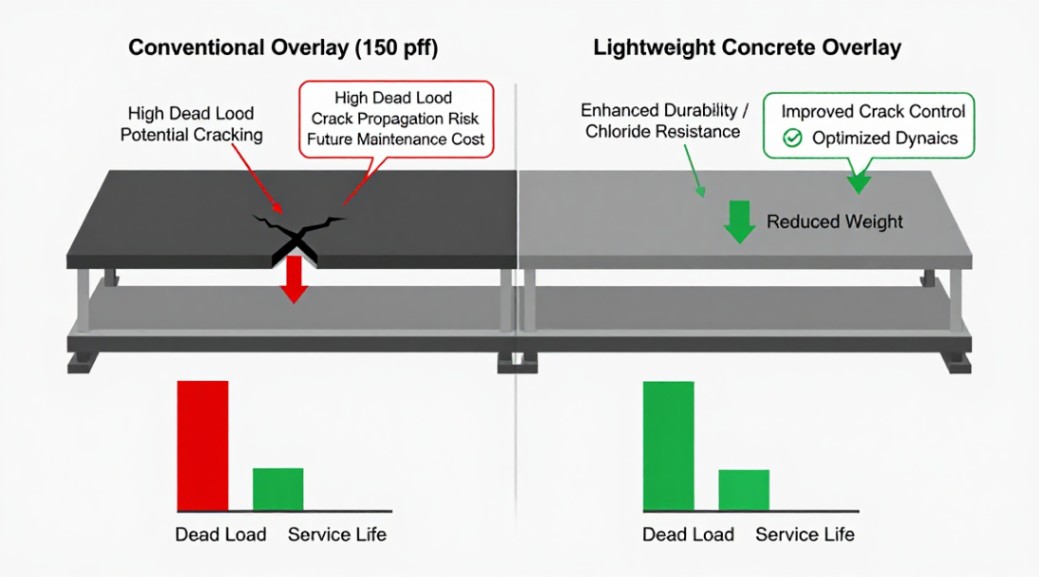
Lightweight concrete isn’t just a lighter alternative for bridge deck overlays; it’s a superior structural system that fundamentally changes load dynamics and extends service life. The data doesn’t lie. While traditional thinking focuses on dead load reduction, the real advantage lies in enhanced durability, better crack control, and a significant reduction in future maintenance costs. If you’re still specifying conventional 150 pcf concrete for overlays without a rigorous cost-benefit analysis, you’re leaving structural and financial performance on the table.
1. Core Benefits That Go Beyond the Scale
Reducing dead load by 25-35% is the headline, but it’s the secondary effects that deliver the knockout punch for bridge owners and engineers.
- Extended Structural Capacity: Lower dead load directly increases live load capacity. This can defer costly bridge widening or complete replacement projects for decades.
- Superior Durability: High-quality lightweight aggregates are often internally cured and less reactive. This leads to dramatically lower permeability and a more resilient matrix against chloride ion and sulfate attack.
- Thermal & Shrinkage Crack Mitigation: The lower modulus of elasticity and improved internal moisture management mean reduced thermal stresses and less plastic shrinkage cracking. Crack-free overlays last longer.
- Accelerated Construction: Reduced weight allows for larger placement pours, faster construction schedules, and less stress on supporting falsework or existing substructures.
2. Mix Design: It’s About the Aggregate, Not Just the Cement
Forget tweaking the w/c ratio and calling it a day. The heart of a high-performance lightweight concrete for bridge deck overlays is the aggregate system.
2.1. The Non-Negotiable Components
- High-Strength, Pre-Wetted LWA: Use only structural-grade, manufactured lightweight aggregate (LWA) like expanded shale, clay, or slate. Pre-soaking is mandatory to prevent rapid water loss during placement.
- Low Water-Cementitious Materials Ratio (w/cm): Target 0.40 or lower. This demands high-range water reducers and often a viscosity-modifying admixture to ensure pumpability and finishability.
- Supplementary Cementitious Materials (SCMs): Fly Ash or Slag Cement at 20-30% replacement isn’t optional. They reduce heat, improve long-term strength, and enhance durability against chemical attack.
- Internal Curing: This isn’t a buzzword. The reservoir of water within the LWA particles provides continuous hydration from within, eliminating autogenous shrinkage-the primary cause of early-age deck cracking.
3. Installation: Precision Over Power
Placing lightweight concrete demands a different mindset. You’re not dumping mud; you’re placing a engineered, low-slump material.
- Surface Preparation is Everything: Hydro-demolition to sound concrete, followed by high-pressure water blasting, is the standard. Milling alone often fails to remove all chloride-contaminated concrete.
- Place with Screeds, Not Magic: Vibratory screeds are essential. Over-vibration with internal poker vibrators will cause aggregate segregation and paste rise. The goal is consolidation, not liquefaction.
- Timing the Finish: The surface will “bleed” less but may stiffen faster. Have your finishing crew ready. Early-entry dry-cut sawing for joints is critical to control cracking.
- Curing is Non-Debatable: Apply wet burlap and plastic sheeting immediately. The internal curing helps, but surface curing prevents plastic shrinkage. Maintain for a minimum of 7 days.
4. The Performance Data You Won’t Ignore
Let’s cut through the marketing. Here’s what happens in the real world.
4.1. Structural Performance & Load Distribution
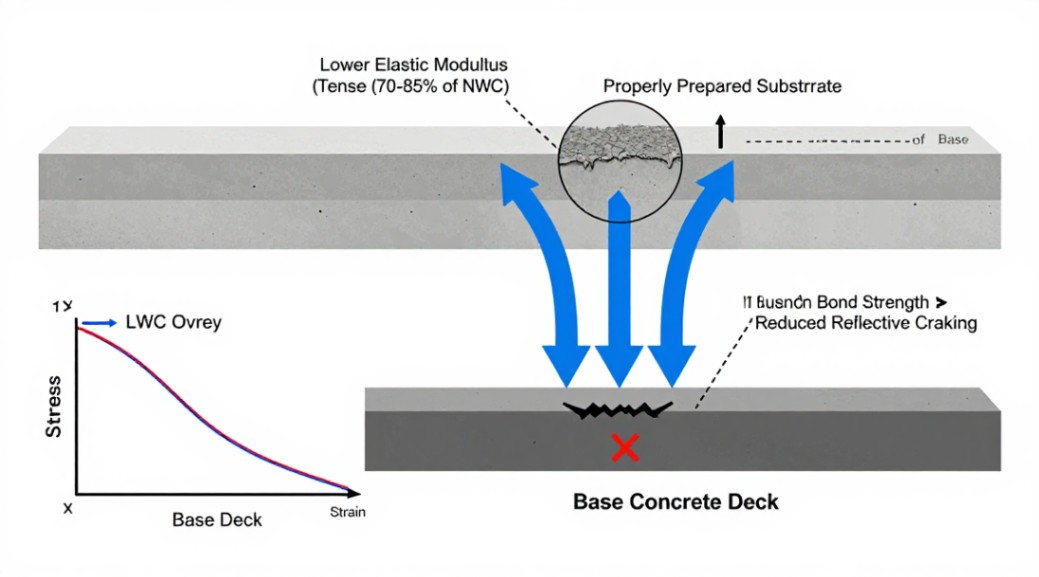
The lower elastic modulus of lightweight concrete (typically 70-85% of normal weight) is a feature, not a bug. It creates a more flexible overlay that better accommodates differential movement between the overlay and the base deck. This drastically reduces reflective cracking. The composite action remains excellent because the bond strength, when the substrate is properly prepared, often exceeds the tensile strength of the base concrete.
4.2. Durability in the Trenches
Field cores from 15-year-old projects show a consistent pattern: chloride penetration depths are 40-60% less than adjacent normal-weight concrete sections. The pore structure of quality LWA is discontinuous, creating a more tortuous path for moisture and chlorides. Freeze-thaw resistance, when air-void systems are properly designed, meets or exceeds ASTM C666 requirements.
4.3. The Cost Argument, Solved
Yes, material costs per cubic yard are 15-30% higher. This is the industry’s biggest mental block. The calculation is wrong. You must analyze cost per year of added service life. When you factor in: 1) Reduced dead load adding 20+ years to a bridge’s functional lifespan, 2) Lower lifetime maintenance from fewer deck repairs, and 3) Potential savings on substructure strengthening, the lifetime cost profile flips decisively in favour of lightweight concrete.
5. Case Studies: Where Theory Meets Asphalt
The proof is on the road. Forget glossy brochures; listen to the field crews.
- Northeast Corridor, US: A major interstate redecking used a 4″ lightweight concrete overlay. 12 years post-construction, ground-penetrating radar shows zero delamination, while adjacent conventional overlay sections on the same project show 15% delamination. The DOT’s maintenance logs confirm it.
- Feedback from the Field: “The finishing crew hated it on day one because it set differently,” one project superintendent noted. “But by day three, they loved it because they weren’t chasing cracks. The inspector loved the bond test results. We finished two days ahead of schedule because we could place larger panels.”
6. Lifecycle: It’s a Marathon, Not a Sprint
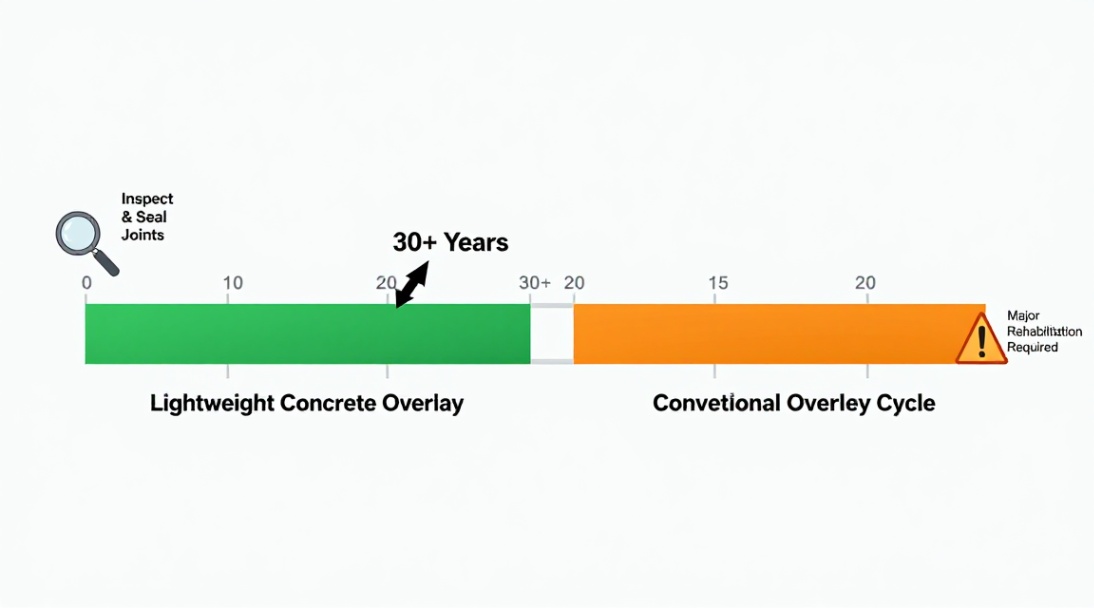
Maintenance for a lightweight concrete overlay system is simple: inspect the joints and seal them. The overlay itself, if placed correctly, becomes the primary protective barrier. Its lifespan is routinely 30+ years before any major intervention, compared to the 15-20 year cycle of conventional overlays. This resets the clock on deck rehabilitation, aligning better with substructure and superstructure lifecycle timelines.
Your Next Move: Validate, Don’t Speculate
The barrier isn’t technical; it’s experiential. You need data specific to your aggregates and climate. Before your next overlay project, demand two things: First, a trial batch and mock-up panel to let your crews feel the difference in placement and finishing. Second, a full lifecycle cost analysis that includes future maintenance and potential capacity upgrades. Stop treating lightweight concrete as a specialty item. Treat it as the default high-performance option that pays for itself by preserving your bridge asset for another generation. The alternative is more frequent closures, higher long-term costs, and lost structural capacity. The choice is clear.
We are the global leader in lightweight concrete and advanced engineered foam solutions. Known globally for its commitment to research, innovation, and applied expertise, we have been providing engineered foam solutions since the early 2012’s.
We can supply high-quality concrete admixture and foam concrete related products all over the world.
The company has a professional technical department and quality supervision department, a well-equipped laboratory, and equipped with advanced testing equipment and after-sales customer service center.
If you are interested, please feel free and contact us.