Professional solutions on concrete addtives, Concrete Foaming Agent, Superplasticizer, CLC Blocks Additives, and foaming machine

The Right Superplasticizer for SCC: A Guide to Smarter Concrete, Fewer Failures
Have you ever watched a beautifully designed self-consolidating concrete mix refuse to flow? Or, worse, seen it flow beautifully only to separate into a mess of rock and paste? Your heart sinks. The clock is ticking, the crew is waiting, and the project budget is staring back at you. If this sounds familiar, the issue almost certainly points back to a single, critical component: the superplasticizer for self-consolidating concrete SCC. Getting this choice wrong isn’t a minor setback; it’s the difference between a flawless, durable finish and a costly, compromised structure. Let’s walk through this logically, comparing the paths you can take, so you can make a decision with confidence.
The Non-Negotiable Role of the Superplasticizer
Forget the old ways. Self-consolidating concrete SCC doesn’t beg for water to become fluid; it demands a superplasticizer. This isn’t just an admixture; it’s the engine of the mix. Its sole, critical job is high-range water reduction. Think of it this way: every drop of water in a concrete mix dilutes the final strength and increases shrinkage. The superplasticizer molecules physically coat the cement particles, giving them a powerful negative charge. They repel each other. This breaks apart the natural clumps, releasing the water trapped inside. The result is a dramatic increase in flowability without adding a single extra gallon of water. This is the foundational magic. The concrete becomes fluid enough to fill every corner of a complex formwork under its own weight. That’s self-consolidation. But achieving flow is only half the battle. The real art lies in maintaining stability-preventing the aggregate from sinking (segregation) or water from rising (bleeding). This delicate balance between flow and stability is where your choice of superplasticizer truly matters.
The Modern Standard and Its Logical Alternatives
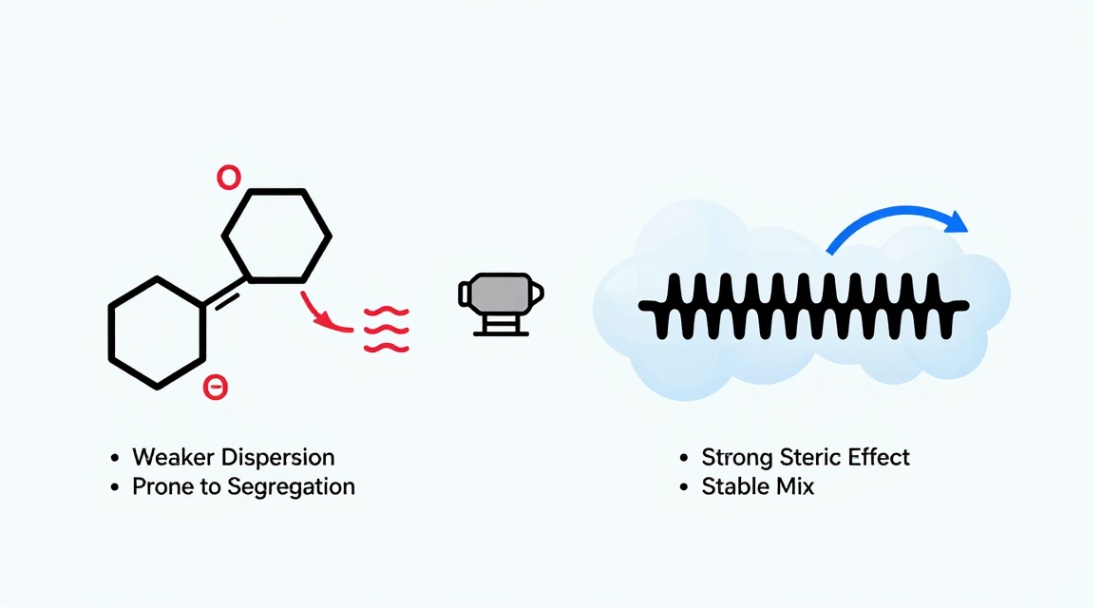
Today, the industry standard is clear: Polycarboxylate Ether (PCE) based superplasticizers. They earned this position for powerful reasons. Their molecular structure is like a comb. The backbone adsorbs onto the cement, while the long, flexible polymer ‘teeth’ create a powerful steric hindrance-a physical barrier that keeps particles apart. This mechanism offers unparalleled control. You can fine-tune the molecular architecture to influence the rate of slump flow, the viscosity of the paste, and the crucial open time before setting begins. For the slump flow test, a good PCE delivers the wide, consistent spread you need. For the J-Ring or L-Box test, it provides the low viscosity and high deformability that ensures perfect passing ability around dense rebar. The benefits are logical: higher early and ultimate strengths from the low water-cement ratio, excellent batch-to-batch consistency when sourced from a quality supplier, and compatibility with a wide range of cements and supplementary materials. But is it always the right choice? Let’s be honest. The primary consideration is cost. PCEs are typically more expensive per liter than older technologies.
The Ghosts of Alternatives Past: A Necessary Comparison
To understand why PCE dominates, we must glance at what came before. Naphthalene or Melamine Sulfonate-based superplasticizers (often called NSF or MSF) were the high-range water reducers of their day. They work through electrostatic repulsion. They’re cheaper. On paper, they seem like a viable option. But for high-performance SCC, their drawbacks are significant and often disqualifying. Their dispersion force is weaker, requiring higher dosages to achieve similar flow. More critically, they lack the stabilizing ‘steric’ effect. This makes the concrete far more prone to segregation, especially in highly flowable mixes. Their slump loss can be rapid and severe. You might achieve a great initial slump flow, only to find the concrete stiffening uncontrollably in 30 minutes, risking cold joints. Their compatibility with modern cements and other admixtures is more finicky, leading to unpredictable results. The logical conclusion? For a simple, low-slump application where cost is the absolute driver and performance margins are wide, an NSF might suffice. For any project where the definition of success includes reliable self-consolidation, durability, and avoiding placement headaches, the older technology presents a risk that outweighs its initial savings.
Dosage, Compatibility, and The Long Game
Choosing PCE is not the end of the decision; it’s the beginning. Dosage optimization is your next critical step. More is not better. An overdose can lead to excessive retardation, severe segregation, or air entrainment issues. An underdose fails to achieve the required flow. You must find the ‘sweet spot’ through methodical trial batches, monitoring not just initial slump flow but also viscosity, passing ability, and surface finish. This ties directly to cost-effectiveness. The optimal dosage provides the required performance at the lowest possible cost per cubic yard. Never skip these trials. Compatibility is another non-negotiable check. Your chosen superplasticizer for self-consolidating concrete SCC must play nicely with your specific cement, fly ash, slag, and any other admixtures like viscosity-modifying agents (VMAs). Incompatibility manifests as rapid slump loss, flash set, or a grossly sticky mix. Test them together. The long-term effects hinge on this early diligence. A well-dosed, compatible PCE superplasticizer in a stable SCC mix yields a dense, impermeable concrete. This directly translates to superior durability-resistance to chloride ingress, sulfate attack, and freeze-thaw cycles. The strength you designed for on paper is the strength you get in the structure.
From Plant to Placement: A Guide to Best Practices
Your work in the lab must translate to the site. Consistency is everything. Ensure your supplier provides a product with tight quality control, batch after batch. During batching, the sequence matters. Typically, you’ll add the superplasticizer to the mixing water or with it, allowing for full dispersion. Never dump dry superplasticizer powder directly onto dry cement. On site, communicate. The crew must understand that this flowing concrete is precisely engineered. Avoid adding extra water at the chute-it destroys the water-cement ratio and the stability of the mix. If adjustment is needed, it should be done with additional superplasticizer, and only by someone who understands the mix design. Watch the concrete as it flows. It should move like thick honey, homogenously, without signs of aggregate pile-up or a watery film. That visual cheque is your first and best quality control test.
The logic is clear. The path to successful self-consolidating concrete is paved with informed choices. You’ve seen the comparison: the modern control and stability of PCE superplasticizers versus the higher risk and limitations of older chemistries. For projects where performance, durability, and reliability are not just goals but requirements, the choice becomes obvious. Don’t gamble with alternatives that have a history of inconsistency. Invest in the superplasticizer technology built for the job. I recommend you start your next SCC project with a high-quality Polycarboxylate Ether based superplasticizer from a reputable technical supplier. Speak with their engineers, provide your mix materials for compatibility testing, and design your trial batches around their product. Take that step. Your concrete, your schedule, and your peace of mind will thank you for it.
We are the global leader in lightweight concrete and advanced engineered foam solutions. Known globally for its commitment to research, innovation, and applied expertise, we have been providing engineered foam solutions since the early 2012’s.
We can supply high-quality concrete admixture and foam concrete related products all over the world.
The company has a professional technical department and quality supervision department, a well-equipped laboratory, and equipped with advanced testing equipment and after-sales customer service center.
If you are interested, please feel free and contact us.