Professional solutions on concrete addtives, Concrete Foaming Agent, Superplasticizer, CLC Blocks Additives, and foaming machine

The Non-Toxic Redispersible Powder Guide: 5 Critical Mistakes to Avoid for Healthier Buildings
The Hidden Cost of a “Standard” Specification
A few years ago, I was called to consult on a high-end residential retrofit. The goal was impeccable air quality. The architects specified premium finishes, advanced ventilation, and explicitly requested “low-VOC” materials. Six months after completion, the client complained of persistent odors and headaches in a newly plastered media room. We traced the issue back to the polymer powder in the finishing plaster. The data sheet claimed “formaldehyde-free,” but it was a partial truth. The powder used vinyl acetate monomers and contained plasticizers as dust suppressants. These compounds off-gassed slowly for months, undermining the entire project’s health goals. That project taught me a painful lesson: specifying a truly non-toxic redispersible polymer powder requires forensic-level scrutiny. Most mistakes happen long before the bag is opened on site.

Mistake #1: Confusing “Low-VOC” with “Non-Toxic”
This is the most frequent and dangerous error. “Low-VOC” is a performance descriptor for volatile organic compounds. “Non-toxic” is a material health declaration about the substance itself.
- The Reality: A powder can be low-VOC yet contain monomers, plasticizers, or heavy metal catalysts that pose chronic health risks through dust inhalation or skin contact.
- The Fix: Demand documentation for full material composition, not just emission testing. Look for certifications that address substance restrictions: the EU’s REACH SVHC (Substances of Very High Concern) compliance, the FDA’s CFR Title 21 for indirect food contact suitability, or the EU Ecolabel. These regulate the chemicals in the product, not just what comes out of it.
Mistake #2: Overlooking the Dust Hazard
Powders are dusty by nature. Conventional powders often use internal plasticizers like phthalates to reduce dust during handling. These additives become part of the respirable dust cloud.
- The Reality: On-site workers inhale this dust. It settles on surfaces. A powder cannot be considered non-toxic if its respirable fraction contains hazardous substances.
- The Fix: Specify powders that achieve low dustiness through particle engineering and granulation, not internal plasticizers. Require a Safety Data Sheet (SDS) that clearly states the powder is “free from harmful plasticizers” and has a declared, low respirable dust fraction. Ask for occupational exposure limit data.
Mistake #3: Assuming All Polymers Are Created Equal
The core polymer chemistry dictates toxicity. The industry standard, vinyl acetate-ethylene (VAE), relies on vinyl acetate monomer. This substance has a stringent occupational exposure limit due to its health risks.
- The Reality: Residual monomers in the powder can off-gas. True non-toxic redispersible polymer powder formulations use alternative, benign base chemistries or employ advanced processes to achieve near-zero residual monomers.
- The Fix: Interrogate the polymer type. Ask for a certificate of analysis showing residual monomer content, typically in parts per million (ppm). For the highest assurance, look for powders based on non-VAE chemistries that are inherently benign.
Mistake #4: Ignoring Compatibility with Other Green Materials
Specifying a non-toxic powder alongside incompatible materials can create new problems or degrade performance.
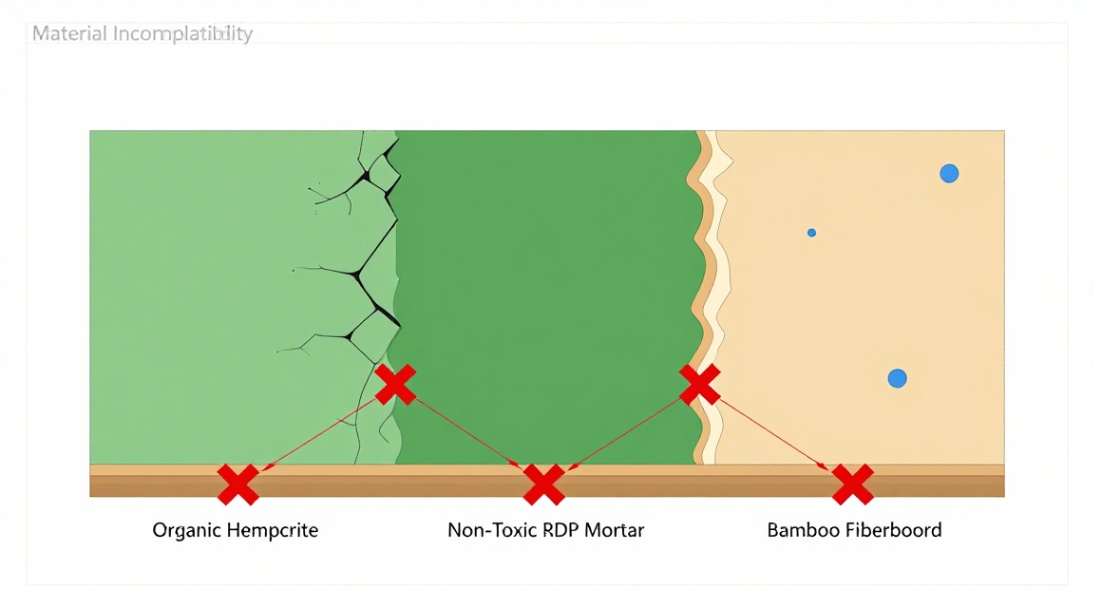
- The Reality: Some non-toxic powders are engineered for specific pH environments. Using them with highly alkaline materials like natural hydraulic lime without verification can reduce redispersion and adhesive strength.
- The Fix: Verify the powder’s compatibility with your total system. A high-performance, non-toxic redispersible polymer powder for interior plasters should have documented testing with clay, lime, and gypsum binders. For tile adhesives and self-leveling underlayments, confirm compatibility with Portland cement and other hydraulics. Request technical data sheets showing performance tests in the final composite system.
Mistake #5: Prioritizing Cost Over Certification Value
Budget pressure often leads to value engineering, where material health is the first casualty.
- The Reality: A certified non-toxic powder may carry a 10-20% premium. The cost of a failed indoor air quality test, a project delay, or occupant health litigation is orders of magnitude higher.
- The Fix: Frame the specification around risk mitigation and value. These powders directly contribute to credits in LEED, WELL, and BREEAM certifications. They de-risk the project for owners targeting healthy building labels. Present the premium not as a cost, but as insurance for the project’s health and sustainability promises. Write performance-based specifications that mandate the relevant certifications, locking in the quality.
Your Specification Checklist
To avoid these mistakes, use this checklist for your next project specification.
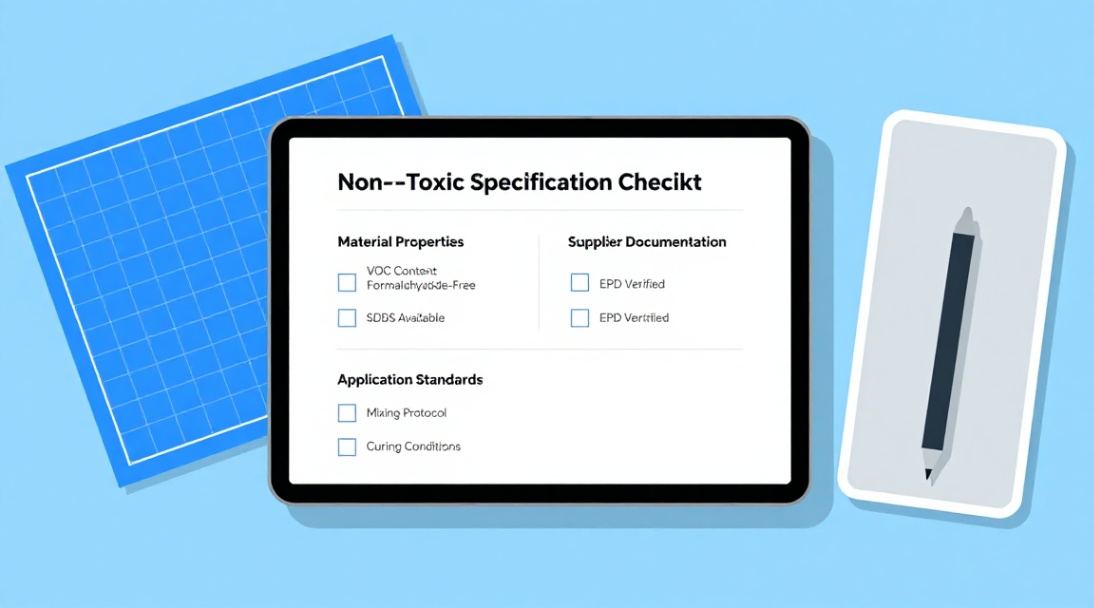
- Chemistry & Composition: Certificate of Analysis showing residual monomer content < 100 ppm. Statement on the absence of phthalates, formaldehyde, and heavy metals.
- Material Health Certifications: Proof of compliance with REACH SVHC, FDA CFR 21, EU Ecolabel, or similar health-based standards.
- Dust Safety: SDS indicating no hazardous plasticizers and data on respirable dust fraction.
- System Performance: Technical data sheets showing tested performance (adhesion, flexibility, water resistance) in your specific application mix (e.g., Cement-based adhesive, Gypsum plaster).
- Sustainability Credentials: Documentation for contributions to green building certification schemes like LEED v4.1 Building Product Disclosure and Optimization credits.
The market for healthy building materials is growing. So is greenwashing. Your due diligence is the only filter. Specify with the rigor of a toxicologist, not just a procurer. The integrity of your building’s air and the well-being of its occupants depend on these unseen, powdered ingredients. Do not compromise.
We are the global leader in lightweight concrete and advanced engineered foam solutions. Known globally for its commitment to research, innovation, and applied expertise, we have been providing engineered foam solutions since the early 2012’s.
We can supply high-quality concrete admixture and foam concrete related products all over the world.
The company has a professional technical department and quality supervision department, a well-equipped laboratory, and equipped with advanced testing equipment and after-sales customer service center.
If you are interested, please feel free and contact us.