Professional solutions on concrete addtives, Concrete Foaming Agent, Superplasticizer, CLC Blocks Additives, and foaming machine

Potassium Silicate for Refractory Coatings: The 5 Catastrophic Mistakes You’re Probably Making
Potassium Silicate is the Superior Binder, But Most People Use It Wrong
Potassium silicate (K2O·nSiO2) is not just a binder; it’s an inorganic ceramic glue that fuses with your aggregate at high temperature, creating a monolithic, zero-VOC matrix. Forget organic resins that burn out. The real game is forming a protective potassium aluminosilicate glass. Yet, across Reddit forums and industry chats, the same failures keep appearing. Here are the five critical errors destroying your coating’s performance.
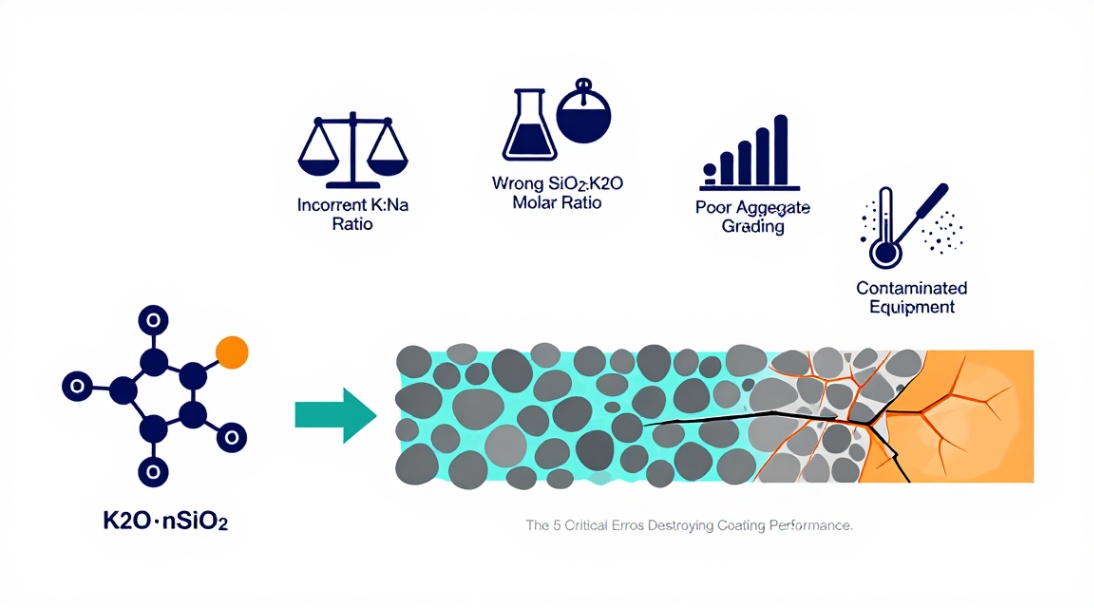
1. Ignoring the Molar Ratio (SiO2:K2O) – The Root of All Evil
You think ‘potassium silicate’ is one product? You’re wrong. Its behavior is dictated by the molar ratio. This isn’t a suggestion; it’s the law.
- Mistake: Grabbing any ‘liquid glass’ off the shelf without checking the spec sheet.
- Why it Fails: A low ratio (~2.0) has excess free alkali. It sets fast but is weak and hygroscopic. A high ratio (~3.3) has more silica, offering better final strength and chemical resistance but slower gelling. Using the wrong one guarantees poor hot strength or a coating that never properly cures.
- Reddit User Feedback: Multiple foundry engineers on r/metallurgy report coatings ‘dusting off’ at 800°C. The culprit? A low-ratio silicate chosen for cheap, fast set times, sacrificing all high-temperature integrity.
- The Fix: For most refractory coatings facing >1000°C, demand a molar ratio of 2.8 to 3.3. Verify the technical data sheet. Every time.
2. Drowning Your Mix – The Water Disaster
Potassium silicate is a solution. Adding more water seems harmless. It’s not. Water controls density, viscosity, and-critically-the final bond strength.
- Mistake: Adding water arbitrarily to ‘make it spray easier’ or extend pot life.
- Why it Fails: Excess water increases the distance between silicate polymers and aggregate particles. During drying and gelling, the bond network is weak and porous. You get a chalky, non-protective layer with terrible abrasion resistance.
- The Precise Fix: Mix by weight, not volume. A typical starting point for a sprayable coating is a 1:1 by weight ratio of dry refractory aggregate to potassium silicate solution (as supplied). Adjust with water in increments of 0.5-1.0% of the total batch weight only if needed for application. Record every addition.
3. Curing Like It’s Portland Cement – A Sure Path to Cracks
This is where the magic-or the tragedy-happens. Curing potassium silicate is a chemical dehydration, not just ‘drying.’
- Mistake: Force-drying with high, direct heat (blow torches, excessive furnace pre-heat).
- Why it Fails: Rapid surface skinning traps moisture underneath. Subsequent heating causes steam pressure, leading to spalling, bubbles, and catastrophic delamination. You bake a weak shell over a wet core.
- The Unconventional, Counter-Intuitive Fix: Air dry first, then heat slowly.
- Apply coating. Allow to air dry at ambient temperature for a minimum of 4 hours (24 is better).
- Initiate a controlled heat-up to ~100-150°C. Hold for 1-2 hours. This drives off free water.
- Only then, ramp to your service temperature. This gradual process allows the silicate gel to polymerize into a strong, continuous network.
4. Assuming Universal Compatibility – The Chemical Attack
Potassium silicate is alkaline (pH 11-12.5). It doesn’t play nice with everything.
- Mistake: Using it with acid-sensitive aggregates or substrates.
- Why it Fails: It will react violently with acidic components (e.g., some phosphate-based materials, certain mineral wools). The result is gas generation, foam, and a completely failed bond. On carbon-containing refractories, the high-alkali environment can catalyze oxidation unless specifically formulated.
- The Fix: Know your materials. Potassium silicate for refractory coatings excels with:
- Alumina (Al2O3)
- Mullite (3Al2O3·2SiO2)
- Fused Silica (SiO2)
- Zirconia (ZrO2)
Test it first on a small batch with any new aggregate.
5. Choosing Sodium Silicate to Save Pennies – The False Economy
The old debate: potassium vs. sodium silicate. This isn’t a matter of taste.
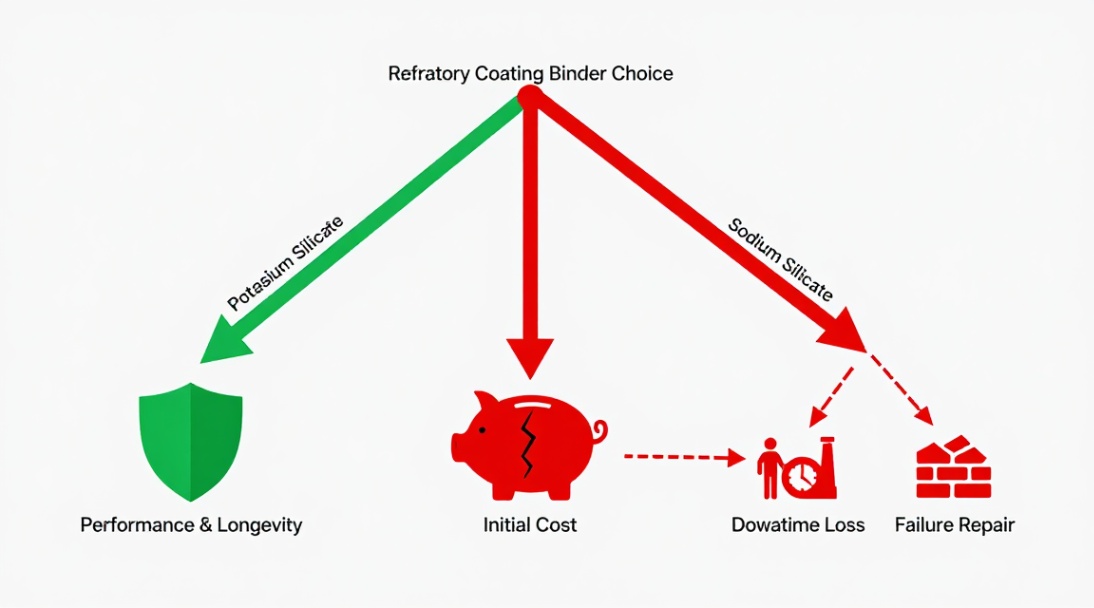
| Factor | Potassium Silicate | Sodium Silicate |
|---|---|---|
| High-Temp Stability | Superior. Forms higher-melting point K-Al-Si glass. | Lower melting point. Prone to fluxing and slag attack. |
| Hygroscopicity | Less prone to picking up atmospheric moisture. | Highly hygroscopic. Can ‘sweat’ and re-dissolve. |
| Compatibility | Better with a wider range of ceramic aggregates. | Can cause efflorescence (white salts) with some mixes. |
| Cost | Higher initial cost. | Cheaper upfront. |
Choosing sodium silicate for high-temperature refractory coatings is engineering malpractice. The minor material savings are obliterated by premature lining failure, increased downtime, and safety risks. You pay tenfold later.
Stop Experimenting. Use a System That Works.
The warnings above are forged from decades of field failures. The chemistry is unforgiving. If you’re specifying or applying these coatings in critical applications-industrial furnaces, kiln car tops, ladle linings, metal casting dies-you need precision, not guesswork.
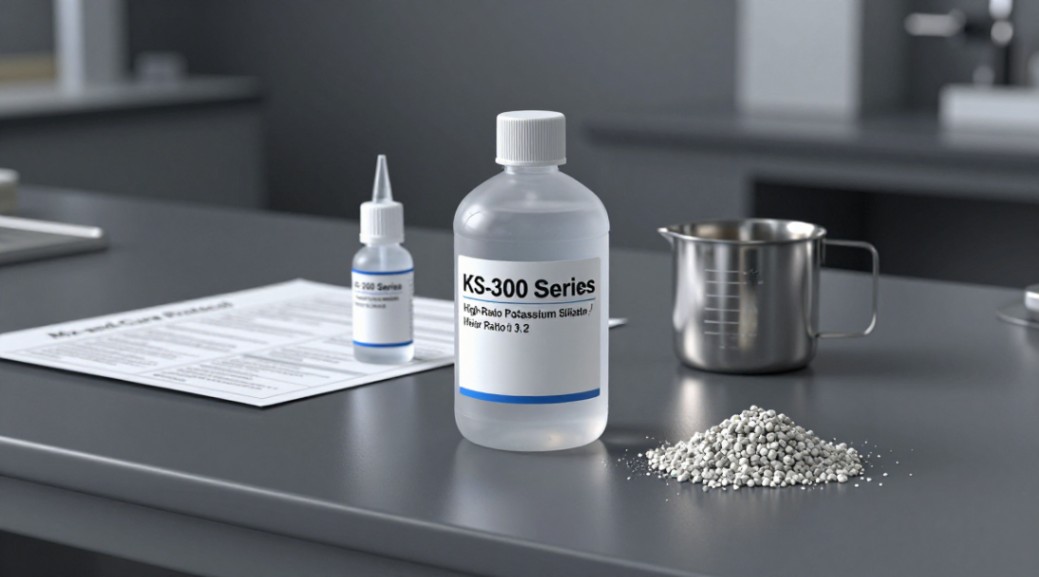
This is why I exclusively recommend and use the KS-300 Series high-ratio potassium silicate system from RefractoBond. It’s not a commodity liquid; it’s an engineered binder system pre-optimized for molar ratio (3.2), viscosity, and gel time. It comes with exact mix-and-cure protocols for every major aggregate type. No more guessing. No more failures.
Your next step is non-negotiable: Visit RefractoBond.com right now. Download their technical guide for potassium silicate for refractory coatings. Then, request a sample kit matched to your specific aggregate. Test it against your current method. The difference in hot strength and durability will be blatantly obvious. Stop risking your linings. Start using the correct tool for the job.
We are the global leader in lightweight concrete and advanced engineered foam solutions. Known globally for its commitment to research, innovation, and applied expertise, we have been providing engineered foam solutions since the early 2012’s.
We can supply high-quality concrete admixture and foam concrete related products all over the world.
The company has a professional technical department and quality supervision department, a well-equipped laboratory, and equipped with advanced testing equipment and after-sales customer service center.
If you are interested, please feel free and contact us.