Professional solutions on concrete addtives, Concrete Foaming Agent, Superplasticizer, CLC Blocks Additives, and foaming machine

The Truth About Concrete Demolding Agents for Intricate Patterns: A Brutal Comparison
Forget Everything You Think You Know About Concrete Demolding Agents
The single most important factor for flawless intricate concrete patterns isn’t the mix design or the mold quality-it’s your concrete demolding agent for intricate patterns. Get this wrong, and you’re left with torn surfaces, stained details, and wasted capital. The industry is flooded with marketing, but success hinges on a ruthless chemical and mechanical match between agent, formwork, and concrete. This isn’t about lubrication; it’s about controlled separation chemistry.
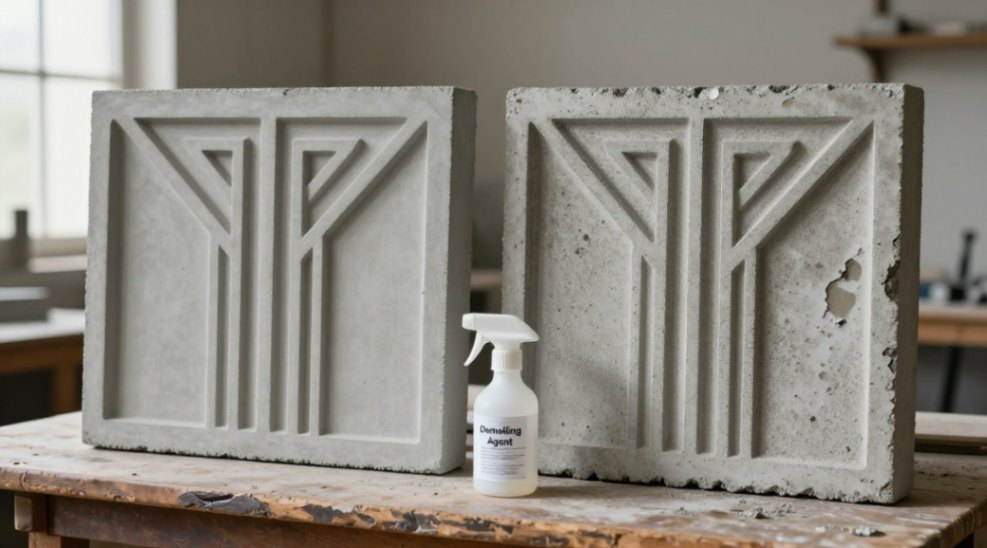
Core Functions: More Than Just Release
A proper demolding agent for intricate patterns performs two non-negotiable functions. First, it creates a near-invisible barrier that prevents adhesion. Second, and critically, it protects the immature concrete surface during the violent act of stripping. It must prevent the paste from tearing or scuffing on the finest edges and undercuts. Many users report failures not from adhesion, but from microscopic damage that ruins the visual depth of a pattern. As one project lead noted on a specialty construction forum, “We switched to a high-quality agent and our reject rate on complex architectural panels dropped from 15% to near zero. The cost was higher, but the savings were monumental.”
The Showdown: A Raw Comparison of Agent Types
Your choice boils down to three chemical families, each with distinct advantages and brutal trade-offs.
1. Water-Based Emulsions
These are the current industry default for good reason. They are safe, low-odor, and easy to apply uniformly. Their key benefit is leaving no residual film, which is ideal for surfaces slated for further treatment like coatings or acid staining. However, they have a critical weakness: timing. Apply too early, and they can be absorbed by porous formwork or dry out. Apply too late, and you risk dilution from condensation or bleed water. On Reddit, a seasoned formworker shared, “We use water-based for 90% of our intricate work. The trick is a perfect, dry application. Miss that window, and you’ll see surface pitting, especially on vertical forms.”
- Pros: User-friendly, non-flammable, environmentally softer, clean surface.
- Cons: Sensitive to application timing and ambient humidity; can freeze; less effective on highly absorbent molds.
2. Solvent-Based Formulations
This is the old-school, high-performance option. Solvents carry heavier film-forming solids like petroleum-based waxes or resins, depositing a tougher, more durable barrier. They work brilliantly on absorbent wood forms, in humid conditions, or for extended cure times where a water-based agent would fail. The drawbacks are severe: volatile organic compounds (VOCs), fire hazard, and a residue that can interfere with subsequent finishes or bonding. Use them only with serious ventilation and when no other agent performs.
- Pros: Superior release on difficult molds, long-lasting film, insensitive to moisture.
- Cons: High VOCs, flammable, residue can stain or prevent bonding, strict safety protocols required.
3. Reactive/Chemical Release Agents
This is the specialist’s tool. These agents don’t just coat; they react with the concrete surface to form a soapy layer (saponification) or an ultra-thin polymer film. They offer the clearest, most precise release for glass-fiber-reinforced polymer (GFRP) or ultra-smooth steel molds used for the most complex patterns. The finish is often pristine. The downside is cost and specificity. They can be incompatible with certain formwork sealers or concrete admixtures. A precast specialist online warned, “Reactive agents are miracles on GFRP. But test them first with your specific mix. We once had a retarder interaction that caused a hazy film on the concrete.”
- Pros: Unmatched release for high-detail, non-absorbent molds; minimal residue; excellent for subsequent aesthetic treatments.
- Cons: Highest cost; chemical compatibility is critical; limited shelf life.
Non-Negotiable Best Practices for Complex Molds
Choosing the right agent is only 50% of the battle. Execution decides the other 50%.
Application is Everything: For intricate patterns, spraying with a low-pressure, fine mist is mandatory. Brushing can leave streaks and uneven film thickness that translate directly to surface defects. Apply two thin, even coats, allowing the first to dry completely. The mold should look uniformly sheened, not wet or puddled.
Timing and Compatibility: Apply the agent as the final step before concrete placement. Test the agent with your specific formwork sealant. A common failure point is the agent dissolving or beading up on an incompatible sealer. Also, verify it doesn’t negatively interact with your superplasticizers or air-entraining admixtures.
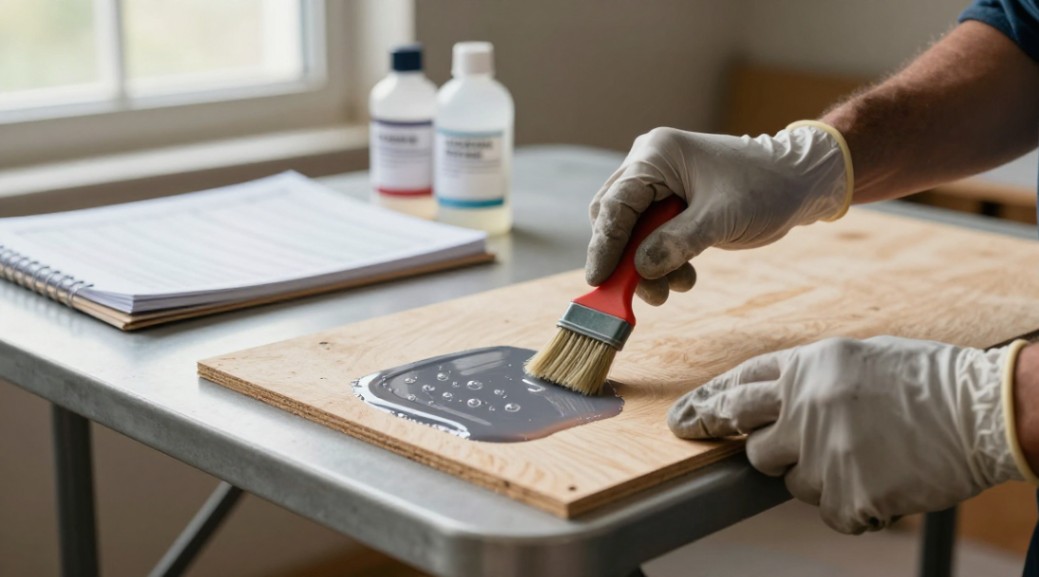
The Durability Myth: A good agent has zero negative impact on ultimate concrete strength or durability. Its job is to be a temporary barrier. However, oil-based residues can create a hydrophobic layer that might affect the bond of plaster or toppings if not removed. Plan your post-stripping surface preparation accordingly.
Solving the Inevitable Problems
When failures happen, diagnose fast.
Sticking or Tearing: This is either an under-application of agent, using the wrong type (e.g., water-based on dry, thirsty wood), or stripping too early before the concrete has gained sufficient tensile strength.
Surface Staining or Discoloration: Often caused by an uneven application or a solvent-based agent pooling in pattern crevices. It can also be a chemical reaction with formwork materials. Switch to a lighter-colored or clear, non-staining formula.
Bugholes or Pitting: Frequently misdiagnosed. This is often the agent trapping air against the formwork due to improper application (too thick) or the agent itself being too viscous for the pattern’s detail. Thin coats and a less viscous product are the fix.
The Real Cost-Benefit Analysis
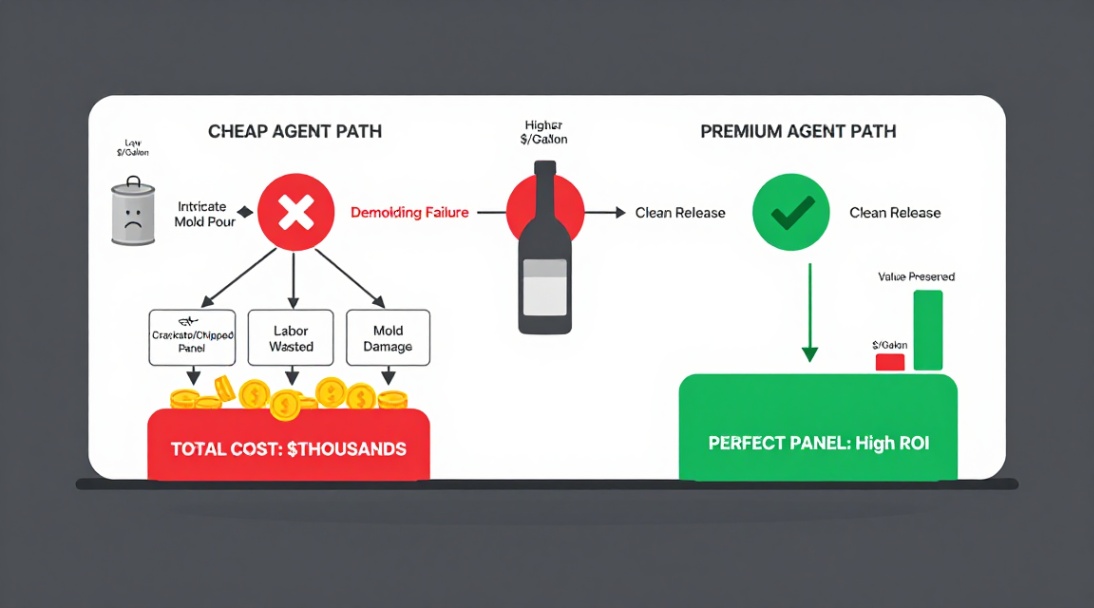
On a simple slab, the cheapest agent works. For intricate concrete patterns, this logic is bankrupt. The cost of the demolding agent is a rounding error compared to the value of the mold, the labor for placement and stripping, and the project’s aesthetic value. A single failed panel can cost thousands. Spending 50% more on a premium, compatible agent that guarantees a 99% success rate is not an expense; it’s the highest-return insurance policy you can buy. Your metric shouldn’t be cost per gallon, but cost per perfect square foot of finished, intricate concrete.
The Final Verdict
Stop guessing. For most architectural precast with intricate patterns, start with a high-quality, low-residue water-based emulsion and master its application. For extreme conditions or problematic absorbent forms, use a solvent-based agent with extreme caution. For the pinnacle of detail on polymer or polished steel molds, invest in a reactive chemical agent. Your next step is not to buy a product. It is to procure samples of all three types and run destruction tests on sample molds with your exact concrete mix. The data from those tests is the only opinion that matters.
We are the global leader in lightweight concrete and advanced engineered foam solutions. Known globally for its commitment to research, innovation, and applied expertise, we have been providing engineered foam solutions since the early 2012’s.
We can supply high-quality concrete admixture and foam concrete related products all over the world.
The company has a professional technical department and quality supervision department, a well-equipped laboratory, and equipped with advanced testing equipment and after-sales customer service center.
If you are interested, please feel free and contact us.