Professional solutions on concrete addtives, Concrete Foaming Agent, Superplasticizer, CLC Blocks Additives, and foaming machine

What is Superplasticizer for Self-Consolidating Concrete (SCC)? A Definitive Guide
From Stubborn Mix to Flowing River
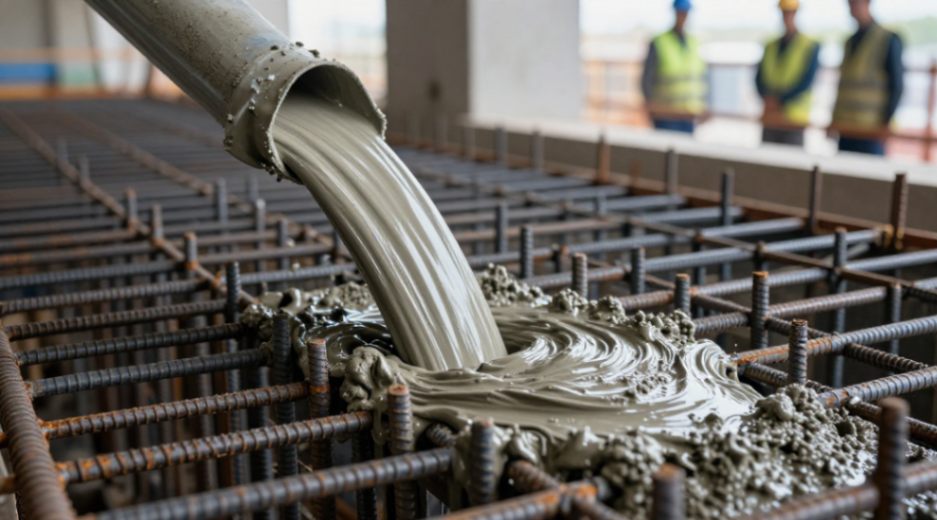
I remember a project with columns so densely reinforced, you could barely see through them. The vibrator was useless. We had a choice: accept honeycombed concrete or find another way. That’s when we turned to Self-Consolidating Concrete (SCC) and its essential partner-the superplasticizer. It transformed our thick, stubborn mix into a flowing river that filled every corner without a single vibration. If you’ve ever battled with placing concrete in complex forms, you already understand the core problem superplasticizer for SCC solves.
What is Superplasticizer in SCC?
A superplasticizer for Self-Consolidating Concrete is a high-range water-reducing admixture. Its primary function is simple yet profound: it disperses cement particles in the mix. This action dramatically reduces internal friction and the amount of water needed. The result is a concrete that flows easily under its own weight, passes through reinforcement without blocking, and maintains a perfectly uniform composition from start to finish.
The Core Mechanism: How It Works
Think of cement particles in water like a crowded room where everyone is sticking together. This creates a thick, resistant paste. The superplasticizer acts as a social moderator. Its long-chain molecules adsorb onto the cement grains, giving them a strong negative charge. Like magnets with the same pole facing each other, the particles repel. They separate. The crowd thins out. This repulsion, called electrostatic and steric hindrance, is the magic. It unlocks the fluidity that defines SCC, all while using much less water than a conventional mix.
Polycarboxylate Ether (PCE): The Modern Standard
Not all superplasticizers are equal. For modern SCC, Polycarboxylate Ether (PCE)-based superplasticizers are the definitive choice. Earlier generations, like sulfonated naphthalene or melamine formaldehyde condensates, worked well but had limitations. They could cause rapid slump loss or excessive air entrainment. PCEs changed the game. Their comb-like polymer structure offers superior dispersion power at lower dosages. More importantly, their performance is highly tunable. Chemists can engineer the molecular backbone and side chains to precisely control the rate of slump, the retention of flow over time (slump life), and compatibility with various cement types. This tailorability makes PCE superplasticizer for SCC mixtures the reliable, high-performance heart of the system.
Superplasticizer’s Role in Key SCC Properties
The influence of superplasticizer for self-consolidating concrete SCC extends across every fresh property. It’s not just about making concrete wetter.
1. Achieving Flow Without Segregation
This is the fundamental balancing act. The superplasticizer provides the necessary flow (high slump flow diameter, e.g., 650-750mm). Simultaneously, it must help maintain viscosity and stability. A well-designed PCE promotes a cohesive, paste-rich mixture that suspends aggregates. It prevents the heavier rock and sand from sinking (segregation) or water from bleeding to the surface. The right superplasticizer creates a homogeneous, viscous fluid-like a thick smoothie, not a watery soup.
2. Enabling Robust SCC Mix Design
Superplasticizer is the catalyst for the entire SCC proportioning philosophy. Its efficiency allows for a high volume of fine materials (cement, fly ash, slag, limestone powder). This creates the paste needed to lubricate aggregates and fill voids. The mix design table below shows how component roles shift with SCC and superplasticizer.
| Mix Component | Role in Conventional Concrete | Enhanced Role in SCC with Superplasticizer |
|---|---|---|
| Water | Primary lubricant for workability. | Quantity is minimized. Remains for hydration only, not workability. |
| Cement & Supplementary Materials (SCMs) | Binder for strength. | Primary source of paste volume and fines for stability and flow. |
| Superplasticizer | Optional workability aid. | Essential. Primary agent providing flow, replacing water’s lubricating role. |
| Aggregates | Skeleton providing volume and strength. | Must be well-graded and controlled to prevent blocking. Lower volume fraction. |
3. Impact on Hardened Concrete and Durability
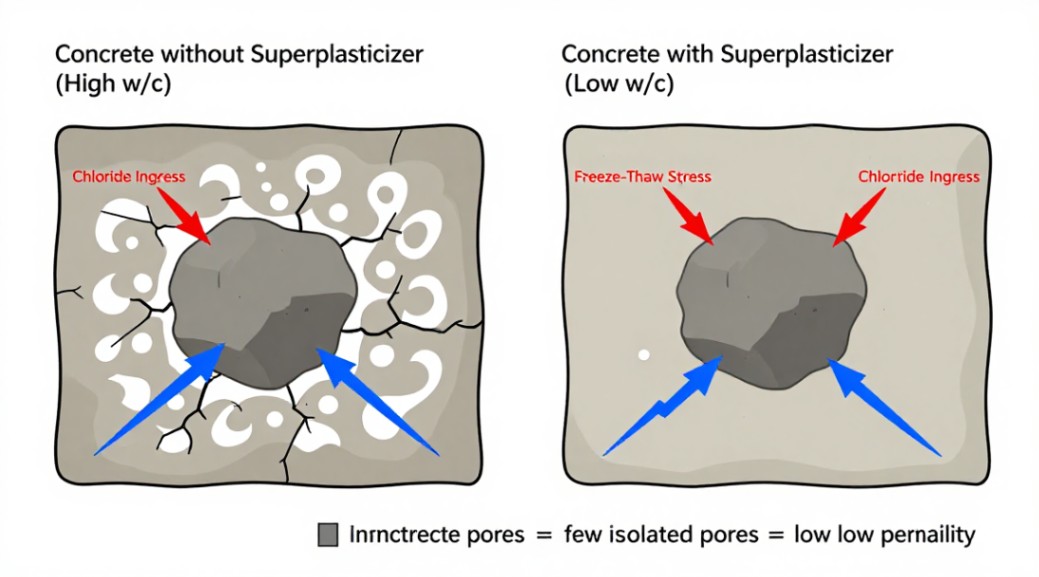
The benefits solidify in the finished structure. By enabling a lower water-cement ratio (w/c), the superplasticizer directly increases compressive and tensile strength. A denser, less porous microstructure emerges. This improves resistance to chloride ingress, sulfate attack, and freeze-thaw cycles. Surface aesthetics become superior-smooth, uniform, and defect-free, directly reflecting the stable, homogeneous state the superplasticizer helped achieve in the plastic phase.
Practical Application and Best Practices
Using superplasticizer for SCC isn’t a “set and forget” process. Success requires attention to detail.
Dosage is Critical: More is not always better. An optimal dosage delivers maximum flow without segregation or excessive retardation. Under-dosing yields a stiff mix. Over-dosing can cause severe segregation, delayed setting, or surface crusting. Always follow manufacturer recommendations and perform trial batches.
Compatibility Testing is Non-Negotiable: Cement chemistry varies. So do other admixtures like viscosity-modifying agents (VMAs). You must test the specific combination of your cement, SCMs, aggregates, and superplasticizer for self-consolidating concrete SCC. Watch for rapid slump loss, false set, or unpredictable rheology.
Batching Sequence Matters: The order of adding materials influences performance. A common best practice is to mix all powders and most of the water first, allowing the superplasticizer to be added last or with the final portion of mixing water. This ensures uniform dispersion.
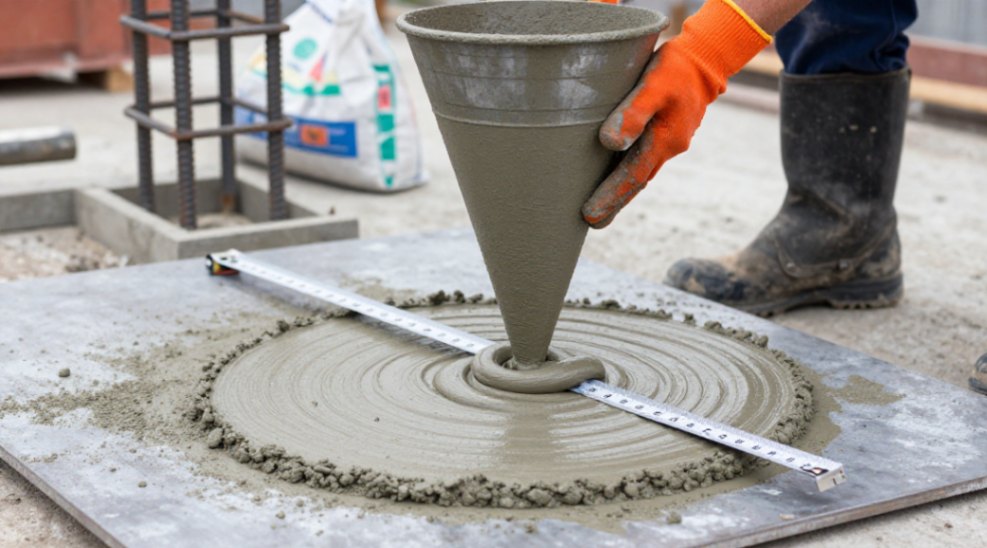
Quality Control Relies on Simple Tests: The slump flow test is your best friend on site. Measure the diameter of the concrete patty after lifting the slump cone. This gives immediate feedback on flow and stability. Observe the edges for signs of segregation. The J-Ring test checks passing ability through reinforcement. Make these tests routine.
Your Path to Flawless Concrete
Understanding superplasticizer for SCC transforms it from a mystery chemical to a predictable, powerful tool. It is the component that makes impossible placements routine and elevates concrete quality to new levels. Start by consulting with your admixture supplier. Discuss your specific materials and project goals. Then, commit to rigorous trial batching. Measure, observe, and adjust. The effort you invest in mastering this relationship between superplasticizer and your SCC mix will pay back tenfold in smoother operations, fewer defects, and more durable structures. Your concrete can flow like water and set like stone. Make it happen.
We are the global leader in lightweight concrete and advanced engineered foam solutions. Known globally for its commitment to research, innovation, and applied expertise, we have been providing engineered foam solutions since the early 2012’s.
We can supply high-quality concrete admixture and foam concrete related products all over the world.
The company has a professional technical department and quality supervision department, a well-equipped laboratory, and equipped with advanced testing equipment and after-sales customer service center.
If you are interested, please feel free and contact us.