Professional solutions on concrete addtives, Concrete Foaming Agent, Superplasticizer, CLC Blocks Additives, and foaming machine

Foamed Concrete Floor Screed: The Balanced Choice for Modern Construction
The Core of Your Decision
Foamed concrete for floor screeding wins in applications requiring lightweight leveling, thermal insulation, and efficient installation, but demands precise mix design and skilled application to avoid failure.
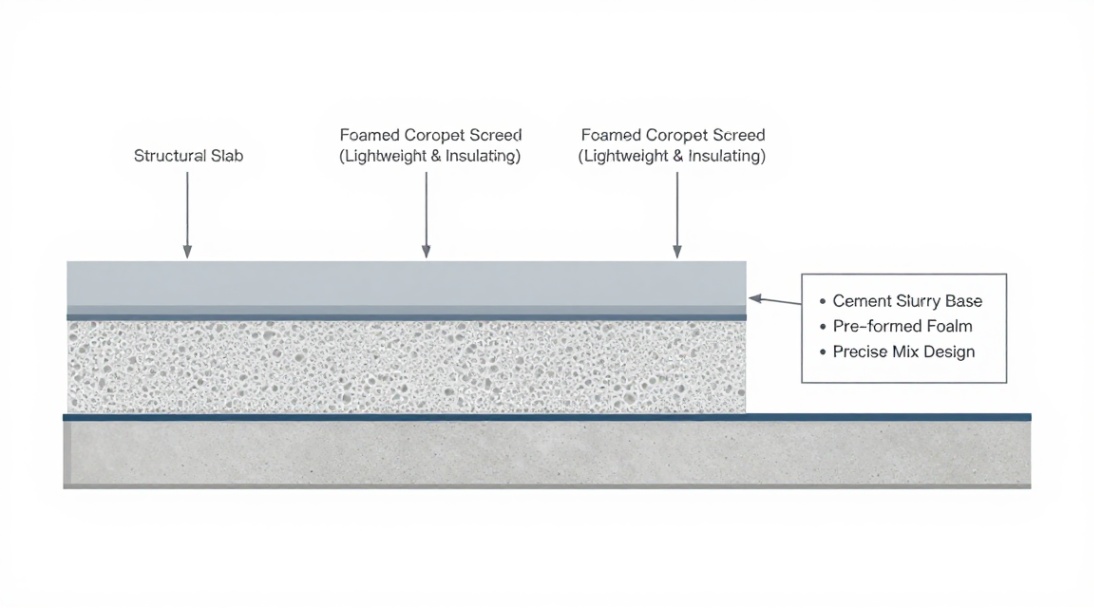
You stand at a crossroads. The concrete truck idles in the driveway. The floor slab awaits its final surface. Do you specify a traditional sand-cement screed, a self-leveling compound, or something else entirely? For two decades, I’ve guided teams through this precise decision. Today, let’s compare foamed concrete as a screeding solution. This isn’t about a perfect material. This is about finding the right tool for the job by honestly weighing its capabilities against your project’s specific needs.
Defining the Contender: What Is Foamed Concrete Screed?
Foamed concrete is a lightweight, cellular material created by introducing a stable foam into a cement-based slurry. Think of it as a controlled, solidified bubble bath for your floor. This process creates a matrix of closed air voids, which fundamentally changes its properties compared to a dense, solid screed. The benefits are significant: it can be 75% lighter than traditional screeds, offers inherent thermal and acoustic insulation, flows easily to fill complex voids, and reduces dead load on the structure. A 2019 industry survey by the International Lightweight Concrete Association noted a 40% increase in its use for residential refurbishment screeds, driven primarily by its weight and insulation advantages.
The Critical Comparison: Weighing the Pros and Cons
Let’s be objective. Foamed concrete is not a universal replacement. Here is the side-by-side analysis you need for decision-making.
Advantages (Where It Excels):
- Weight Reduction: Drastically cuts structural load, ideal for renovations, upper floors, and structures with limited load-bearing capacity.
- Ease of Placement: It flows like a thick liquid. You can pump it over long distances and it self-levels to a high degree, reducing manual labor.
- Thermal Performance: The entrapped air cells provide excellent insulation. This directly translates to lower heating costs and improved building energy ratings.
- Material Efficiency: Uses less raw aggregate than traditional mixes, which can simplify logistics and reduce initial material costs for the base mix.
Disadvantages (What Demands Respect):
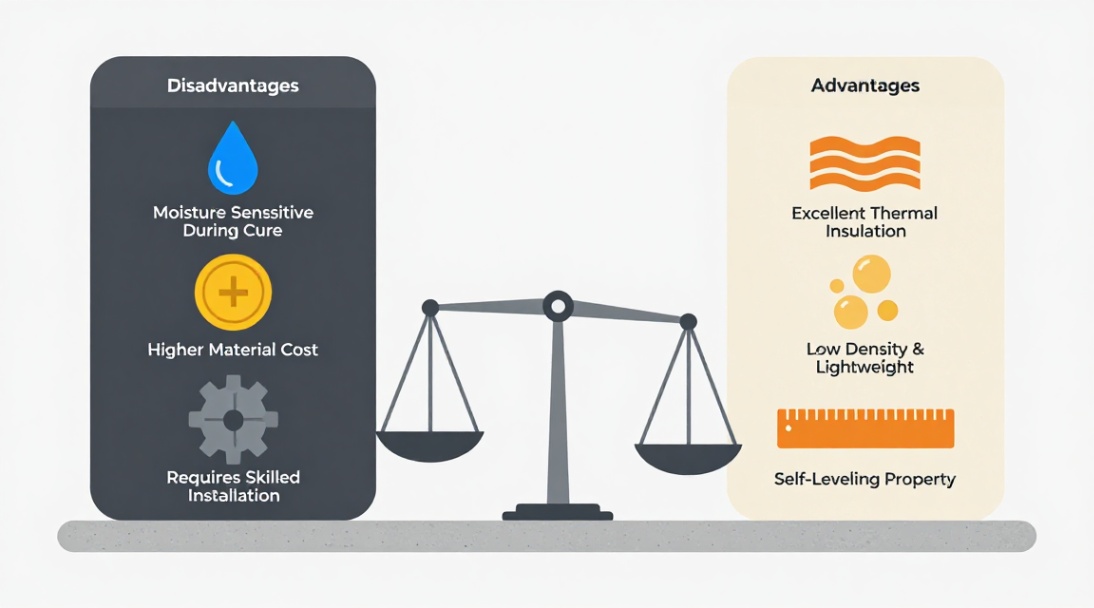
- Mix Design Sensitivity: This is its greatest strength and weakness. The water-cement ratio, foam quality, and mixing sequence are unforgiving. A small error in foam volume can collapse the structure or create a weak, dusty surface.
- Surface Hardness: While strong in compression, its surface abrasion resistance is lower than a dense granite-topped screed. It requires a protective finish (like tiles, vinyl, or a hardening topping) for high-traffic commercial areas.
- Specialist Skill Requirement: You cannot ‘wing it.’ Successful installation requires technicians who understand foam generation, slurry consistency, and the precise timing between mixing and placing.
- Curing Criticality: The high water content and closed structure make proper curing-keeping it moist for at least 7 days-absolutely non-negotiable to prevent shrinkage cracking and achieve design strength.
The Mix Design Decision Matrix
Your project’s requirements dictate the formula. It’s not one mix.
For a domestic floor with underfloor heating seeking maximum insulation, you would prioritize a lower density (maybe 800 kg/m³) with a synthetic foam agent for fine, stable bubbles. The cement content remains high to ensure cohesion, but the water ratio is tightly controlled to maintain bubble integrity. For a commercial mezzanine requiring a stronger, load-bearing screed, you would increase the density (to 1200-1400 kg/m³) and potentially incorporate micro-silica or polypropylene fibers to enhance surface toughness and prevent plastic shrinkage. As veteran mix designer Elena Rossi often states, ‘The foam is an ingredient, not an afterthought. You design the slurry to cradle the bubbles, and you design the bubbles to survive the slurry.’
The Final Verdict and Your Next Step
Choose foamed concrete screed if your project’s primary drivers are weight, insulation, and rapid, pumpable placement over complex spaces. Avoid it if you need an exposed, heavy-duty industrial floor finish or lack access to contractors with proven expertise in its mixing and curing.
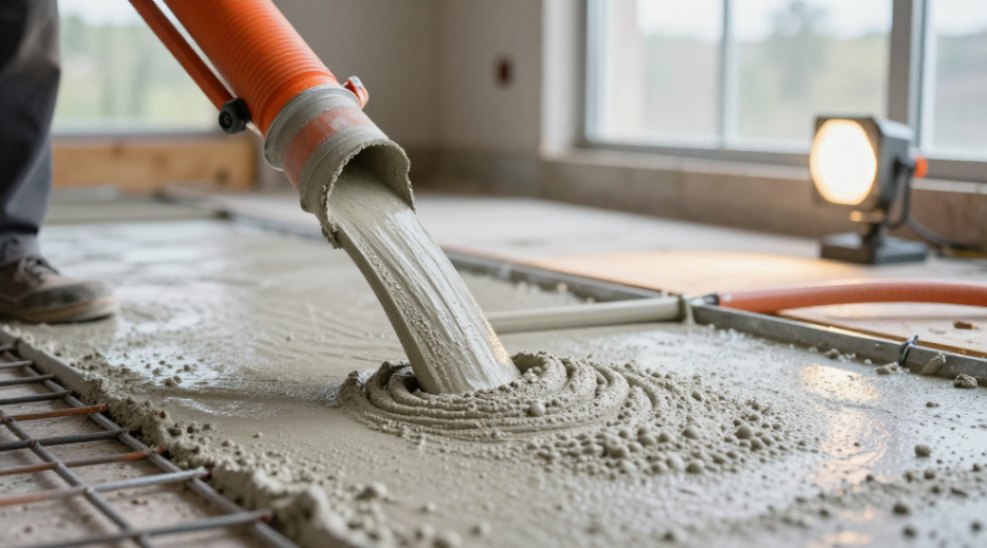
The promise of a lightweight, warm, and quickly installed floor is real. However, achieving it hinges on one critical action: partnering with expertise. Do not gamble with an unproven supplier. Your next step is to consult with a specialist contractor who can provide mix design certifications, project references for similar applications, and a detailed methodology statement for placement and curing. Request a small test panel before full-scale application. This single decision separates successful, durable projects from costly failures. Make the call today to a proven foamed concrete screeding specialist-it is the only way to secure the benefits while mitigating the inherent risks of this powerful technology.
We are the global leader in lightweight concrete and advanced engineered foam solutions. Known globally for its commitment to research, innovation, and applied expertise, we have been providing engineered foam solutions since the early 2012’s.
We can supply high-quality concrete admixture and foam concrete related products all over the world.
The company has a professional technical department and quality supervision department, a well-equipped laboratory, and equipped with advanced testing equipment and after-sales customer service center.
If you are interested, please feel free and contact us.