Professional solutions on concrete addtives, Concrete Foaming Agent, Superplasticizer, CLC Blocks Additives, and foaming machine

Avoid Concrete Failure This Winter: Why Your Cold Weather Accelerator Strategy is Wrong
The Silent Crisis in Cold Weather Concreting
Consider this: a staggering percentage of early-age concrete damage in cold climates occurs not because of a flawed mix design, but because of a fundamental misconception about protection. The industry often operates on the assumption that using an early strength concrete admixture for cold weather provides complete immunity from the elements. This belief is a direct path to compromised structural integrity. The reality is more nuanced. An accelerator is a powerful tool, not a magic wand. It modifies the chemical kinetics of hydration, allowing the concrete to generate its own heat and develop critical strength faster. However, this process requires a specific environment to succeed. Treating the admixture as a standalone solution, while neglecting the supporting practices of proper placement, insulation, and curing, is the single most common and costly error in winter construction. This misplaced trust leads directly to surface scaling, dusting, and in severe cases, a complete loss of load-bearing capacity because the water within the pores still freezes and expands.
Decoding the Chemical Shield
To understand what not to do, you must first grasp what an early strength concrete admixture for cold weather actually does. At its core, it is a chemical accelerator. Traditional mixes rely on ambient warmth to initiate and sustain the reaction between cement and water. In cold weather, this process slows to a crawl, leaving the mix vulnerable for days. The primary purpose of these admixtures is to aggressively jump-start this reaction, generating internal heat and rapidly building a protective strength reserve within the first 24 to 48 hours. This early strength is the concrete’s primary defence against freeze damage. Two dominant chemical families achieve this: chloride-based accelerators, typically calcium chloride, and non-chloride alternatives. The critical warning here is one of compatibility and consequence. Never use a chloride-based accelerator in any application involving embedded steel, such as reinforced concrete, prestressed members, or slabs-on-grade. The chloride ions will initiate rapid corrosion, compromising the steel long before the concrete fails from cold. This is a non-negotiable rule. For reinforced structures, you must specify a non-chloride, nitrite-based or nitrate-based accelerator. The choice is binary and has permanent implications.
The Precarious Dance of Application and Dosage
Even with the correct chemical type, the path is fraught with pitfalls. The most dangerous assumption is that ‘more is better.’ Over-dosing an accelerator is a catastrophic error. Excessive dosages can cause flash set-a nearly instantaneous stiffening of the concrete that renders it unworkable and impossible to consolidate properly. Voids and honeycombing become inevitable, creating pathways for future moisture and salt intrusion. Conversely, under-dosing provides a false sense of security, leaving the concrete unprotected during its most vulnerable period. Dosage is not a guess; it is a calculated variable dependent on the specific cement chemistry, the target ambient temperature, and the desired rate of strength gain. You must follow the manufacturer’s prescribed dosage rates, which are typically given as a percentage by weight of cementitious materials, often ranging from 1% to 2% for non-chloride types. Never base the dosage on the volume of concrete. Always add the liquid admixture to the mix water or directly into the mixer drum to ensure uniform dispersion. Introducing it haphazardly into a partially mixed batch creates pockets of accelerated and unaccelerated paste, leading to inconsistent setting and weak planes within the structure.
The Invisible Web of Compatibility
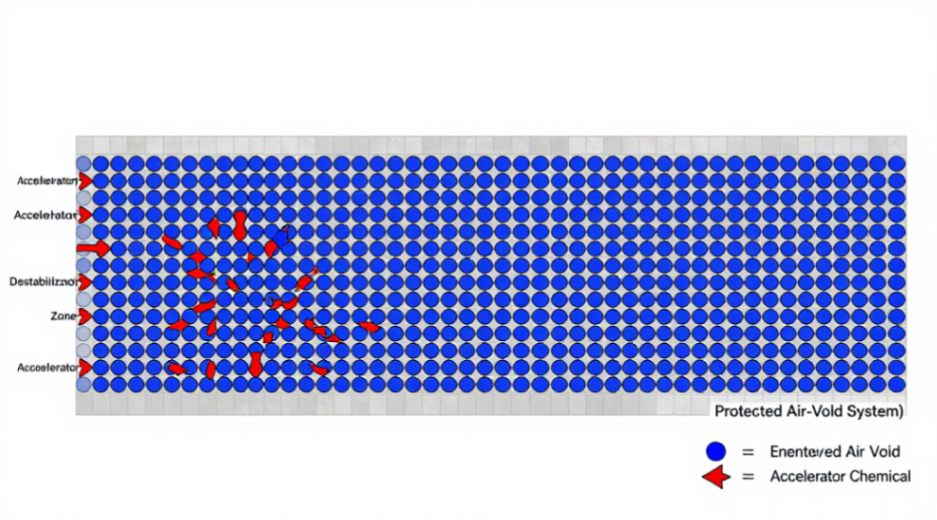
A silent killer of winter concrete performance is admixture incompatibility. An early strength concrete admixture for cold weather rarely works in isolation. Most modern mixes also contain water reducers, high-range water reducers (superplasticizers), and, crucially for freeze-thaw durability, air-entraining admixtures. Here lies a major trap: combining chemicals without verifying their compatibility can lead to severe side effects. Certain accelerators can destabilize the carefully engineered microscopic air-void system created by the air-entrainer. This system is the concrete’s long-term defence against freeze-thaw cycles; if it collapses, the concrete will scale and deteriorate rapidly in its first winter. The rule is simple but absolute: before committing to a full-scale pour, you must conduct laboratory trial batches with the exact combination of cement, supplementary materials, and all admixtures you plan to use. Observe the fresh properties-workability, air content, setting time-and measure the hardened properties. Do not rely on generic compatibility charts. Your specific materials are unique.
Beyond the Bottle: The Non-Negotiable Site Practices
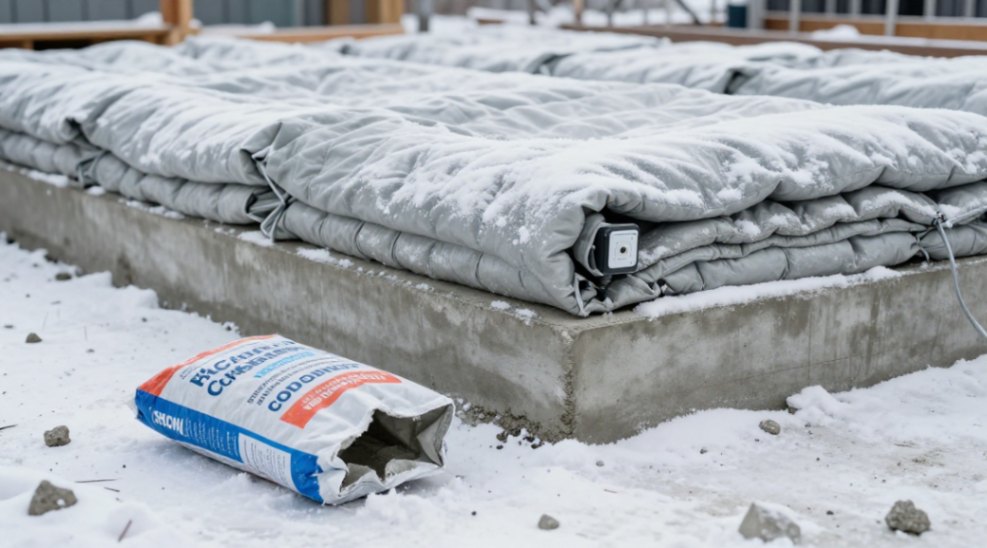
The final, and perhaps most neglected, series of errors occurs after the concrete leaves the mixer. Pouring an accelerated mix onto frozen subgrade or directly onto ice is a guaranteed failure. The subgrade must be thawed and free of ice. The fresh concrete must be placed and finished promptly; accelerated set times wait for no one. Then, the most critical phase begins: curing and protection. The accelerator has done its job by generating initial heat, but you must trap that heat. Immediately after finishing, you must cover the concrete with insulating blankets or enclosures. This is not optional. The insulation maintains a favorable temperature gradient, allowing hydration to continue. Simply placing blankets is not enough; you must seal the edges to prevent thermal bridging and wind chill from stealing the vital warmth. Monitor the concrete temperature with probes. The goal is to maintain the concrete above 50°F (10°C) for at least the first three days, and certainly above freezing. Removing forms prematurely, even with high early strength, is another common mistake. The admixture accelerates strength gain, but it does not accelerate the development of full design strength or maturity. Follow a maturity-based stripping schedule, not just a calendar.
| Critical Step | Wrong Approach (The Pitfall) | Correct Protocol |
|---|---|---|
| Admixture Selection | Using chloride-based accelerators near steel reinforcement. | Use only non-chloride accelerators for reinforced concrete. Verify chemical type. |
| Dosage Control | Estimating dosage or adding ‘a little extra’ for safety. | Calculate dosage precisely by weight of cement (% by weight). Use a calibrated dispenser. |
| Compatibility Check | Assuming all admixtures work together without testing. | Conduct lab trial batches with the full material suite to confirm performance and air-void stability. |
| Subgrade & Placement | Placing concrete on frozen ground or in falling snow. | Thaw and protect subgrade. Schedule placement for the warmest part of the day. Protect fresh concrete from precipitation. |
| Curing & Protection | Relying on the admixture alone, using no external insulation. | Apply insulated blankets immediately after finishing. Seal edges. Monitor internal temperature for a minimum of 72 hours. |
| Formwork Removal | Stripping forms based on calendar time or surface appearance. | Use maturity meters or test cylinders cured under same conditions to verify in-place strength before stripping. |
A Strategic Path Forward
Viewing an early strength concrete admixture for cold weather as the centerpiece of your winter strategy is correct. Viewing it as the entire strategy is a profound error. It is one vital component in a system that includes material selection, precise batching, disciplined site preparation, and rigorous thermal protection. The admixture buys you time and creates the opportunity for strength development; it does not eliminate physics. Your most powerful tool is a holistic plan that respects the chemistry you are employing. For complex projects or when margins for error are zero, this plan should be developed in consultation with a qualified materials engineer and the technical support team of your chosen admixture supplier. Their guidance can help you navigate dosage optimization and compatibility testing, turning a risky winter pour into a predictable, successful operation. The goal is not just to place concrete in the cold, but to place durable, high-quality concrete that will perform for decades. That outcome is engineered, not hoped for.
We are the global leader in lightweight concrete and advanced engineered foam solutions. Known globally for its commitment to research, innovation, and applied expertise, we have been providing engineered foam solutions since the early 2012’s.
We can supply high-quality concrete admixture and foam concrete related products all over the world.
The company has a professional technical department and quality supervision department, a well-equipped laboratory, and equipped with advanced testing equipment and after-sales customer service center.
If you are interested, please feel free and contact us.