Professional solutions on concrete addtives, Concrete Foaming Agent, Superplasticizer, CLC Blocks Additives, and foaming machine

Concrete Foaming Agent vs. Lightweight Aggregates: Which Delivers Lower Density & Higher Profit?
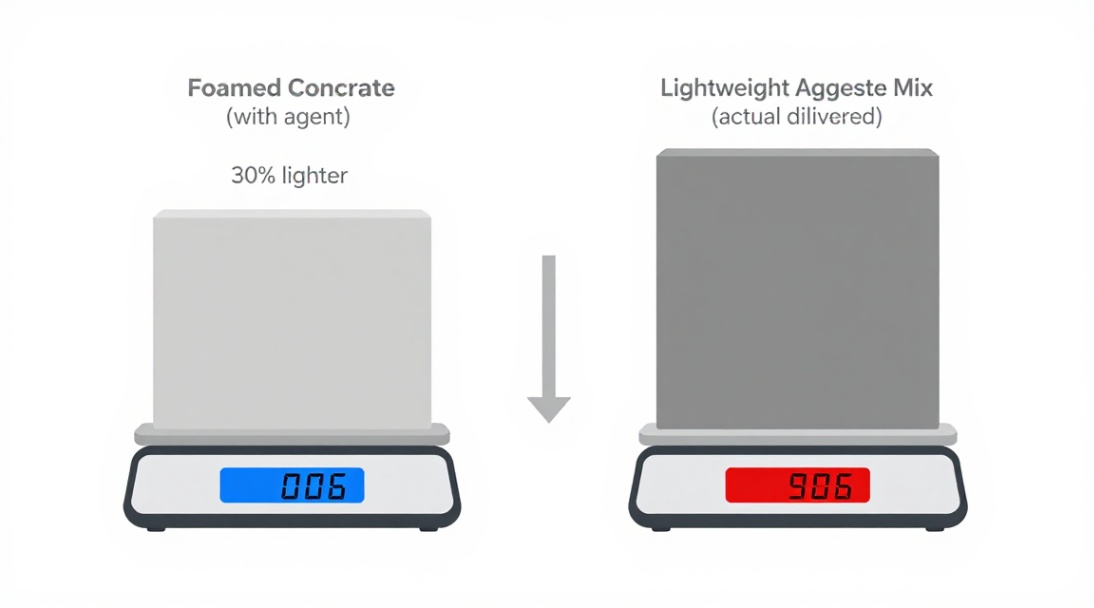
You Specified a Lightweight Mix. It Arrived 30% Heavier.
That is the reality of relying on lightweight aggregates without a concrete foaming agent. You spend hours adjusting the special cement ratio. You add superplasticizer. Yet density remains unpredictable. Foamed concrete solves this. But only if you pick the right agent.
This article compares the two dominant families: synthetic and protein-based (hydrolyzed) foaming agents. We cover dosage, mixing methods, and compatibility. No fluff. Just data you can use on your next pour.
1. How a Concrete Foaming Agent Creates Stable Air Bubbles
An air bubble in concrete is a thermodynamic insult. It wants to collapse. A concrete foaming agent reduces surface tension. It wraps each bubble in a surfactant film. The film must survive the alkaline environment of cement paste and the shear of mixing.
Synthetic agents use alkyl ether sulfates or alpha-olefin sulfonates. Protein-based agents use hydrolyzed keratin or casein. Protein films are thicker. They resist alkali better. But they produce a less uniform bubble distribution.
Bubble size matters. Bubbles below 0.5 mm improve workability. Bubbles above 2 mm reduce strength fast. A good foaming agent yields a median bubble diameter between 0.3 mm and 0.8 mm.
2. Synthetic vs. Protein-Based: A Side-by-Side Breakdown
Choose based on your application. Not on brand loyalty.
| Property | Synthetic (e.g., alkyl ether sulfate) | Protein-based (hydrolyzed) |
|---|---|---|
| Foam stability in cement slurry | Moderate – bubbles collapse faster under high shear | High – thick film resists alkaline attack |
| Density control precision | Excellent – repeatable, narrow range | Good – varies with water temperature and pH |
| Compressive strength at same density | Higher (more uniform bubble size) | Lower (larger, less uniform bubbles) |
| Cost per liter of foamed concrete | Lower (dilution ratio 1:40 to 1:60) | Higher (dilution ratio 1:15 to 1:25) |
| Odor | Mild, chemical | Strong, ammonia-like (hydrolysis by-product) |
| Best use case | Precision blocks, roof screeds | Void filling, trench backfill |
2.1. When Synthetic Wins
Use synthetic for light weight concrete blocks where you need a target density of 800 kg/m³ ± 20 kg/m³. The foam density from a foam generator stays consistent. You can adjust the concrete water reducer dosage without destabilizing the foam.
2.2. When Protein-Based Wins
Use protein-based for thick lifts (over 200 mm) in foamed concrete fills. The film resists the hydrostatic pressure of the wet cement. It does not collapse under its own weight. Expect 10–15% lower strength at the same dry density compared to synthetic. Plan your mix design accordingly.
3. The Two Mixing Methods: Pre-Foaming vs. Mixed-Foaming
Your foaming equipment dictates the method. But the method also dictates your agent choice.
- Pre-foaming method: Produce the foam first in a foam generator. Inject it into the cement slurry after mixing. This gives the best density control. Use a synthetic agent. Dilute the liquid agent in water at a ratio of 1:50 to 1:60 by mass. Feed the solution into the generator at 1.5–2.5 bar air pressure. Match the foam injection rate to achieve the target wet density.
- Mixed-foaming method: Add the foaming agent directly into the mixing water. This is simpler but yields less stable bubbles. Use a protein-based agent here. The whole mix works like a sieve. Add the agent at 0.5%–1.0% by mass of cement. Extend the mixing time by 30 seconds to incorporate air.
Do not mix pre-foaming with a protein agent. The high shear in the generator breaks the thick film. Foam collapses. You waste material.
4. Dosage and Foam Density: How to Hit Your Target Strength
The relationship is linear. Plot it once. Use it forever.
For a target compressive strength of 2.0 MPa at 28 days: start with a dry density of 1000 kg/m³. That requires a wet density of approximately 1100 kg/m³. To achieve 1100 kg/m³ wet density with a cement content of 350 kg/m³, you need a foam volume of about 650 liters per cubic meter of foamed concrete.
Increase the foam volume by 10% and the wet density drops by roughly 100 kg/m³. The compressive strength drops by 25–35%. This is not a linear scaling. At densities below 600 kg/m³, a small dosage error causes a large strength loss. Add an early strength agent to compensate. Use 0.5% by mass of cement of a calcium chloride-free accelerator.
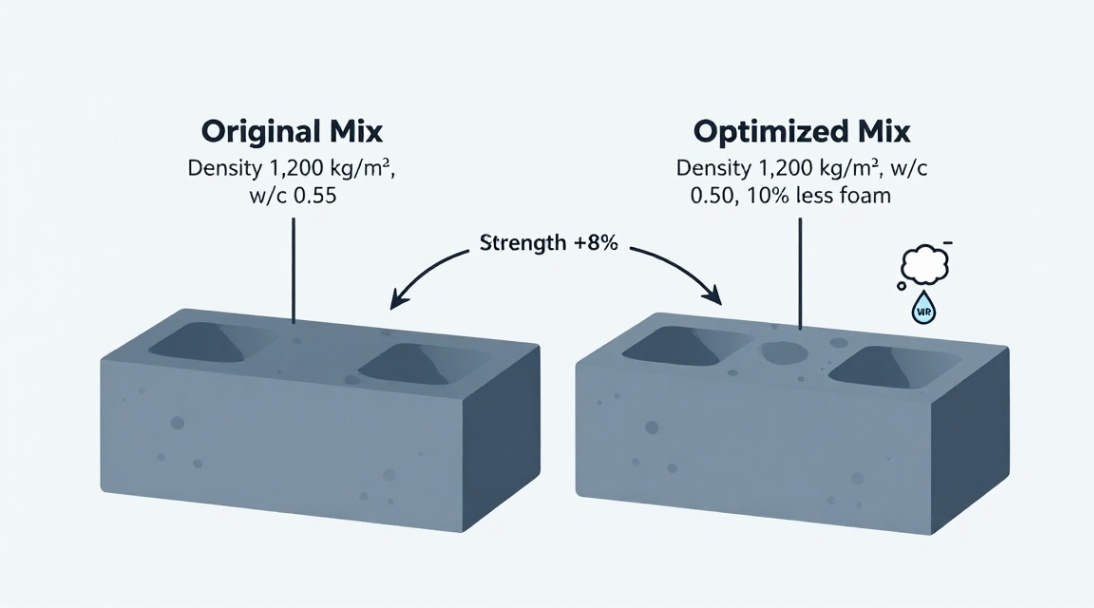
If strength loss is too high, reduce the foam volume by 10% and add a concrete water reducer to keep workability. A 1% reduction in water-to-cement ratio from 0.55 to 0.50 can increase strength by 8% at the same target density.
5. Compatibility with Cements, Admixtures, and Water
Not all cocktails work.
- Cement type: Ordinary Portland Cement (CEM I 42.5 N) is safest. Blended cements with fly ash or slag reduce foam stability. Increase the foaming agent dosage by 10–15% if using CEM II or CEM III. High-alumina cement reacts violently with some synthetic surfactants. Test a 5-liter batch first.
- Superplasticizer: Polycarboxylate ethers are compatible with synthetic foaming agents. Lignosulfonates de-stabilize protein-based foams. Add the superplasticizer 15 seconds after the foaming agent to avoid direct contact during the initial adsorption phase.
- Fiber: Polypropylene fiber at 0.9 kg/m³ improves crack resistance. Do not use steel fibers in foamed concrete below 700 kg/m³. The fiber sinks. It creates weak planes.
- Water quality: Hard water (above 300 ppm CaCO₃) reduces foam expansion by up to 20%. Soft water (below 50 ppm) gives the best foam quality. If you use recycled water from a concrete plant, filter out the fines. They act as a concrete defoamer.
6. Quality Testing Protocols on Site
You cannot fix a bad foam after the pour. Test before pumping.
| Test | Equipment | Acceptance Criteria |
|---|---|---|
| Foam density (wet) | 1-liter graduated cylinder, scale (±0.1 g) | Target ± 30 g/L. For 800 kg/m³ concrete, foam density must be 80–100 g/L. |
| Foam bleed test | 100 mL graduated cylinder, stopwatch | Less than 5 mL of water drained after 60 minutes. More than 5 mL indicates instability. |
| Wet concrete density | 1-liter container (known volume), scale | Target ± 30 kg/m³. For 1000 kg/m³ dry density, wet density should be 1050–1100 kg/m³. |
| Slump flow (with foam) | Slump cone, flow table | 500–600 mm spread. Below 450 mm means the foam is breaking during mixing. |
| Hardened core density | 100 mm cores, oven-dried for 24 hours at 105°C | Dry density within 5% of design value. |
Perform the foam bleed test every two hours during production. Instability increases as the foaming agent solution ages. Synthetic solutions are stable for 24 hours. Protein solutions degrade after 8 hours. Discard old solution.
7. Cost Comparison: Foaming Agent vs. Lightweight Aggregates
Lightweight aggregates (expanded clay, pumice, perlite) cost between 25 and 70 USD per cubic meter. A concrete foaming agent, at typical dosages, costs between 8 and 18 USD per cubic meter of foamed concrete.
But that is only the material cost. Foamed concrete requires no heavy compaction. You save on labor and vibration equipment. You also save on formwork. Foamed concrete exerts lower lateral pressure. Use thinner form panels.
The total in-place cost is 30–40% lower for foamed concrete at densities between 600 and 1200 kg/m³ compared to lightweight aggregate concrete. For densities below 600 kg/m³, lightweight aggregates cannot compete. Only foamed concrete works.
8. Environmental and Sustainability Advantages
Foamed concrete uses less aggregate. You reduce quarrying impact. You also reduce cement content per unit volume. A lightweight aggregate concrete at 1000 kg/m³ might use 400 kg of cement per cubic meter. Foamed concrete at the same density uses 300 kg. That is a 25% reduction in embodied CO₂.
You can substitute 30–40% of the cement with fly ash or slag without losing foam stability. Add nano-modifier (nano-silica at 0.2% by mass of cement) to pozzolanic mixes to regain early strength.
Thermal insulation improves by 10–15% compared to lightweight aggregate concrete at the same density. The closed cell structure of a well-stabilized foam traps air. Use foamed concrete for roof screeds. Reduce HVAC load. The payback period is under 3 years in most climates.
9. Five Steps to Your First Successful Foamed Concrete Batch
- Select the agent based on your method. Pre-foaming requires synthetic. Mixed-foaming accepts protein-based. Do not cross the streams.
- Calibrate your foam generator. Measure the foam density at three different air pressures (1.5, 2.0, 2.5 bar). Plot foam density vs. pressure. Use the curve to dial in your target.
- Make a 50-liter test batch. Measure wet density immediately after mixing. Wait 30 minutes. Measure again. A drop of more than 50 kg/m³ indicates foam collapse. Add hydroxypropyl methyl cellulose (0.05% by mass of cement) to thicken the paste and stabilize the bubbles.
- Cast cubes for 7-day and 28-day compressive strength. Core and dry the cubes for density verification. If strength is more than 20% below target, reduce the foam volume by 10% or increase cement by 20 kg/m³.
- Record every batch. Temperature, water quality, agent batch number, foam density, wet density. Use the data to fine-tune the next pour.
Trust the Process, Not the Claims
Foamed concrete is not a magic material. It is a precision product. The concrete foaming agent is the most critical ingredient. Synthetic agents give you control. Protein-based agents give you stability in deep lifts. Know your application. Test your mix. Adjust the dosage.
Start with a small batch. Validate the densities. Then scale up. Your first pour will teach you more than any datasheet.
If you work with special cements or challenging water conditions, consult a technical specialist. Companies like TRUNNANO provide application-specific guidance on concrete release agent compatibility and sodium silicate or potassium silicate stabilization. Use their expertise. Don’t guess.
We are the global leader in lightweight concrete and advanced engineered foam solutions. Known globally for its commitment to research, innovation, and applied expertise, we have been providing engineered foam solutions since the early 2012’s.
We can supply high-quality concrete admixture and foam concrete related products all over the world.
The company has a professional technical department and quality supervision department, a well-equipped laboratory, and equipped with advanced testing equipment and after-sales customer service center.
If you are interested, please feel free and contact us.