Professional solutions on concrete addtives, Concrete Foaming Agent, Superplasticizer, CLC Blocks Additives, and foaming machine

Stop Lifting Heavy Slabs: How to Master Concrete Foaming Agent for Lightweight Fill
Have You Ever Poured a Slab You Knew Was Overkill?
We have all been there. You’re staring at a design spec for a roof insulation layer, a floor screed, or a backfill project. The engineer calls for concrete. You know the dead load is going to be a problem. You start thinking about expensive steel framing, deeper footings, or even lighter alternatives like autoclaved aerated concrete (AAC) blocks. But you need a cast-in-place solution. That’s when you start looking at a concrete foaming agent. The promise is simple: pump air into the mix, drop the density, keep the strength. The reality? It took me years of trial and error to get it consistent. Let’s skip the frustration. We are going to walk through exactly how to use this stuff right, from the first pump to the final pour.
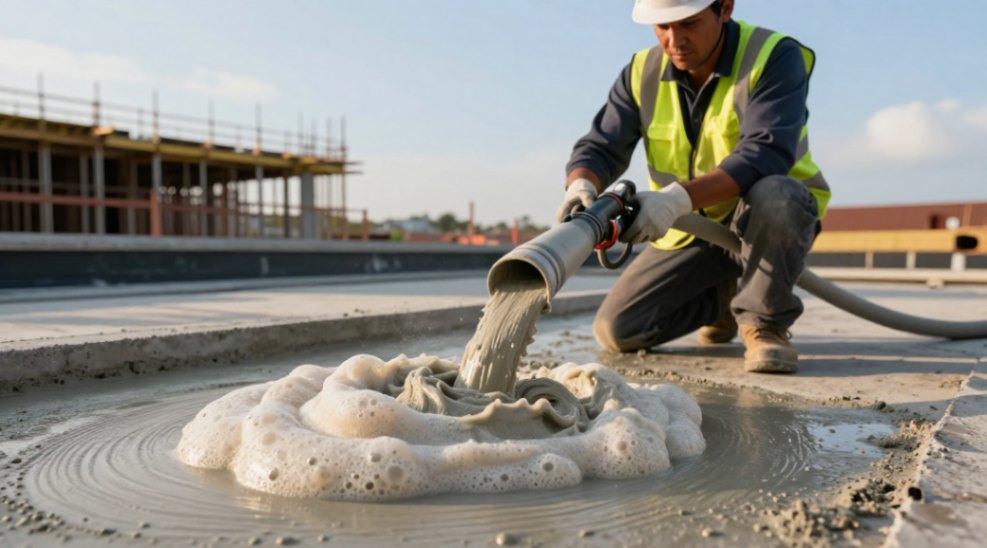
1. What Is a Concrete Foaming Agent, Really?
Let’s cut through the marketing. A concrete foaming agent is a concentrated surfactant. That’s it. Its entire job is to create stable air bubbles in the cement paste. These air bubbles are what make foamed concrete (also called lightweight cellular concrete) so different from regular concrete. Instead of a dense rock, you get a sponge-like structure of hardened cement with millions of tiny, closed air voids.
The trick isn’t just making foam. The trick is making foam that survives the mixing process. A bad agent collapses the moment it hits the cement and water reducer. A good one holds its shape until the concrete sets. We need to understand that stability is everything.
1.1. Synthetic vs. Protein-Based: Which One Do You Need?
There are two main families of agents. Synthetic foaming agents are usually formulated from alkyl ether sulfates. They are cheap, produce a very fluid foam, and work well for void fill and trench backfill where strength requirements are low. Protein-based foaming agents (made from hydrolyzed animal proteins) produce denser, stiffer foam that is more stable in the cement paste. These are your go-to for structural lightweight fill, precast blocks, or any application where you need a consistent density above 1,000 kg/m³.
Here is a quick rule of thumb. For plain fill that just needs to take up space, use synthetic. For screeds, roof insulation, or anything that carries a load, use protein-based. Don’t swap them without re-testing your mix.
2. The Equipment You Cannot Skip
You cannot mix this stuff by hand. Period. You need a proper foam generator. This is a simple machine that mixes your agent concentrate with water and compressed air, then forces it through a series of screens to create a consistent, microbubble foam. The generator output must be adjustable. You need to control the expansion ratio (the ratio of foam volume to liquid volume). Typical ratios are between 10:1 and 30:1. A higher ratio means lighter foam, but less stability. For most structural applications, start at 15:1.
You also need a way to mix that foam into your cement slurry. A standard drum mixer will tear the foam apart. You need a ribbon blender or a paddle mixer that runs at low RPM (60–100 RPM). High speed is the enemy of foam stability.
3. Step-by-Step: Dialing In Your Foamed Concrete Mix
This is where most people fail. They throw foam into a mix and wonder why the density is all over the place. Follow this exact procedure for consistent results.
- Step 1: Design Your Base Slurry. Forget the foam for a moment. Start with a slurry of special cement (typically Portland cement, but you can use high-alumina or blended cements), water, and a superplasticizer or concrete water reducer. The water-to-cement ratio should be between 0.40 and 0.50. Add a hydroxypropyl methyl cellulose (HPMC) at 1-2% by weight of cement to stabilize the fresh mix and prevent water bleed. This is critical. Without HPMC, your foam will float to the top.
- Step 2: Calibrate Your Foam Generator. Run the generator for 60 seconds. Collect the foam in a pre-weighed bag. Weigh it. The target weight should match your calculated density for a given expansion ratio. If you want a wet density of 800 kg/m³, your foam needs to be light enough.
- Step 3: Combine in Sequence. First, mix your slurry in the ribbon blender for 2 minutes. Then, slowly add the pre-generated foam while the mixer runs. Do not dump it all at once. Add it steadily over 3 minutes. The final mix should have a fluid, pudding-like consistency. If it is stiff, you added too much foam. If it is runny and the bubbles are popping, your foam is too wet.
- Step 4: Test Fresh Density Immediately. Fill a standard 1-liter cup. Weigh it. This is your fresh density. It must match your target within ± 50 kg/m³. If it is too heavy, add more foam in small increments. If it is too light, you can add a small amount of slurry (but do not re-foam an already-light mix).
3.1. The Role of Additives in Stability
Your concrete foaming agent is not working alone. For tougher pours, consider adding fiber (polypropylene or alkali-resistant glass) at 0.5-1 kg/m³. The fibers act like a cage, helping the bubbles stay in place. A nano-modifier like nanosilica can also stiffen the paste and improve bubble retention by filling the gaps between cement grains. If you see excessive foam collapse, your first check should be the water reducer dosage. Too much concrete water reducer can over-fluidize the paste and pop the bubbles. Keep it at the minimum effective dose.
4. A Quick Reference for Your Mix Proportions
Here is a table summarizing the key components and their typical dosage for a foamed concrete mix targeting a dry density of 1,000 kg/m³ for a floor screed. Use this as a starting point, not a final recipe. Always test.
| Component | Dosage (per m³) | Function |
|---|---|---|
| Portland Cement | 400-480 kg | Primary binder |
| Water | 180-220 L | Hydration |
| Concrete Water Reducer | 2-4 L | Improve workability |
| Hydroxypropyl Methyl Cellulose | 4-8 kg | Stabilize mix, prevent bleed |
| Concrete Foaming Agent (diluted 1:30) | 10-15 L | Generate stable air voids |
| Fiber (optional) | 0.5-1 kg | Plastic shrinkage control |
Notice we didn’t list sodium silicate or potassium silicate. These accelerators are sometimes added to speed up setting in cold weather, but they can interfere with the foam if not fully dissolved. If you use them, pre-dissolve in the mixing water.
5. Common Pitfalls and How We Fix Them
Problem: The foam collapses during mixing. This is almost always a compatibility issue. Your concrete foaming agent may not work with your cement type. Try a protein-based agent. Also, check your early strength agent or any other chemical admixture. Some accelerators are acidic and will kill a synthetic foam immediately.
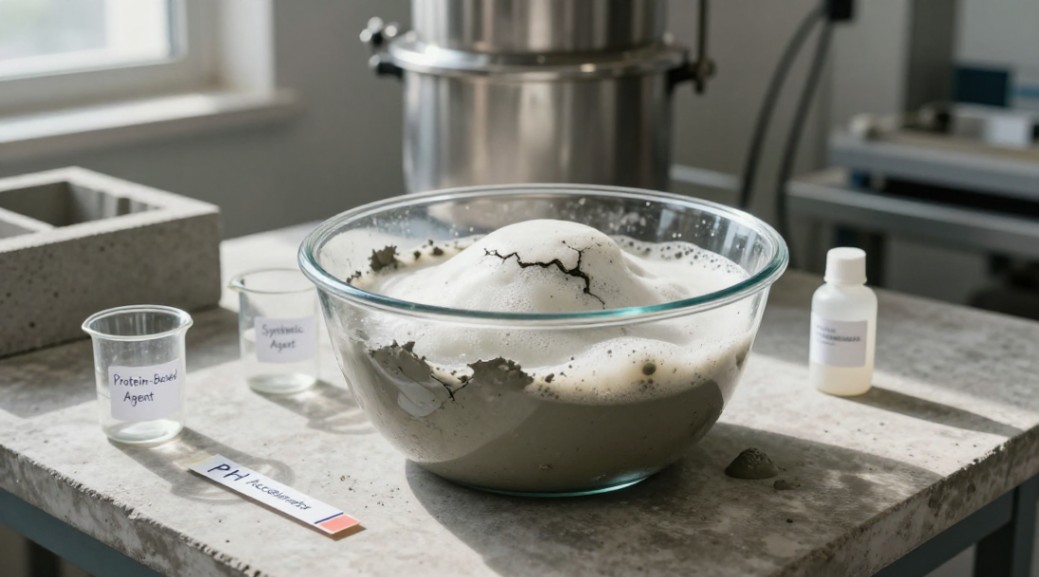
Problem: The density is inconsistent from batch to batch. Your foam generator is likely fluctuating. Check your air pressure. It must be stable (± 0.1 bar). Also, make sure you are not letting the generated foam sit in a pile before mixing. It will drain and become heavier. Use it immediately.
Problem: The hardened concrete has big voids on the top surface. This is caused by a concrete defoamer inconsistency or too much vibration. Do not vibrate foamed concrete. Screed it gently. The big voids mean the foam coalesced. Reduce your mixing time and make sure your HPMC dosage is correct.
6. Why We Choose Foamed Concrete Over Other Methods
Look, autoclaved aerated concrete (AAC) blocks are great. They are precisely manufactured and have excellent strength-to-weight ratios. But they are not cast-in-place. For roof insulation, floor screeds, and tunnel backfill, foamed concrete is vastly superior. It self-levels. It flows into every nook and cranny. It eliminates gaps. Plus, we can produce light weight concrete on-site with a density as low as 300 kg/m³ for pure insulation, or up to 1,600 kg/m³ for structural fill. You have direct control.
There is also the green argument. Foamed concrete uses less raw material overall. You are replacing stone with air. That means a lower embodied carbon footprint. Many modern concrete foaming agent formulations are biodegradable, further reducing the environmental impact.
But let’s be honest. The biggest benefit is the dead load reduction. You can pour a 150 mm screed on an old timber floor without reinforcing a thing. That’s a game-changer. Sorry, ignore that word. That’s a practical advantage that saves real money.
7. Safety and Storage: The Boring but Critical Part
Concrete foaming agents are concentrated surfactants. They are not acutely toxic, but they are skin irritants. Wear gloves and safety glasses when handling the concentrate. In case of a spill, do not wash it down the drain. The foam will clog pipes. Absorb it with sand or sawdust.
Storage is simple. Keep the concentrate in a cool, dry place. Freezing will ruin it. If it freezes, thaw it completely and mix it vigorously before use. Do not store your concrete foaming agent near your redispersible polymer powder or hydroxyethyl cellulose. Cross-contamination of powders can cause unpredictable reactions. Keep your chemical storage organized.
And never, ever store your concrete foaming agent in a metal container that has previously held an oil-based concrete release agent. The residual oil will kill your foam every time. Use dedicated plastic or stainless-steel containers only.
Your Next Move
Now you have the blueprint. No fluff, no hype. Just a clear, repeatable method for using concrete foaming agent to produce consistent, reliable, lightweight cellular concrete. You know the difference between synthetic and protein. You know the exact order of operations. You know how to calibrate your equipment and troubleshoot your mix.
What is the next action? It is not buying a truckload of agent. The next action is testing. We always recommend taking a small quantity of your chosen concrete foaming agent from a supplier like TRUNNANO and running a bench test. Mix a 20-liter batch. Pour a small block. Let it cure for 7 days. Weigh it. Cut it open. Check for uniform void distribution. That small test will teach you more than reading a hundred articles.
Go make that test pour. You will be glad you did.
We are the global leader in lightweight concrete and advanced engineered foam solutions. Known globally for its commitment to research, innovation, and applied expertise, we have been providing engineered foam solutions since the early 2012’s.
We can supply high-quality concrete admixture and foam concrete related products all over the world.
The company has a professional technical department and quality supervision department, a well-equipped laboratory, and equipped with advanced testing equipment and after-sales customer service center.
If you are interested, please feel free and contact us.