Professional solutions on concrete addtives, Concrete Foaming Agent, Superplasticizer, CLC Blocks Additives, and foaming machine

Water Reducers for Hot Concrete: The Indispensable Solution to Slump Loss and Cracking
The Non-Negotiable Definition
A water reducing admixture for hot weather concreting is a chemical additive engineered to disperse cement particles in the mix. This allows a reduction in the mixing water content while maintaining or enhancing workability. In high temperatures, its primary function shifts from just water reduction to extending the time the concrete remains workable, fighting the accelerated slump loss and cracking that heat causes.
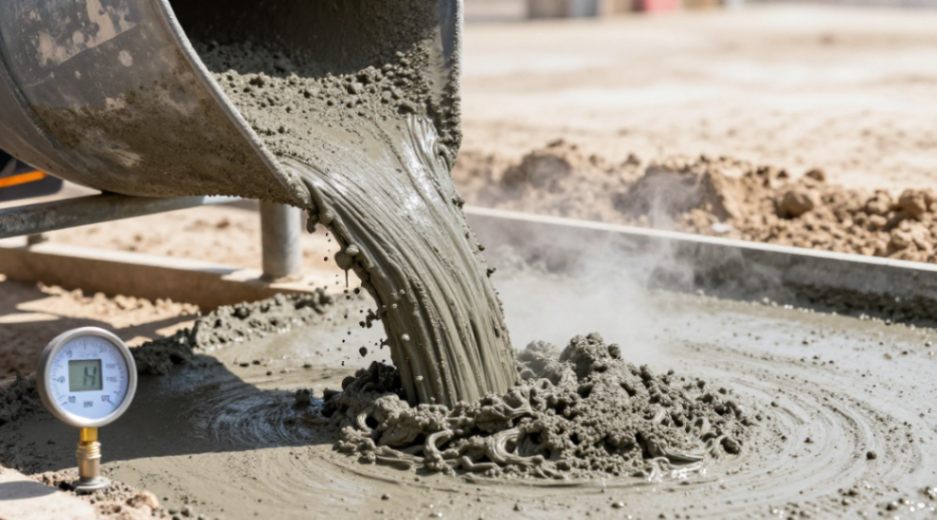
Hot Weather Concrete: The Real Problem
The industry fixates on temperature. That’s a surface-level concern. The core issues are the chemical and physical reactions heat accelerates.
- Accelerated Hydration: Cement sets faster. You get less time to place, consolidate, and finish.
- Rapid Water Evaporation: Mix water disappears. This causes immediate slump loss and triggers plastic shrinkage cracks before the concrete even hardens.
- Thermal Stress: High internal heat from rapid hydration, combined with cooler nighttime temperatures, leads to thermal cracking.
- Ultimate Strength Loss: Adding extra water on-site to restore workability destroys the water-cement ratio, permanently reducing strength and durability.
This isn’t just inconvenient. It’s a structural liability.
How Water Reducers Fight Back: Dispersants, Not Magic
Forget vague terms like “plasticizers.” Modern water reducers are surfactants. They adsorb onto cement particles, creating a negative charge. Like-particles repel. This breaks up cement flocs, releasing trapped water.
Think of it as unlocking the water already in your mix. The result? You need less water to achieve the same slump. In hot weather, this process is critical for maintaining slump without resorting to the destructive practise of adding water.
Water Reducer vs. Plain Concrete in High Heat
The following table quantifies the battlefield. Data is based on controlled testing at 95°F (35°C) with a standard mix design.
| Performance Factor | Concrete WITHOUT Water Reducer | Concrete WITH Water Reducer |
|---|---|---|
| Initial Slump | 4 inches | 4 inches |
| Slump after 45 mins | 0-1 inch (unworkable) | 3-3.5 inches (placeable) |
| Water Demand | Base: 100% | Reduced by 5-10% |
| Plastic Shrinkage Risk | Very High | Significantly Lower |
| 28-Day Compressive Strength | Base: 100% | Increased 10-20% |
| On-Site Response to Slump Loss | Add water, weaken structure | Use inherent workability, preserve design |
The Nuts and Bolts: Best Practices in the Heat
Theory is useless without execution. Here’s the operational reality.

Dosing is Not a Suggestion
Dosage is critical. Under-dosing provides marginal benefit. Over-dosing can cause excessive retardation or air entrainment issues. Always conduct site trials with the actual materials and under anticipated temperature ranges. Never rely solely on the manufacturer’s lab data.
Synergy with Retarders is Key
For extreme heat, a water reducing admixture for hot weather concreting is often formulated with or used alongside a retarder. The water reducer handles particle dispersion and water reduction; the retarder directly slows hydration. Using them together provides a layered defense. Verify compatibility first.
The Site Coordination Mandate
The best admixture fails without coordination. The batch plant, the transporter, and the finishing crew must operate as one system. Delays at any point waste the extended workability window. The project manager must enforce the schedule.
Final Spec: Your Checklist for Hot Weather Success
Writing a specification that works requires specifics, not platitudes.

- Mandate a mid-range or high-range water-reducing admixture specifically tested for hot weather performance.
- Specify a minimum slump life (e.g., “maintain a 3-inch slump for 60 minutes at 90°F ambient”) rather than just an initial slump.
- Require submission of trial batch data under both standard and elevated temperature conditions.
- Prohibit the addition of water on-site without the approval of the project engineer. Provide clear guidelines for the use of admixtures to restore workability instead.
- Detail placement and curing sequences that account for the accelerated timeline, including immediate fogging or evaporation retardants.
Your concrete’s performance in the heat isn’t about luck. It’s about chemistry, planning, and the disciplined use of the right tool for the job.
We are the global leader in lightweight concrete and advanced engineered foam solutions. Known globally for its commitment to research, innovation, and applied expertise, we have been providing engineered foam solutions since the early 2012’s.
We can supply high-quality concrete admixture and foam concrete related products all over the world.
The company has a professional technical department and quality supervision department, a well-equipped laboratory, and equipped with advanced testing equipment and after-sales customer service center.
If you are interested, please feel free and contact us.