Professional solutions on concrete addtives, Concrete Foaming Agent, Superplasticizer, CLC Blocks Additives, and foaming machine

The Cold Weather Concreting Mistake That Costs Time & Compromises Concrete Integrity
We’ve All Made This Mistake, and It’s Costly
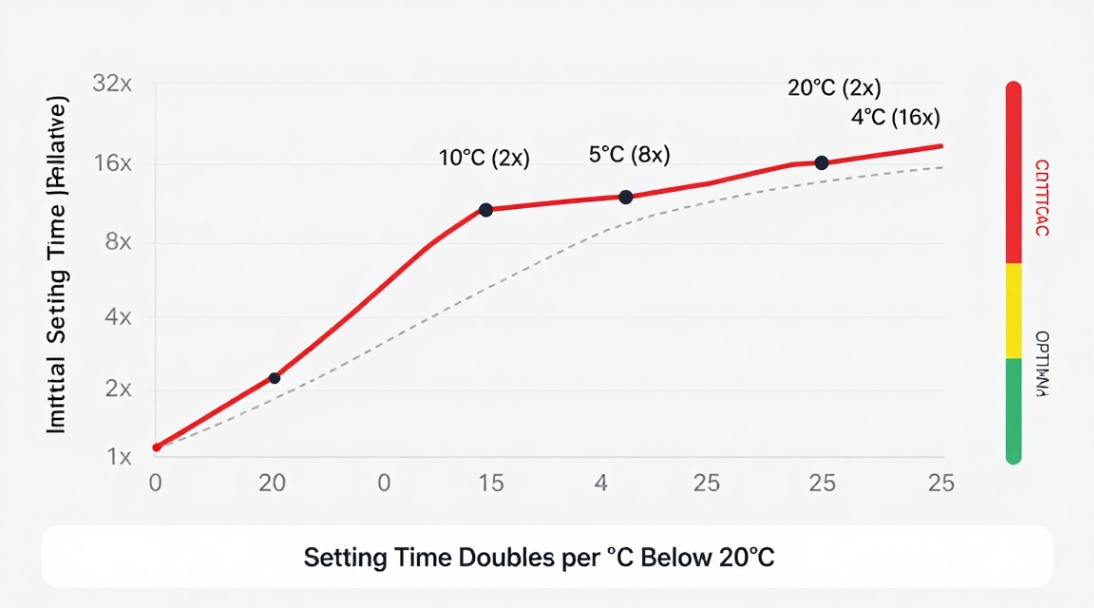
Here’s a number that changes everything: for every 1-degree Celsius (1.8°F) drop in concrete temperature below 20°C (68°F), the initial setting time can double. At 4°C (39°F), it’s not just slower. It’s a project-derailing crawl. Too many of us have tried to ‘push through’ a winter pour with generic methods or, worse, the wrong chemical help. Let’s talk about what not to do-and the right way to use an early strength concrete admixture for cold weather.
1. The #1 Error: Confusing Standard Accelerators with True Cold-Weather Solutions
This is the big one. You grab a bag of calcium chloride accelerator, thinking it’s the universal fix. It works in fall, right? But in true cold weather, this is a recipe for trouble. The problem is two-fold. First, traditional calcium chloride only works within a narrow temperature band. Second, the chloride ions wreak havoc on embedded steel, leading to premature corrosion and spalling. We’ve seen the Reddit threads and field reports. Users will say, ‘My garage slab scaled after one winter,’ or ‘My bridge deck showed rust stains by spring.’ The root cause is often chloride contamination from an inappropriate accelerator.
1.1 The Non-Chloride Imperative
For any reinforced concrete or where corrosion is a concern, you must switch to a non-chloride early strength admixture. These are nitrate, nitrite, or carboxylate-based. They accelerate the hydration reaction by providing a different chemical pathway, getting you strength gain without the corrosive side effects. This isn’t a ‘nice-to-have.’ It’s a specification requirement for nearly all modern structural work.
2. How a Proper Admixture Works (And Why You Still Need Protection)
A true cold weather admixture doesn’t just speed up reaction time. It modifies the crystallization process of the cement hydrates to form strength-bearing structures faster, even when molecular movement is slowed by the cold. Think of it as providing a better ‘roadmap’ for the chemical reaction under adverse conditions.
Warning: The biggest misconception is that the admixture replaces thermal protection. It does not. The admixture helps you gain strength *during* the protection period. You must still follow ASTM C94 and ACI 306R practices: use insulated blankets, heated enclosures, or hydronic heating to keep the concrete above 10°C (50°F) for at least the first 72 hours. The admixture ensures that within that protected window, you achieve critical early strength for formwork removal and finishing.
3. Dosage: The Delicate Balance You Can’t Afford to Guess
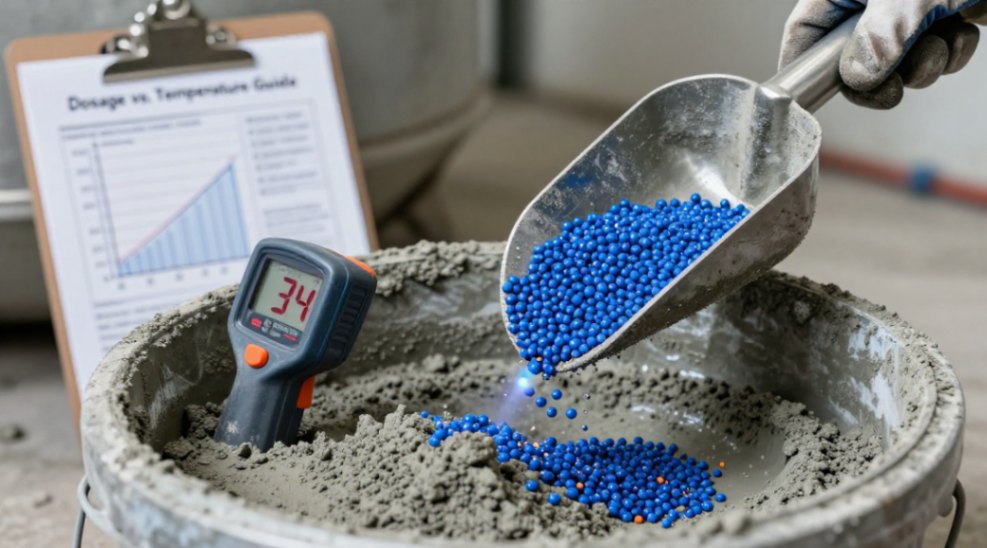
More is not better. Overdosing can cause a flash set, making the concrete unworkable, or create excessive thermal stress from too-rapid hydration. Underdosing leaves you vulnerable to freezing. Dosage is strictly temperature-dependent.
| Concrete Temperature Range | Typical Dosage Guideline (by cement weight) | Key Action |
|---|---|---|
| 5°C to 10°C (41°F to 50°F) | Low to Moderate Dose | Accelerates for normal finishing & form stripping. |
| 0°C to 5°C (32°F to 41°F) | Moderate to High Dose | Essential for achieving safe early strength before freezing risk. |
| Below 0°C (Below 32°F) | High Dose + Heated Materials & Enclosures | Critical component of a full winter protection plan. |
Always follow the specific manufacturer’s data sheet for your chosen product. Batch it with the mixing water for uniform dispersion.
4. The Silent Partner: Air-Entrainment
Never use an early strength admixture in cold weather without considering air. If your mix design calls for air-entrainment for freeze-thaw durability (and it should for exterior concrete), you must ensure compatibility. Some accelerators can reduce air content. The solution is to use a compatible, non-chloride accelerator and add the air-entraining admixture separately, verifying air content with a metre at the point of placement. Combining them effectively is what creates a durable, early-strength concrete for cold weather.
5. A Smarter Year-Round Strategy
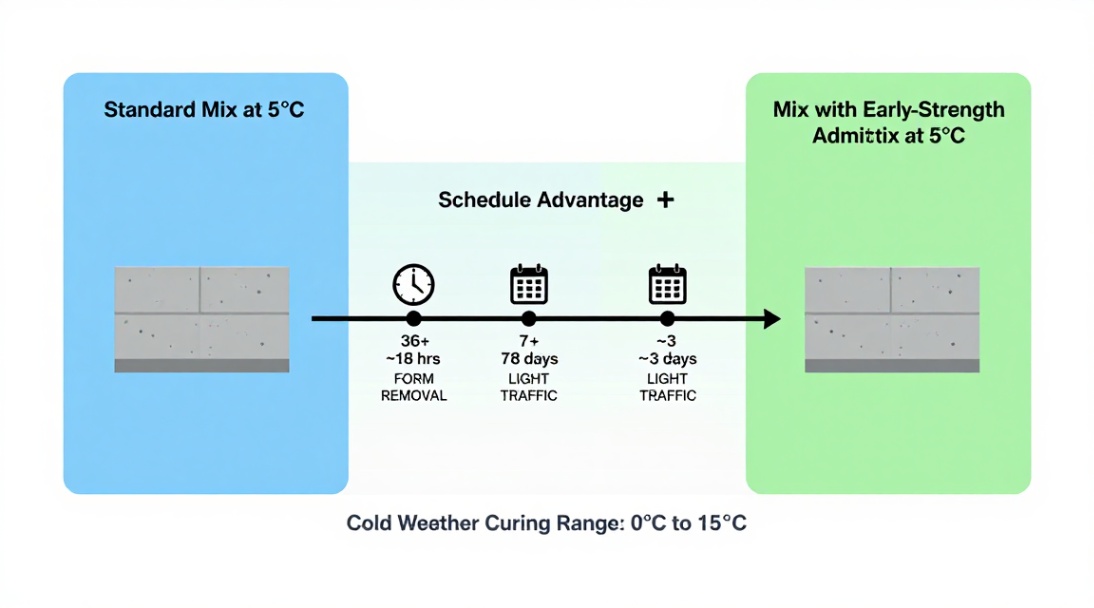
Here’s our pro-tip: consider making a non-chloride early strength admixture part of your standard mix from late autumn through early spring. The scheduling benefit is immense. Predictable, accelerated early strength means you can pull forms in 18 hours instead of 36, or open a warehouse floor to traffic days earlier. This turns a defensive cost (winter concreting) into an offensive scheduling advantage. When evaluating options, look for a proven early strength concrete admixture for cold weather that offers consistent performance data across the 0°C to 15°C range.
Stop Gambling with the Cold
Cold weather doesn’t have to mean downtime or defective concrete. The mistake is using the wrong tool or expecting a chemical to do a heater’s job. The correct approach is a system: a compatible, non-chloride early strength admixture for cold weather, dosed precisely for the temperature, paired with mandatory thermal protection and proper air management. This is how we build with confidence, no matter what the thermometer says. Your next step is to review your last cold-weather spec and compare it to a modern admixture’s technical data sheet. The difference in performance-and risk-will be clear.
We are the global leader in lightweight concrete and advanced engineered foam solutions. Known globally for its commitment to research, innovation, and applied expertise, we have been providing engineered foam solutions since the early 2012’s.
We can supply high-quality concrete admixture and foam concrete related products all over the world.
The company has a professional technical department and quality supervision department, a well-equipped laboratory, and equipped with advanced testing equipment and after-sales customer service center.
If you are interested, please feel free and contact us.